


Signature elements of Italian design for timeless style
TL;DR:
- Authentic Italian design emphasizes durability, quality materials, and understated elegance over fleeting trends.
- It features full-grain leather, skilled hand-finished details, and a restrained, timeless aesthetic rooted in cultural heritage.
- Choosing Italian accessories with these qualities ensures investments that age beautifully and reflect genuine craftsmanship.
There is a particular kind of frustration familiar to women who take their wardrobe seriously: standing before a beautifully presented accessory, sensing its appeal, yet unable to determine whether it will still feel relevant in ten years. Fashion is relentless in its cycle of promises, and the market is saturated with pieces that borrow Italian aesthetics without delivering Italian substance. Identifying the real article requires more than recognising a label. It demands understanding the values, materials, and techniques that underpin truly signature Italian design, and knowing precisely what to look for before you commit to an investment that deserves to last a lifetime.
Table of Contents
- How to recognise true Italian design
- The enduring hallmarks of Italian design
- From radical to refined: The full spectrum of Italian design
- Making the right investment: Choosing accessories with signature Italian style
- The real legacy of Italian design: Why restraint outlasts fashion
- Experience Italian design with San Rocco Italia
- Frequently asked questions
Key Takeaways
| Point | Details |
|---|---|
| Longevity defines luxury | The most sought-after Italian accessories are designed to last decades, gaining beauty over time. |
| Heritage meets innovation | Italian design spans both classic elegance and ground-breaking statements, offering options for every sophisticated style. |
| Know what to look for | Prioritise authentic materials, expert construction, and subtle branding when seeking signature Italian pieces. |
| Investment over impulse | Choosing refined, well-crafted accessories ensures enduring value beyond momentary trends. |
How to recognise true Italian design
The first thing to understand about authentic Italian design is that it operates from a fundamentally different starting point to fast fashion. Where trend-driven pieces begin with what is popular this season, Italian design begins with what is lasting. The question asked at the outset is not “what does the market want right now?” but rather “what will still be beautiful in thirty years?” This shift in philosophy shapes every subsequent decision, from the selection of raw materials to the way a seam is finished.
Material quality is the most immediate indicator. Genuine full-grain leather, sourced from premium hides and processed without the heavy surface treatments that disguise inferior skins, develops a richness over time that synthetic or corrected-grain alternatives simply cannot replicate. Full-grain leather retains the natural fibre structure of the hide, which means it is stronger, more breathable, and capable of developing the patina that lasts decades that distinguishes a cherished piece from a worn-out one. When you run your fingers across it, there is a subtle irregularity that speaks of authenticity rather than industrial uniformity.
Construction is the second criterion. Skilled Italian artisans employ techniques passed through generations, many of them documented and preserved through Italy’s network of leather schools and design institutes. Look for consistent, tight stitching with no loose threads, clean edge finishing, and hardware that feels weighty and sits flush without wobbling. These are not cosmetic details. They are indicators of the time and skill invested in a piece, and they directly predict how it will hold up over years of regular use.
The third criterion is what we might call design restraint. Signature Italian design rarely shouts. It does not rely on oversized logos or attention-seeking embellishment to communicate its value. Instead, it earns admiration through proportion, balance, and a refined colour palette that transcends seasonal trends. This is an important distinction when comparing pieces in-store or online, because restraint is actually harder to achieve than ornamentation. Anyone can add a buckle or a bold print. Removing every unnecessary element and still producing something beautiful requires genuine design intelligence, which is exactly why the Italian craftsmanship guide is so instructive for serious buyers.
Here are the key criteria for identifying authentic Italian pieces:
- Full-grain or top-grain leather sourced from premium hides, with no heavy surface coating to mask the natural grain.
- Consistent, skilled construction, including tight saddle stitching, clean interior lining, and reinforced stress points.
- Understated hardware in solid brass or sterling silver finishes, feeling substantial and sitting precisely.
- Refined colour palette built around neutrals, earth tones, and classic shades that remain elegant season after season.
- Transparency about origin, with the maker willing to confirm where materials were sourced and where the piece was made.
- Design restraint, where proportion and balance speak louder than ornamentation or branding.
Pro Tip: Always ask the retailer specifically where the leather was tanned, not just where the bag was assembled. Italy’s most respected tanneries, many of them concentrated in Tuscany’s Arzignano and Santa Croce sull’Arno regions, produce leather of a quality that is genuinely difficult to source elsewhere. A retailer confident in their product will answer this question without hesitation. If they cannot, that itself is informative. Understanding heritage artisanship is the foundation for making decisions you will not regret.
The enduring hallmarks of Italian design
With the core criteria established, it is worth examining the specific hallmarks that have made Italian design a global benchmark not just for fashion, but for furniture, ceramics, automotive design, and architecture. These hallmarks did not emerge by accident. They are the product of a culture that has treated beauty as a serious discipline for centuries, and they manifest in fashion accessories in ways that are both visible and deeply felt.
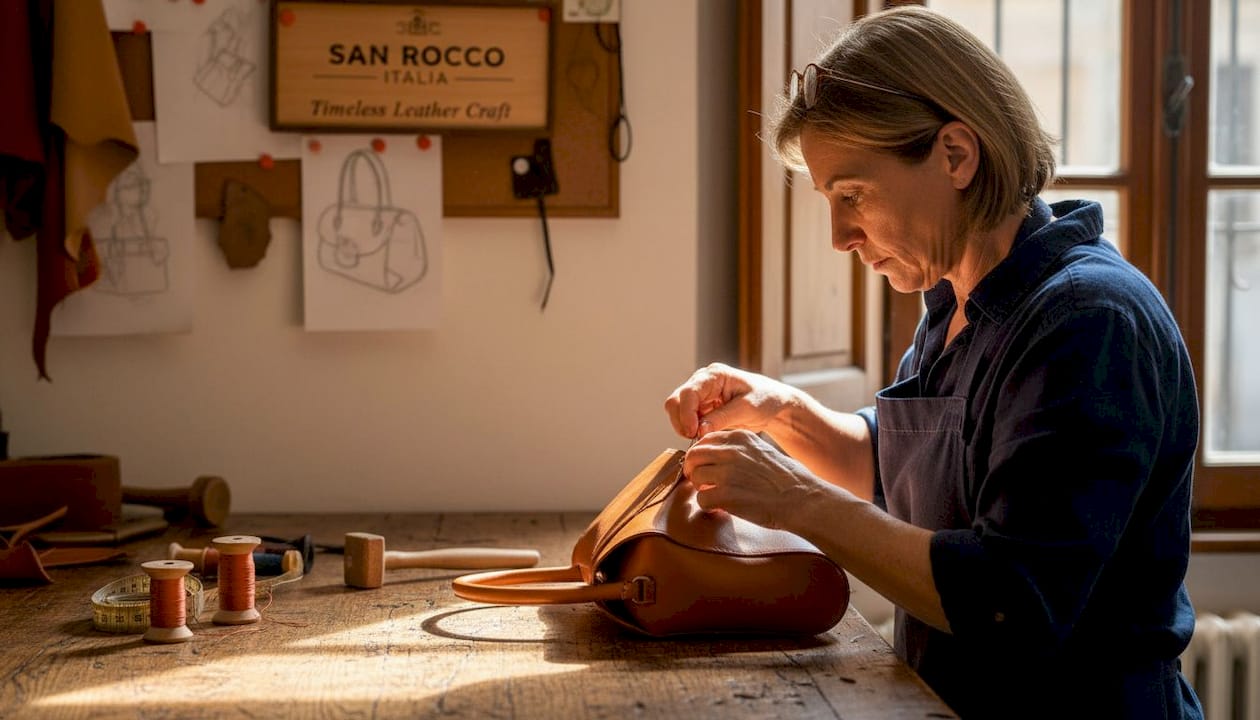
Restraint is perhaps the most defining hallmark. Italian design does not confuse busyness with richness. A beautifully proportioned handbag with minimal external hardware communicates sophistication precisely because it does not need to announce itself. This philosophy aligns with how truly well-dressed women approach their wardrobes: not as a collection of statements, but as a coherent expression of considered taste. The most enduring Italian accessories from the mid-twentieth century forward share this quality. They read as modern today because they were never anchored to a particular moment’s excess.
Colour deserves particular attention. The classic Italian palette draws from the landscapes of Tuscany, the mineral richness of Venetian architecture, and the warm, ochre-tinted light of the Mediterranean. Cognac, caramel, deep navy, forest green, warm black, and bone white recur because they are genuinely flattering against a wide range of skin tones and work across every season. This is not conservatism. It is design intelligence applied to real life. Exploring timeless Italian decor reveals how the same colour sensibility that governs a Florentine interior applies with equal force to a leather tote.
Hand-finishing is where Italian accessories separate most clearly from their imitators. The edges of a strap, the turn of a gusset, the way a zip pull is attached: these details reveal the extent of human skill involved. Burnished leather edges painted and polished by hand, rather than simply folded over and glued, take significantly more time to produce but they hold their shape and appearance far longer. The same is true of hand-painted details, hand-applied patina treatments, and the careful way Italian artisans balance visual weight across a design.
As expert voices in leather craftsmanship consistently note, the best Italian pieces are designed not simply to be owned, but to be used. They are built to absorb the marks of a life lived well, softening and deepening in colour with exposure to light and handling. This is radically different from the luxury model that produces pieces so delicate they must be stored in dust bags indefinitely.
“Pieces age gracefully, developing patina and character, lasting decades with proper care, prioritising longevity over trends.”
The hallmarks you should look for when assessing any Italian-made accessory:
- Premium full-grain leather with visible natural grain texture and no artificial uniformity.
- Hand-burnished or painted edges rather than folded or unfinished.
- Understated, solid hardware in brass, nickel, or palladium, without wobble or surface peeling.
- Consistent interior finishing, including quality lining, secure stitching, and organised structure.
- Minimal but purposeful branding, often embossed rather than printed, subtle enough to enhance without dominating.
- Genuine structural integrity, meaning the bag holds its shape when empty and does not collapse or distort with use.
From radical to refined: The full spectrum of Italian design
Italian design is often discussed as though it were a single, monolithic tradition. In reality, it spans a remarkable range, from the measured classicism of Florentine leather houses to some of the twentieth century’s most deliberately provocative aesthetic movements. Understanding this spectrum is essential for anyone building a collection with real depth, because it reveals that the commitment to quality and intention runs through even Italian design’s most experimental moments.
The Memphis Group, founded in Milan in 1981 by the visionary architect Ettore Sottsass, represents the most striking example of Italian design’s willingness to challenge its own conventions. Where mainstream Italian luxury prized restraint and heritage, Memphis embraced geometry, bold primary colours, laminate surfaces, and an almost cartoonish playfulness that was explicitly intended to confront the solemnity of good taste. As one recent retrospective on Sottsass at Palazzo Buontalenti observed, the Memphis movement introduced irony and colour in direct contrast to the core of timeless craftsmanship, demonstrating Italian design’s full range from radical to refined. The point was not that seriousness was wrong, but that design had the power to delight, provoke, and question received ideas.
For collectors of fashion accessories, this context matters. It means that when you choose a quietly elegant Italian leather bag, you are not simply selecting something conservative. You are participating in a tradition that has rigorously examined the alternative, considered it, and returned to restraint as a considered position rather than a default.
The following table illustrates the contrast between these two poles of Italian design thinking:
| Feature | Classic Italian design | Radical Italian design (Memphis) |
|---|---|---|
| Colour palette | Neutrals, earth tones, timeless shades | Bold primaries, contrasting geometrics |
| Materials | Full-grain leather, natural textiles | Laminates, plastics, mixed media |
| Branding approach | Minimal, embossed, discreet | Deliberately anti-establishment |
| Design philosophy | Longevity, restraint, refinement | Provocation, irony, playfulness |
| Legacy in fashion | Enduring classics that transcend trends | Influence on colour and shape experimentation |
| Intended lifespan | Decades of use and appreciation | Moment of cultural statement |
Italy’s influence on global trends is precisely this breadth that makes it such a rich source of genuine style inspiration. A woman who understands both ends of the spectrum is better equipped to appreciate what she is choosing and why, whether she gravitates toward the classical or the expressive.
The statistical weight of Italian design’s global influence reinforces this point. Italy accounts for a disproportionate share of the world’s finest leather goods production, with the country’s artisanal clusters in Tuscany, the Veneto, and Campania producing work that commands premium prices in markets from Tokyo to New York. This is not brand mythology. It is the measurable result of centuries of accumulated knowledge, maintained through apprenticeship systems and family workshops that transmit technique in ways no factory manual can replicate.
Making the right investment: Choosing accessories with signature Italian style
Understanding the theory of Italian design is satisfying. Being able to apply it confidently when standing in front of a piece is the practical skill that protects your investment. The good news is that the criteria we have examined are all observable and verifiable. You do not need specialist training to assess them. You need patience, clarity, and the willingness to ask direct questions.
Here is a practical approach to evaluating Italian accessories before you buy:
- Assess the leather first. Press gently on the surface and observe how it responds. Quality full-grain leather has a slight give and warmth; it does not feel plasticky or rigid. Check for consistency of grain across the surface. Artificially corrected leather often has a suspiciously perfect, almost embossed regularity.
- Examine the edges. Turn the piece over and look at the edges of straps and gussets. Painted, burnished edges in good condition indicate skilled hand-finishing. Raw, fraying, or poorly folded edges are a warning sign regardless of what the label says.
- Test the hardware. Open and close clasps, zips, and fastenings several times. Quality hardware moves smoothly, feels substantial, and does not leave metal residue on your fingers. Lightweight, hollow-feeling hardware is a consistent indicator of reduced construction quality.
- Check the lining. Interior lining should be securely attached with no bubbling, peeling, or visible glue residue. Pockets should be cleanly stitched and reinforced at their openings.
- Ask about provenance. A retailer who can confirm the tannery, the workshop, and the specific techniques used is demonstrating the transparency that Italian accessories for timeless style genuinely requires.
The following comparison table helps you evaluate pieces side by side against signature Italian criteria:
| Criterion | High-quality Italian piece | Imitation or lower-quality piece |
|---|---|---|
| Leather surface | Natural grain variation, warm to touch | Overly uniform, slightly waxy or plastic feel |
| Edge finishing | Hand-burnished, smooth, sealed | Raw, folded only, or peeling |
| Hardware weight | Solid, substantial, smooth action | Light, hollow, stiff or gritty action |
| Interior lining | Securely attached, clean stitching | Bubbling, loose, or glue visible |
| Branding | Discreet, embossed or stitched | Oversized printed logos, stickers |
| Provenance information | Tannery, region, artisan available | Vague country of manufacture only |
Pro Tip: When shopping online, look specifically for brands that name the region or workshop where their leather goods are produced. Vague references to “Italian-inspired” or “crafted in the Italian tradition” are not the same as “made in Italy by skilled artisans using full-grain leather.” The distinction is significant, and it is one that reputable handbag craftsmanship retailers are proud to make explicit. Also explore handbag style guidance to understand which silhouettes have genuine longevity across changing fashion seasons.
The real legacy of Italian design: Why restraint outlasts fashion
Here is something we have observed that most fashion commentary overlooks: the pieces that generate the greatest satisfaction over time are rarely the ones that generated the most excitement at point of purchase. The bag that made your heart race because of its seasonal colour or its recognisable hardware is often the one sitting unused in your wardrobe three years later. The bag you chose for its quality, its proportions, and its quiet confidence is the one you reach for every day.
This is not a coincidence. It reflects something fundamental about the philosophy of handcrafted luxury that sits at the heart of Italian design. The mastermakers of Florence, Rome, and Milan have always understood that the highest aspiration for a designed object is not to make the owner feel fashionable, but to make the owner feel like themselves, only better. That is an entirely different goal, and it produces entirely different objects.
The current re-embrace of quiet luxury in global fashion is not a trend. It is a correction. After years of conspicuous branding and maximalist excess, the market is rediscovering what Italian design has always known: that discretion is more powerful than announcement. The Sottsass retrospective reinforces this beautifully. Even Memphis, Italian design’s most deliberately radical movement, operated from a position of deep knowledge and intention. Its playfulness was not ignorance of tradition. It was a fully informed departure from it. That distinction matters enormously.
We would offer this view: the women who have the most coherent, satisfying relationship with their accessories are those who chose for meaning rather than for moment. They invested in pieces that reflect their values, not their desire to be seen as current. Italian design, at its best, supports exactly that kind of investment.
“The most enduring pieces are those that ask nothing of you except to be used and loved. They do not need you to be fashionable to justify them.”
The uncomfortable truth about luxury accessories is that most of the anxiety people feel around them comes from buying for the wrong reasons. When you purchase something because it signals membership in a current trend, you are taking on the obligation to remain current, which is exhausting and expensive. When you purchase something because it is genuinely, objectively beautiful and expertly made, you are freed from that obligation entirely.
Experience Italian design with San Rocco Italia
Everything we have explored in this article, from the qualities of full-grain leather to the philosophy of design restraint, reflects exactly the standards we hold at San Rocco Italia.

Every handbag and leather accessory in our collection is made in Italy by skilled artisans using premium full-grain leather and traditional techniques that prioritise longevity. We are deliberate about transparency: we can tell you where our leather comes from, how our pieces are constructed, and why each design choice was made. Explore the San Rocco Italia collection and discover accessories built to become the pieces you reach for every day, season after season, for years to come. This is Italian design as it was always meant to be experienced.
Frequently asked questions
How can I tell if a fashion accessory is genuinely Italian-made?
Look for authentic full-grain leather, skilled hand-finishing on edges and stitching, and a retailer who can clearly confirm where materials were sourced and where the piece was assembled. Authentic Italian design prioritises longevity over trends, so the quality of construction will always speak for itself on close examination.
What makes Italian design unique compared to other luxury styles?
Italian design blends centuries of artisanal heritage with an instinct for understated elegance that transcends seasonal fashion. Even its most radical movements, such as the Memphis Group’s bold anti-design of the 1980s, reflected deep design knowledge and a commitment to lasting cultural value rather than mere novelty.
Why do Italian accessories develop patina instead of looking worn out?
High-quality full-grain leather retains the natural fibre structure of the hide, which gives it the strength and suppleness to absorb use gracefully. Italian pieces age with patina and character because the leather is not artificially treated to look perfect from the outset; it is meant to become more beautiful through use.
Is there a place for bold or colourful fashion in classic Italian style?
Absolutely. The Memphis movement’s playful designs demonstrate that Italian design has always encompassed both radical expression and timeless sophistication. Choosing bold colour or geometric form within a framework of quality craftsmanship is entirely consistent with the Italian design tradition.



