


Discover the meaning of handcrafted luxury in Italian fashion
TL;DR:
- Genuine handcrafted luxury involves skilled artisans using traditional techniques with premium materials.
- Italian regions have unique craftsmanship traditions, ensuring authenticity and regional mastery.
- Authentic craftsmanship offers lasting value, provenance, and emotional significance beyond superficial branding.
Not all luxury is created equal. You may already sense this when you hold a bag that feels noticeably different, heavier with purpose, alive with texture, or when you notice stitching so precise it seems impossible to replicate. Yet the term ‘handcrafted luxury’ is thrown around with alarming frequency, from high-street brands dressing up factory output to heritage houses quietly shifting production offshore. For women who care about authenticity, this matters enormously. This guide cuts through the noise to reveal what genuine handcrafted luxury truly means in Italian fashion, how to recognise it, and why it remains the most meaningful investment you can make in your wardrobe.
Table of Contents
- What does handcrafted luxury really mean?
- The essence of Italian craftsmanship: Heritage and mastery
- Handcrafted vs. mass-produced luxury: A critical comparison
- Emotional connection: Why provenance and story matter
- The future of handcrafted luxury: Innovation, challenges, and opportunities
- Why authentic craftsmanship remains the heart of luxury
- Experience authentic Italian handcrafted luxury
- Frequently asked questions
Key Takeaways
| Point | Details |
|---|---|
| True meaning | Handcrafted luxury is defined by artisan skill, heritage, and authenticity—not just price or branding. |
| Italian advantage | Italy’s legal standards, regional specialisation, and history create an unmatched benchmark for craftsmanship. |
| Buyer empowerment | Understanding provenance, materials, and artistry helps buyers avoid ‘craftwashing’ and invest wisely. |
| Emotional value | The story, heritage, and unique touch behind each piece offer lasting emotional and financial value. |
What does handcrafted luxury really mean?
The phrase ‘handcrafted luxury’ carries real weight when used correctly. Handcrafted luxury in fashion refers to products made by skilled artisans using traditional, manual techniques with premium materials, emphasising meticulous attention to detail, heritage, and uniqueness over mass production. That definition sounds straightforward, but in practice, the gap between genuine artisan work and clever marketing is vast.
At its core, handcrafted luxury is defined by human skill applied over time. A master leather worker in Florence may spend several days on a single handbag, hand-cutting panels from full-grain hide, saddle-stitching seams with linen thread, and burnishing edges by hand until they achieve a smooth, rounded finish. No machine replicates this process with the same result, because each artisan brings their own trained instincts to the work.
Heritage sits at the centre of this world. Genuinely handcrafted pieces carry a narrative: who made them, where, using which techniques, and why those techniques were chosen. This storytelling is not decoration. It is evidence of a knowledge system passed down through generations, refined through practice, and expressed in every finished piece.
The materials also matter fundamentally. Handcrafted luxury demands premium inputs: full-grain leather rather than bonded or corrected leather, naturally dyed fabrics rather than synthetic alternatives, solid metal hardware rather than plated alloys. These choices affect how a piece ages, and handcrafted items are specifically designed to improve with time rather than degrade.
Here is what genuinely distinguishes handcrafted luxury from the rest:
- Visible hand-stitching, often in linen or waxed thread, with slight natural variation between stitches
- Individual artisan signatures or stamps, indicating the maker’s identity and accountability
- Premium full-grain or vegetable-tanned leather, which develops a unique patina with use
- Precise, seamless finishing on edges, linings, and hardware attachments
- Limited production volumes, because skilled artisan time is finite
- Provenance documentation, including certificates of origin and artisan details
The importance of craftsmanship in luxury goods lies precisely in this combination of skill, time, and material integrity. Mass production can replicate the appearance of luxury at a glance. It cannot replicate the substance of it.
This is why understanding what you are really purchasing matters so much. Italian leather luxury offers a particularly vivid example, where centuries of leather-working tradition are still very much alive and producing pieces of extraordinary quality. For those drawn to subtlety and substance over surface gloss, exploring artisanal craftsmanship in Italian fashion reveals a world that rewards careful attention. This is the very essence of quiet luxury: understatement backed by exceptional quality.
With the confusion around the term clarified, let’s explore how these principles materialise in Italian craftsmanship.
The essence of Italian craftsmanship: Heritage and mastery
Italy did not become the world’s benchmark for luxury by accident. Its traditions are rooted in the Renaissance, when Florentine guilds established rigorous standards for leather work, silk weaving, jewellery, and tailoring. Those standards created a culture of excellence that persists today in family-owned workshops where craft knowledge moves from parent to child like a living inheritance.
The numbers are striking. 80% of Italian luxury companies are family-owned workshops, and regional specialisation defines their excellence across leather, silk, and tailoring, all legally protected under the ‘Made in Italy’ designation.
“Italian craftsmanship is not simply a production method. It is a cultural identity, built over centuries and expressed through regional mastery that no other country has fully replicated.”
Each Italian region has its own area of specialisation, developed over centuries of concentrated practice.
| Region | Specialisation | Notable heritage |
|---|---|---|
| Tuscany | Vegetable-tanned leather | Florentine handbag and glove making |
| Como | Silk weaving | 18th-century silk mill tradition |
| Naples | Tailoring | Sartorial techniques dating to the 1700s |
| Venice | Glass and textile | Murano glass, Burano lace |
| Vicenza | Goldsmithing | Fine jewellery and metalwork |
Becoming a master artisan in Italy is not a short journey. Apprenticeships typically last three to seven years, and full mastery is considered to take a decade or more of dedicated practice. This investment of time is precisely why authentic Italian pieces carry the value they do. You are not simply paying for materials; you are paying for decades of accumulated human knowledge embedded in every seam and surface.
The ‘Made in Italy’ designation is legally protected and requires that significant stages of production occur within Italy. It is not a vague marketing claim. Understanding Made in Italy quality means recognising that this label carries legal and ethical weight, not just aesthetic appeal.
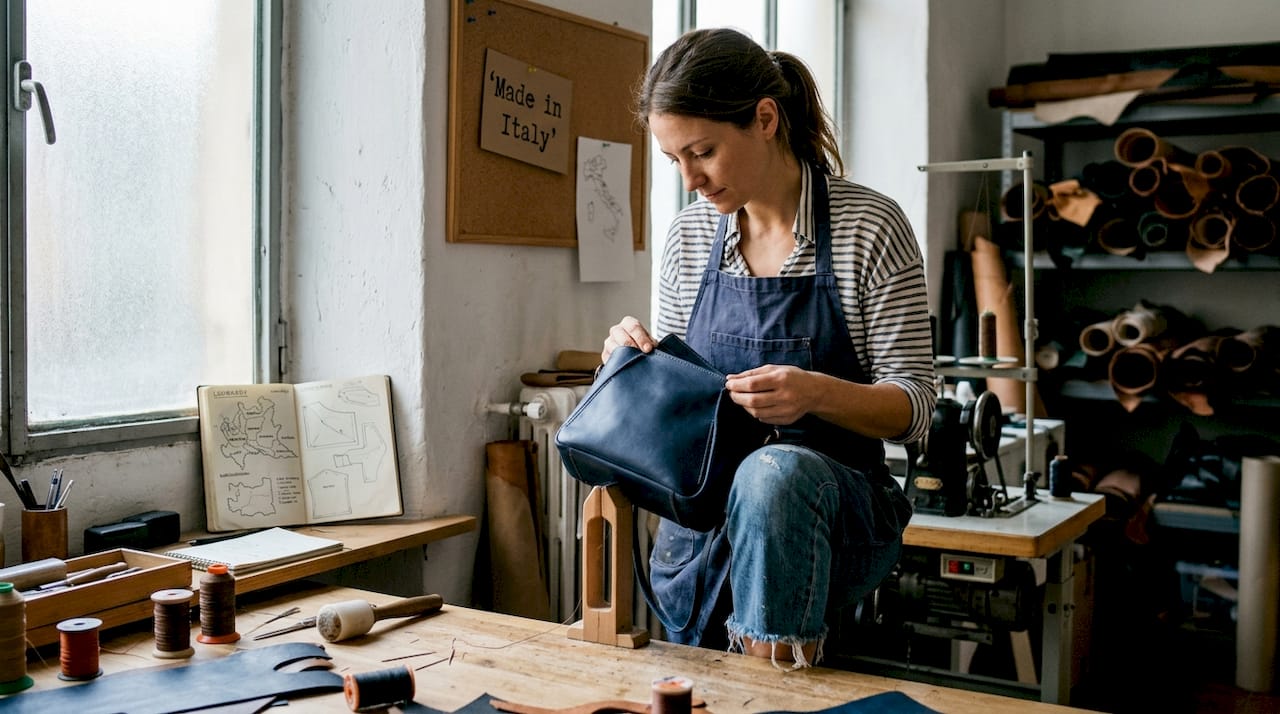
Pro Tip: When evaluating an Italian piece, ask specifically which region it was made in and which artisan or atelier produced it. Genuine makers are proud to share this information. Vague answers are a warning sign.
The prestige of Made in Italy is not merely sentimental. It represents a verifiable system of quality rooted in legal definition, regional expertise, and generational mastery. For women who value lasting beauty, exploring luxury accessories heritage and the world of unique Italian craftsmanship offers a genuinely rewarding perspective.
Understanding Italy’s extraordinary tradition sets the stage to distinguish handcrafted luxury from mass-produced options.
Handcrafted vs. mass-produced luxury: A critical comparison
The luxury market has a problem it rarely admits openly: price is not a reliable indicator of quality. A bag can cost four figures and still be produced in a factory using automated cutting, machine stitching, and corrected-grain leather with a surface coating designed to mimic texture. This is the uncomfortable reality behind much of what markets itself as premium.
70% of luxury consumers prefer handcrafted items for exclusivity, recognising that mass production sacrifices quality for efficiency even at high price points.
| Feature | Handcrafted luxury | Mass-produced luxury |
|---|---|---|
| Production method | Manual, artisan-led | Automated or semi-automated |
| Material quality | Full-grain, premium inputs | Often corrected or bonded leather |
| Exclusivity | Limited, unique | High-volume, uniform |
| Longevity | Decades with proper care | Often degrades within years |
| Provenance | Fully traceable | Frequently opaque |
| Ageing | Develops character | Peels, cracks, fades |
The term ‘craftwashing’ (presenting factory-made goods as artisan products through selective marketing) is increasingly common and increasingly sophisticated. Brands reference heritage in their advertising whilst their production lines bear no resemblance to what that heritage once meant. Craft has become luxury’s most valuable currency, which is precisely why so many brands are eager to claim it without earning it.
Here is how to identify genuine handcrafted pieces:
- Examine the stitching closely. Hand stitching has slight, natural irregularity. Machine stitching is perfectly uniform. Neither should be loose or unravelling.
- Feel the leather. Full-grain leather feels warm, slightly varied in texture, and develops patina. Corrected leather feels uniform and slightly plasticky.
- Check the edges. Handcrafted pieces have burnished, rounded edges. Mass-produced items often have raw or painted edges that flake over time.
- Request provenance documentation. Authentic makers provide certificates of origin, artisan details, and production location.
- Research the brand’s production model. Genuine artisan houses are transparent about where and how they produce.
Pro Tip: If a brand cannot tell you the name of the atelier or the region where your piece was made, treat that opacity as meaningful information.
Investing in genuinely handcrafted pieces also connects with sustainable Italian luxury values, because buying fewer, better items made to last is inherently more responsible than replacing lower-quality goods repeatedly. Understanding Italian leather gives you the vocabulary to ask the right questions and make choices you will not regret.
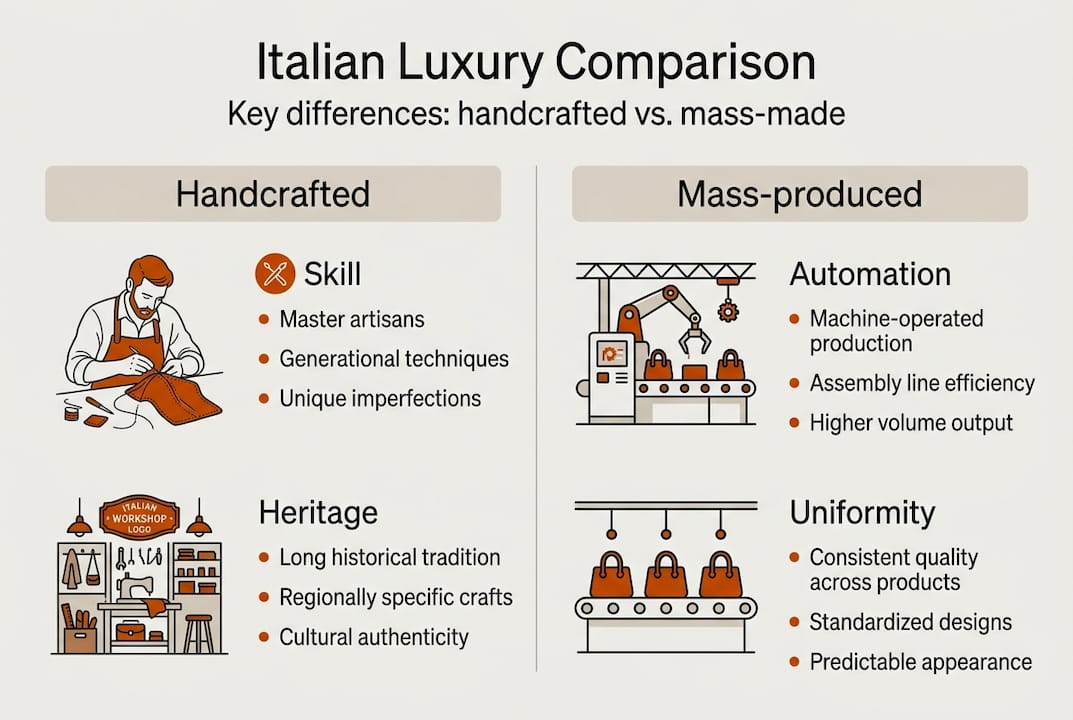
Having compared the two approaches, it is essential to understand the emotional and enduring value of handcrafted pieces.
Emotional connection: Why provenance and story matter
A handcrafted Italian bag is not simply a functional object. It is a record of decisions made by a skilled person on a specific day, working with materials selected for their character, shaped by techniques refined over generations. This is what transforms an accessory into something genuinely meaningful.
43% of luxury consumers cite exceptional craftsmanship as the most important reason for brand loyalty, and older affluent buyers place particular value on heritage and provenance when making purchasing decisions.
Provenance, which means knowing where something comes from and who made it, dramatically increases both desirability and long-term value. The Hermès Kelly bag is perhaps the most cited example: its documented history, artisan traceability, and consistent hand-production methods have made it one of the few fashion items that reliably appreciates in monetary value over time. The story is inseparable from the object.
“When you know the hands that shaped something, you form a relationship with the object itself. This is what separates a purchase from an heirloom.”
Italian heritage brands operate on this principle instinctively. The artisan’s knowledge, the regional tradition, the specific leather tannery supplying the hide: these details are not background noise. They are the value proposition.
For discerning women, this connection matters personally as well. A piece with genuine provenance becomes part of your story too. It carries meaning that a factory-produced bag simply cannot offer, regardless of its price tag or the size of its logo.
Verifying authenticity involves a few practical steps:
- Ask for the name and location of the producing atelier
- Request a certificate of Italian origin if applicable
- Look for artisan stamps or numbered production identifiers inside the piece
- Research the brand’s supply chain and production philosophy
- Seek out Prada’s approach to manufacturing history as a reference point for how serious luxury houses document their craft
To truly experience Italian leather bags in this context is to understand why provenance is not a luxury extra. It is the foundation. For women ready to build a collection rooted in meaning, elevating your style starts with choosing pieces whose stories are as beautiful as their surfaces.
With heritage and narrative as the heart of true luxury, let’s consider the evolving landscape and future challenges for Italian artisans.
The future of handcrafted luxury: Innovation, challenges, and opportunities
The world of Italian handcrafted luxury is not static. It faces genuine pressures: a shrinking pool of trained artisans, rising material costs, and a market flooded with convincing imitations. Yet it also sits at the intersection of renewed consumer demand for authenticity and exciting technological possibilities that, when handled with care, can support rather than diminish the artisan’s work.
Hybrid human-AI production is emerging as a considered approach, where technology enhances artisan precision without displacing creativity, and brands are actively investing in training programmes to secure the next generation of skilled makers.
| Challenge | Current response | Opportunity for buyers |
|---|---|---|
| Artisan shortage | Investment in apprenticeships | Support brands that train new makers |
| Craftwashing | Demand for transparency | Request full provenance documentation |
| Rising material costs | Sustainable sourcing partnerships | Choose brands committed to ethical supply chains |
| Technology pressure | Selective AI integration | Look for human-led production with digital support |
The risks are real. As demand for ‘artisan’ products grows, the incentive to simulate rather than deliver handcrafted quality increases. Buyers who do not know what to look for are vulnerable to paying significant sums for products that do not reflect genuine skill or tradition.
The opportunities, however, are equally significant. Women who invest in authentic handcrafted pieces now are securing items that will almost certainly become more valuable, both financially and culturally, as the pool of genuine artisan-made goods contracts. You are not simply buying a bag. You are preserving a form of human knowledge.
The Italian luxury industry continues to grow globally, with Italian fashion exports reaching significant annual values. Demand is high. The question is whether supply remains authentically grounded.
Key things to watch as a buyer:
- Brands that publish detailed artisan profiles and workshop locations
- Houses that invest in formal apprenticeship programmes
- Collections with clearly limited production volumes per season
- Transparency about the role of technology in their production process
For those committed to supporting genuine makers, following the evolution of craft in Italian fashion is both an education and a pleasure.
Why authentic craftsmanship remains the heart of luxury
Here is what rarely gets said plainly: a prominent logo is not craft. It is branding. And branding, however beautiful, cannot replicate the physical intelligence of a trained artisan’s hands, the accumulated wisdom of a regional workshop tradition, or the quiet confidence of a piece that was built to outlast its owner.
The luxury industry has spent decades conflating the two. Heritage is invoked in advertising campaigns whilst production quietly migrates to factories far removed from the ateliers being celebrated. This is not cynicism. It is simply an observation that the market rewards what it can sell, not always what it can stand behind.
For women who have refined their taste past the point of being impressed by names alone, this distinction is critical. The red flags are recognisable once you know them: vague production claims, no named atelier, marketing language heavy on ‘inspired by tradition’ rather than grounded in it, and finishings that look immaculate in photographs but feel hollow in person.
Collecting authentic handcrafted pieces matters more than ever in a world where fast fashion has taught consumers to expect novelty over substance. Each genuine piece you choose is a vote for a different set of values: patience over speed, mastery over volume, lasting beauty over seasonal relevance.
We believe this deeply at San Rocco Italia, which is why every handbag and leather good in our collection is made in Italy by skilled artisans. Celebrating Italian artisans is not a marketing strategy for us. It is the reason we exist.
Experience authentic Italian handcrafted luxury
If this guide has confirmed what you have long suspected, that genuine luxury lives in the hands of skilled artisans rather than in the glow of a marketing campaign, then you are exactly the kind of woman San Rocco Italia was created for.
Our collection brings together handcrafted Italian handbags and leather goods made by skilled artisans using premium full-grain leather and time-honoured techniques. Every piece is chosen for its authenticity, its material integrity, and its capacity to become a lasting part of your wardrobe rather than a seasonal footnote. We also carefully curate accessories from trusted European makers who share these values. If you are ready to invest in pieces that honour both your discernment and your desire for lasting beauty, explore the San Rocco Italia collection and discover what handcrafted Italian luxury truly feels like.
Frequently asked questions
How can I distinguish genuine handcrafted luxury from mass-produced items?
Look for artisan signatures, visible hand-stitching with natural variation, precisely burnished edges, and full provenance paperwork confirming Italian origin. Handcrafted luxury involves individual artisan creation and superior materials that mass production simply cannot replicate.
Why is ‘Made in Italy’ important for handcrafted fashion?
‘Made in Italy’ guarantees legal, regional, and quality standards rooted in historic artisan traditions, not merely a geographical claim. The designation requires full production within Italy and signals verifiable legal and quality benchmarks.
Does technology like AI compromise handcrafted luxury?
When used responsibly, technology can enhance artisan precision without replacing the creativity and intent of human hands. AI enhances but does not replace human creativity in genuine luxury craftsmanship.
Are handcrafted luxury items a better investment than regular luxury goods?
Handcrafted items typically hold their value longer and become heirlooms due to rarity, superior quality, and traceable provenance. Handcrafted luxury offers longevity and heirloom value that mass-produced alternatives cannot match.
