


European leather standards explained for luxury handbags
TL;DR:
- European standards for leather ensure durability, colour fastness, and chemical safety verification.
- Digital product passports increase transparency by providing traceability and test results.
- Buyers should ask for specific test methods and certifications rather than relying on vague marketing claims.
The word “premium” appears on leather labels more often than it deserves to. Walk through any boutique or browse any luxury website, and you’ll encounter promises of superior quality without a single verifiable detail to support them. The problem is that “premium,” “genuine,” and even “full-grain” are largely unregulated marketing terms unless they are backed by specific European standards and independent test methods. For anyone investing seriously in a leather handbag or accessory, understanding what those standards actually mean transforms you from a hopeful buyer into a genuinely informed one. This guide cuts through the noise and gives you the precise knowledge needed to shop with real confidence.
Table of Contents
- Why European leather standards matter for luxury accessories
- The structure of European standards: CEN, ISO and test methods explained
- Testing and traceability: The rise of digital product passports
- Sustainability and voluntary labels: Finding stricter benchmarks
- What matters most for choosing luxury European leather
- Explore authentic Italian leather craftsmanship
- Frequently asked questions
Key Takeaways
| Point | Details |
|---|---|
| Standardised testing matters | European leather quality hinges on specific CEN and ISO standards, not just brand claims. |
| Traceability enhances trust | Modern digital product passports allow buyers to verify leather origin and chemical safety easily. |
| Eco-labels boost assurance | Voluntary labels, though not mandatory, set stricter sustainability benchmarks than legal minimums. |
| Generic claims aren’t enough | True luxury means seeking detailed test evidence and documented quality for every purchase. |
Why European leather standards matter for luxury accessories
Europe’s leather industry has spent decades building one of the most rigorous and globally respected quality frameworks in the world. That credibility isn’t accidental. It comes from a coordinated system of standards bodies, independent testing, and harmonised methods that span borders and product categories. When you choose a handbag made in Italy or sourced from a trusted European maker, those standards are the invisible architecture behind every claim of excellence.
The heart of this system sits with the European Committee for Standardisation, known as CEN. Within CEN, Technical Committee 289, referred to as CEN/TC 289, is dedicated specifically to leather. This committee works in close alignment with international bodies to ensure that test methods are standardised across the continent and linked to ISO protocols. When a leather goods manufacturer in Florence or Porto references a European standard, they are drawing on this shared, independently verified framework.
Why does this matter to you as a buyer? Because without standardised testing, every claim of quality is simply a claim. The word “genuine” in “genuine leather” legally includes split leather, which is the lowest-grade cut from the hide, far removed from the full-grain surface prized by craftspeople. The word “premium” has no legal definition whatsoever. These terms exist in a marketing vacuum, free to mean whatever a brand finds convenient.
Here is what rigorous European standards actually evaluate:
- Tensile strength and tear resistance: How much force the leather can withstand before it stretches or tears, which directly predicts long-term durability.
- Colour fastness: Whether the dye holds under rubbing, perspiration, light exposure, and moisture, which matters every time you carry your bag.
- Flex endurance: How many times the leather can bend without cracking, a critical factor for structured handbags with folding sections.
- Water resistance and absorption: How the leather responds to rain, humidity, and spills over time.
- Chemical safety: Levels of restricted substances including chromium VI and certain azo dyes, which affect both human health and environmental impact.
Our Italian leather certification guide explores how these tests connect to what you find in the Italian market specifically. And if you have wondered about the real differences between leather grades, the answer lies squarely in how materials perform against these criteria, as our guide on leather grades and premium differences explains in detail.
“The difference between a handbag that ages beautifully and one that fails within two seasons often has nothing to do with country of origin or price point. It has everything to do with whether the leather was ever tested against a measurable standard.”
European standards raise the floor for every brand operating in the region. They establish minimum benchmarks that protect consumers from the worst misrepresentations. But they also create a shared language that allows serious makers to communicate genuine quality to buyers who know what to look for. Learning that language is the single most powerful thing you can do before making a significant purchase.
The structure of European standards: CEN, ISO and test methods explained
Understanding who sets these standards helps you use them far more effectively. Three bodies are central to European leather quality: CEN, ISO, and IULTCS. Each plays a distinct role, and together they create the interconnected framework that underpins genuine luxury leather certification.
CEN (European Committee for Standardisation) is the regional body that coordinates standards across EU and associated countries. Its leather-specific committee, CEN/TC 289, adopts and develops European Norms (EN) for leather, often by directly harmonising with ISO methods. This means a standard published as EN ISO carries both European and international recognition.

ISO (International Organisation for Standardisation) works at a global level, establishing test method codes and protocols that can be adopted by national or regional bodies. In the leather world, ISO methods are the backbone of most meaningful quality claims.
IULTCS (International Union of Leather Technologists and Chemists Societies) is the technical society that develops the underlying test methods that ISO then formalises. Think of IULTCS as the scientific engine that ISO translates into official global standards.
Here is how these three bodies interact in practice:
- IULTCS researchers and member organisations develop a detailed test method based on practical laboratory knowledge.
- ISO adopts and formalises the method with a reference code, such as ISO 20433.
- CEN/TC 289 harmonises the method into a European Norm, often published as EN ISO 20433, making it binding or reference-standard within European frameworks.
- Manufacturers and laboratories use the EN ISO reference when testing leather for commercial use or regulatory compliance.
- Buyers who know these codes can request test certificates and independently verify quality claims.
One of the most practically relevant examples is EN ISO 20433:2012, which specifies exactly how to test colour fastness to crocking (rubbing). This matters enormously for handbags, because a dark leather bag that transfers colour to a light coat or seat is not merely inconvenient; it is a clear sign of inadequate dyeing and finishing.
Here is a summary of the key test categories and what they assess:
| Test category | What it measures | Why it matters for handbags |
|---|---|---|
| Colour fastness to crocking | Dye transfer under rubbing | Prevents staining on clothing and interiors |
| Tensile strength | Force needed to tear the leather | Predicts long-term structural durability |
| Flex endurance | Cycles before cracking occurs | Critical for structured shapes and hinged sections |
| Water absorption | How much moisture the leather takes on | Affects performance in rain and humidity |
| Chromium VI content | Levels of restricted hexavalent chromium | Safety and environmental compliance |
It is also important to understand a critical edge case: legal compliance and quality can diverge. A leather product can meet all EU chemical safety regulations and still perform poorly on colour fastness or durability. Legal rules primarily target chemical hazards, not aesthetic or structural longevity. This is why test-method evidence matters far more than a generic “EU compliant” label.
Pro Tip: When shopping for a luxury leather handbag, ask the retailer or brand for specific test-method references rather than general claims. A reputable maker will be able to name the EN ISO codes their leather has been tested against. If they cannot, that tells you something important.
For practical ways to verify authenticity before you buy, our article on identifying original leather walks you through hands-on checks. And our guide on spotting fake leather covers the most common deceptive practices you are likely to encounter.
Testing and traceability: The rise of digital product passports
Knowing the test methods is a strong start. But a new development in European regulation is taking transparency much further, and it is one that informed buyers should understand before their next significant purchase.
The digital product passport (DPP) is an emerging EU framework designed to give consumers verifiable, structured information about what a product is made of, where its materials come from, how it was made, and how it can be repaired or recycled at the end of its life. For leather goods specifically, DPP frameworks increasingly require brands to provide traceability data and chemistry or material substance disclosures, rather than simply asserting compliance with general standards.
Think of a DPP as a product’s permanent, verifiable record. Accessible via a QR code or digital link, it should tell you where the hide was sourced, what tanning method was used, which chemicals were applied in finishing, and how the leather was tested. This is a significant shift from the current norm, where most of that information is either proprietary, absent, or locked inside supplier chains invisible to the end buyer.
What should a well-documented leather accessory tell you, now and increasingly under DPP requirements?
- Material origin: The country and ideally the region where the hide was produced and processed.
- Tanning method: Whether the leather is chrome-tanned (faster, widely used) or vegetable-tanned (longer process, more biodegradable), which affects both care needs and environmental footprint.
- Finishing chemicals: What substances were used to achieve colour, texture, and water resistance, and whether any restricted substances are present above threshold levels.
- Test evidence: Which specific EN ISO or IULTCS test methods the leather was submitted to, and the results.
- Repair and care guidance: Whether the brand provides guidance for extending the product’s life, which is central to both sustainability and value retention.
Here is how traditional assurance compares to DPP-enabled transparency:
| Feature | Traditional assurance | DPP-enabled assurance |
|---|---|---|
| Material origin | Brand claim only | Verified traceability chain |
| Chemical safety | Regulatory compliance statement | Disclosed substance data |
| Test evidence | General certification logo | Named EN ISO test results |
| Repairability info | Rarely available | Explicitly documented |
| End-of-life guidance | Absent or vague | Included in product record |
For those who invest in quality leather goods with the expectation that they will last decades, DPPs represent a meaningful shift in accountability. They move the burden of proof from the buyer to the brand. A maker who cannot provide this information is, in practical terms, asking you to take their word for it.
Caring properly for leather that meets these standards is equally important. Our guide on expert leather purse care covers the techniques that preserve full-grain surfaces over time. For day-to-day maintenance, our article on cleaning leather purses naturally offers practical, gentle methods. And if you want to protect the finish and lustre of a well-made bag, our advice on leather polish for bags is worth reading before you reach for any product on the shelf.
Sustainability and voluntary labels: Finding stricter benchmarks
Alongside regulatory and standards-based frameworks, a parallel world of voluntary eco-labels has grown up around leather goods. These labels often set standards that exceed what the law requires, making them genuinely useful signals for buyers who prioritise both quality and environmental responsibility.
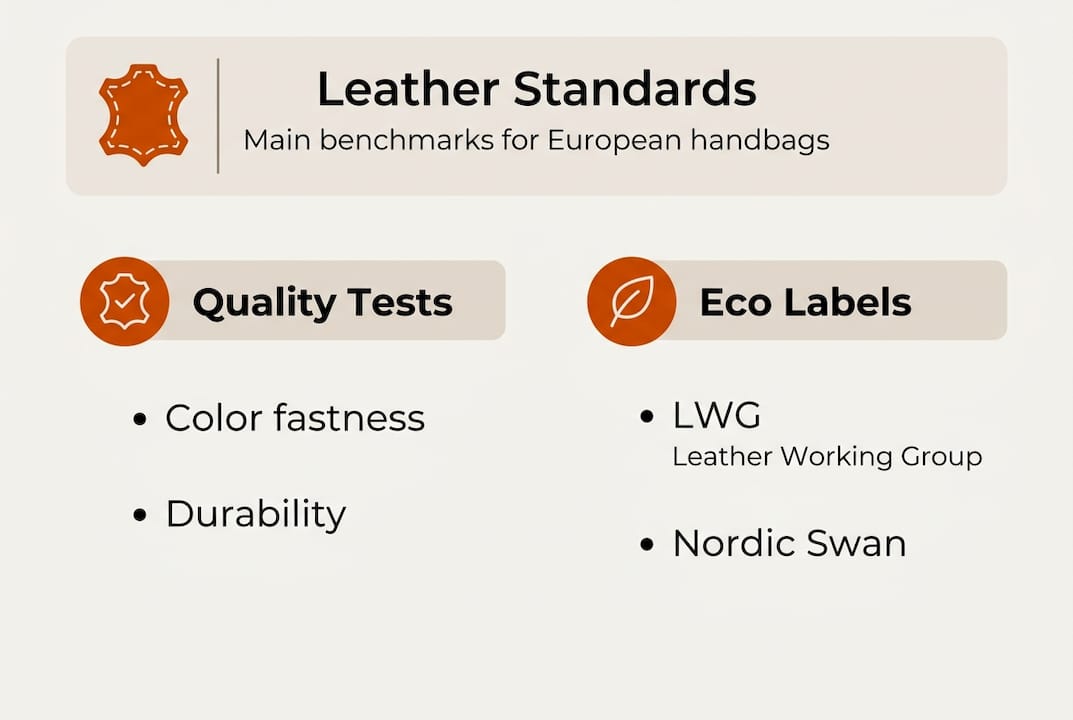
The most prominent example in the European context is the Nordic Swan Ecolabel. Applied across product categories, its criteria for leather goods include restrictions on chromium VI levels, the exclusion of endocrine-disrupting substances, and limits on a wide range of hazardous chemicals used in tanning and finishing. Critically, these criteria are voluntary rather than mandatory, which means a brand must actively seek this certification, bear the cost of independent auditing, and maintain compliance over time. That commitment is itself a signal of intent.
Other voluntary and brand-specific audit frameworks worth knowing include:
- Leather Working Group (LWG) certification: A widely used audit standard that assesses tanneries on environmental performance, water management, traceability, and restricted substance compliance. An LWG Gold or Silver rating is a meaningful indicator of responsible sourcing.
- REACH compliance: While technically a legal requirement across the EU, voluntary disclosure of REACH test results (beyond minimum reporting thresholds) signals a brand’s willingness to go further than required.
- SA8000 social compliance: Focused on working conditions across the supply chain, ensuring that quality leather is not produced at the expense of worker welfare.
- ISO 14001: An environmental management standard that tanneries and manufacturers can hold, indicating systematic management of their environmental impact.
Pro Tip: Do not let a single eco-label do all your decision-making. A handbag can hold an LWG-certified tannery sourcing certificate while using synthetic lining and dyes that carry their own environmental concerns. Look for brands that discuss their supply chain openly across multiple dimensions, not just one certification.
The complexity here is intentional to understand. As expert analysis confirms, the standards ecosystem for leather is genuinely multi-layered, and consumers are best served by asking for specific test-method names rather than relying on generic claims. A maker who says “our leather is sustainable” without naming a single test method, certification body, or restricted substance threshold is giving you marketing, not information.
The good news is that this sophistication cuts in your favour once you know what to ask. Brands serious about sustainability and quality actively want buyers who understand the difference between a Nordic Swan certification and a printed logo. It validates their investment in doing things properly.
Our guide on sustainable leather alternatives explores the broader landscape of responsible sourcing, including how traditional full-grain Italian leather can compare favourably to newer materials when assessed across a full life-cycle. For a broader perspective on how Italian craftsmanship intersects with ethical sourcing, our luxury leather goods ethical guide covers the key questions worth asking.
What matters most for choosing luxury European leather
Here is something the luxury leather industry rarely says plainly: most marketing language is designed to create feeling, not convey information. “Artisan,” “heritage,” “premium,” and “handcrafted” are curated atmospherics. They may be true. They may not be. They are almost never independently verified, and they tell you nothing about how the leather will perform in three, five, or ten years.
Our honest view, shaped by years of working with Italian artisans and sourcing leather goods across Europe, is this: the buyers who are consistently happiest with their purchases are the ones who ask specific questions. Not “is this good leather?” but “what grade of hide is this, and against which EN ISO test methods was it assessed?” Not “is this sustainable?” but “does your tannery hold LWG certification, and is the chromium VI content disclosed?”
This is not about being difficult. It is about respecting your own investment. A quality leather handbag at a serious price point should come with serious documentation. If a brand cannot provide it, or responds with vague reassurances, the gap between the price and the accountability is telling you something.
Understanding quality grades and what premium means in real, testable terms is the foundation of every confident purchase. Standards are not bureaucratic obstacles; they are your clearest ally in a market saturated with beautiful-looking, underperforming goods. The leather that ages into something extraordinary, that develops a patina you love rather than cracks you regret, is almost always leather that was tested, documented, and made by people who were held accountable for the result.
Explore authentic Italian leather craftsmanship
Understanding European leather standards fundamentally changes how you shop. It shifts your focus from surface impression to verifiable substance, from beautiful marketing to genuine accountability.

At San Rocco Italia, we built our collection around exactly this principle. Every handbag and leather accessory we offer is made in Italy by skilled artisans using full-grain leather and traditional techniques, chosen not just for their beauty but for their traceability and quality. The remainder of our curated European collection comes from makers we know personally and trust completely. We are committed to helping you shop with clarity and confidence, which is why our store offers detailed product information and our editorial guides give you the tools to ask the right questions. Explore our collection and discover what genuinely certified, beautifully crafted European leather looks and feels like.
Frequently asked questions
What is the main European standard for leather quality?
Most European leather quality is anchored in CEN/ISO test methods, particularly those developed through CEN/TC 289 in collaboration with IULTCS, covering mechanical performance, colour fastness, and chemical safety.
How do digital product passports improve leather shopping?
DPPs provide verifiable material traceability and chemical substance disclosures, so you can confirm a bag’s origin, tanning method, and test evidence rather than relying on brand claims alone.
Are sustainability labels mandatory for European handbags?
Eco-labels such as Nordic Swan are voluntary, but they set more stringent chemical and environmental criteria than minimum legal requirements, making them a useful signal of a brand’s genuine commitment to responsible sourcing.
Can a handbag meet legal EU requirements but still be low quality?
Yes. Legal compliance and lasting performance can diverge significantly; EU chemical regulations focus on hazard thresholds, not durability or colour fastness, which is why standardised test evidence from EN ISO methods is essential for assessing true quality.
Recommended
- Luxury handbag terminology guide: elevate your shopping – San Rocco Italia
- Italian vs French leather bags: choosing timeless luxury – San Rocco Italia
- Leather Treatment for Bags: Preserving Italian Luxury – San Rocco Italia
- Best Leather for Handbags: Italian Quality and Timeless Style – San Rocco Italia
