


Leather Grades: Why Quality Matters for Luxury Bags
Finding a truly luxurious handbag means separating meaningful quality from clever marketing. When labels and prices blur together, understanding leather grades becomes your most powerful tool. For Central European women who value ethical luxury and masterful craftsmanship, recognising the difference between full-grain Italian leather and lesser materials ensures your investment ages beautifully. This guide reveals how leather grade shapes both the elegance and endurance of every handbag you consider, helping you invest with absolute confidence.
Table of Contents
- Leather Grades Defined And Common Myths
- Major Leather Grades And Key Distinctions
- How Leather Grade Influences Craftsmanship
- Longevity, Costs, And What To Avoid
Key Takeaways
| Point | Details |
|---|---|
| Understanding Leather Grades | Familiarise yourself with leather grades like full-grain, top-grain, split, and bonded to make informed purchasing decisions. |
| Investment Value of Full-Grain | Opt for full-grain leather bags as they develop character over time, offering higher durability and long-term value. |
| Beware of Misleading Labels | Avoid terms like “genuine leather” without context, as they do not indicate quality; verify the leather grade with suppliers. |
| Cost-Effectiveness of Quality | Spending more on high-quality leather pays off over time due to longevity and lower replacement frequency. |
Leather Grades Defined and Common Myths
When you’re investing in a luxury handbag, understanding leather grades separates informed decisions from costly mistakes. The terminology surrounding leather quality can feel deliberately confusing, but once you grasp the fundamentals, you’ll navigate the market with real confidence.
Full-grain leather retains the entire hide surface, including natural characteristics like markings and variations. This is what you find in San Rocco Italia’s Italian leather goods, where imperfections become badges of authenticity rather than flaws.
Top-grain leather has the outermost layer intact or refinished, but a corrective process removes some natural grain texture. Here’s where a common myth surfaces: “top-grain” doesn’t automatically mean superior quality. It’s a technical classification, not a quality guarantee.
Split leather comes from the lower layers beneath the grain surface and lacks the durability and patina potential of grain leather. This material deteriorates quickly under regular use.
Bonded leather isn’t truly leather at all. It combines leather scraps with polyurethane adhesive, creating a product that flakes and peels within months. Avoid this entirely if quality matters to you.
Common misconceptions about leather grading:
- The term “genuine leather” appears on everything from premium full-grain to cheap bonded material—it’s legally meaningless
- Higher price doesn’t automatically equal higher quality; craftsmanship and sourcing matter equally
- Leather doesn’t require harsh chemicals to achieve quality; understanding leather production reveals how much complexity goes into proper tanning
- Natural variations in hide texture represent character, not defects, in authentic full-grain leather
- A handbag’s grade depends on the entire construction, not just the leather label
The structural layers of cowhide determine everything about durability, appearance, and how your bag will age over decades of use.
When examining a bag, look for transparency about grading. San Rocco Italia specifies full-grain Italian leather because it’s honest about what you’re receiving. Manufacturers who hide behind vague terminology likely have something to hide.
Pro tip: Ask your leather goods supplier directly which layer of the hide they’re using and whether the leather has been corrected or treated—their answer reveals whether they prioritise quality or compromise.
Major Leather Grades and Key Distinctions
Not all leather is created equal. The grade you choose determines whether your handbag develops a rich patina or deteriorates within years. Understanding these distinctions helps you invest wisely in pieces that genuinely last.
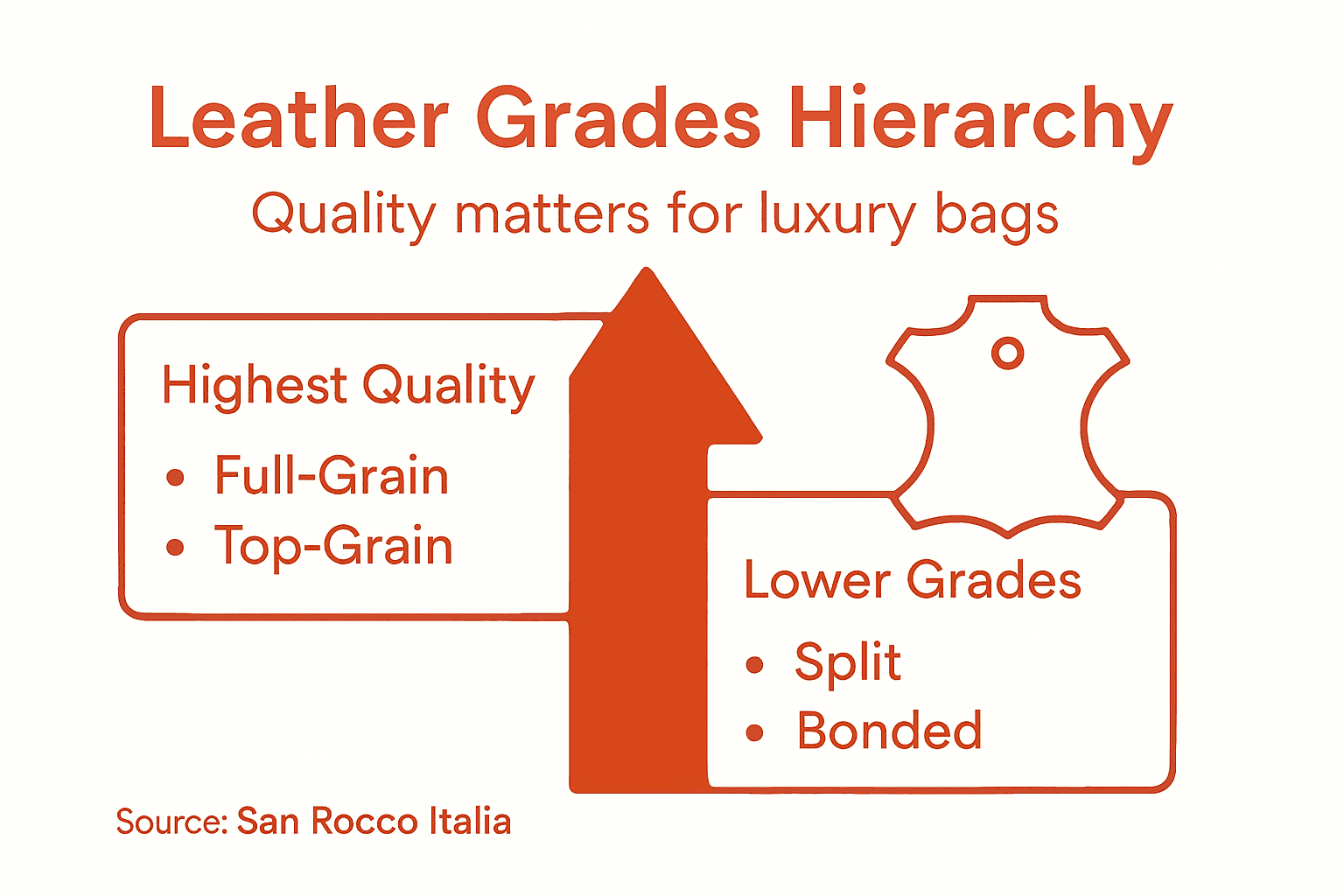
Full-grain leather stands at the top of the hierarchy. It retains the entire hide surface, including natural grain patterns, pores, and yes, minor imperfections. This authenticity is precisely what makes full-grain leather treasured by luxury collectors across Central Europe. The natural surface breathes, ages beautifully, and becomes more supple over time.
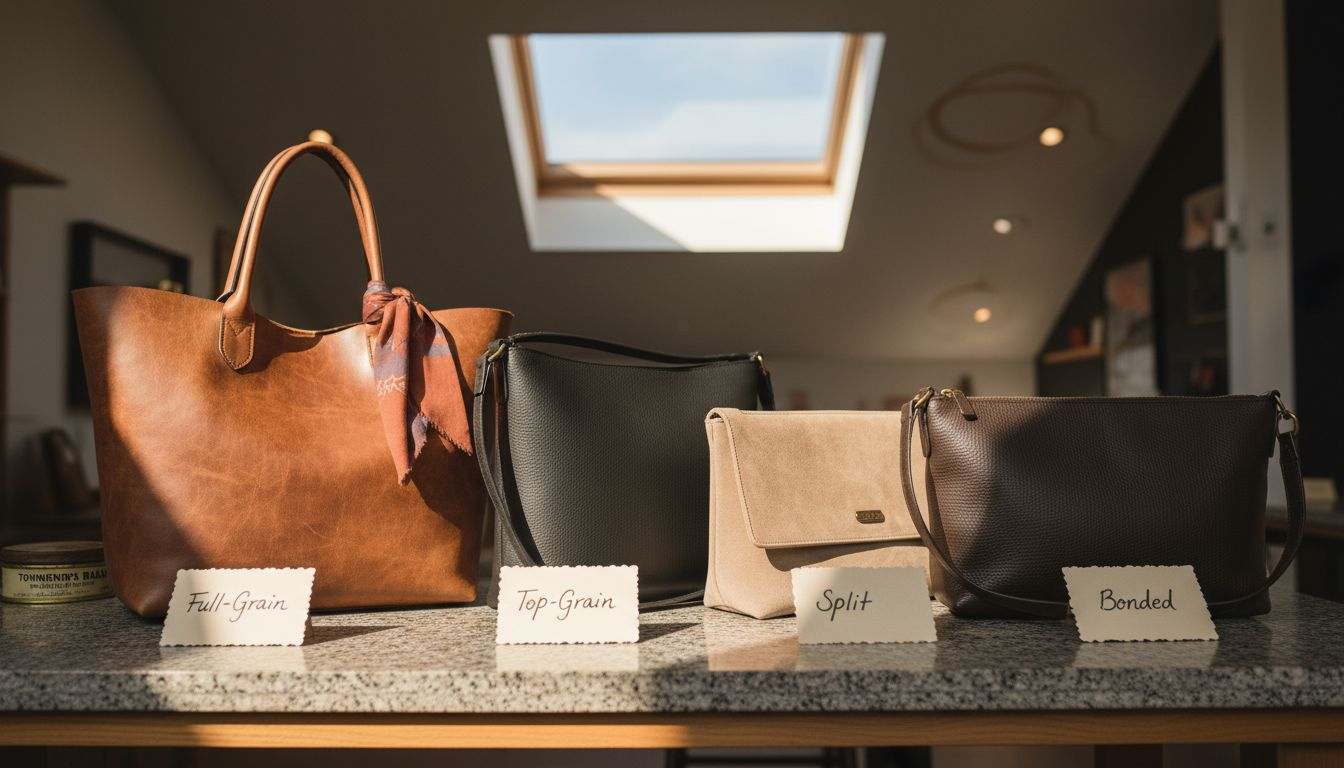
Top-grain leather undergoes sanding or buffing to remove surface blemishes. Whilst this creates uniformity, it also removes some protective grain layer. The leather industry’s standardised definitions establish that top-grain retains structural integrity, but it lacks full-grain’s durability and patina development.
Split leather comes from the fibrous layer beneath the grain. Manufacturers often emboss artificial grain patterns onto it. This material feels cheaper, performs poorly, and won’t withstand regular use in daily handbags.
Bonded leather is leftover leather fibres glued together with polyurethane. It’s not genuine leather despite its name. Within months of use, bonded leather flakes, peels, and deteriorates completely.
Key distinctions at a glance:
Here’s a concise reference contrasting leather grades and their practical implications:
| Leather Grade | Typical Use Case | Natural Ageing Result | Investment Potential |
|---|---|---|---|
| Full-grain | Luxury handbags, heirlooms | Beautiful patina, softens | Highest, lasts decades |
| Top-grain | Quality accessories | Mild patina, even finish | Moderate, 5–10 years’ use |
| Split | Budget bags, casual items | Cracking, loss of shape | Low, rarely lasts |
| Bonded | Disposable fashion, décor | Flaking, peeling | Negligible, quick failure |
- Full-grain: Natural grain visible, develops patina, most durable, highest cost
- Top-grain: Sanded smooth, more uniform appearance, good durability, moderate cost
- Split: Embossed pattern, poor durability, lowest cost, unsuitable for investment pieces
- Bonded: Not real leather, deteriorates quickly, artificially affordable
Full-grain leather from Italian artisans improves with age, whilst lower grades degrade no matter how well you care for them.
San Rocco Italia uses full-grain Italian leather precisely because it represents the pinnacle of the grading hierarchy. When you examine a luxury handbag, checking the grade immediately tells you whether you’re investing in timeless craftsmanship or temporary fashion.
The distinction matters beyond aesthetics. A full-grain leather bag becomes softer and more beautiful with use. Lower grades become brittle and damaged.
Pro tip: Request documentation specifying the leather grade from any supplier, and ask whether the leather has been corrected or treated—transparency here reveals genuine commitment to quality over marketing claims.
How Leather Grade Influences Craftsmanship
Leather grade isn’t simply a quality label—it fundamentally shapes how artisans approach every stage of creation. The grade you choose determines cutting technique, stitching method, and finishing approach. This is where craftsmanship truly begins.
Full-grain leather demands respect from skilled hands. Its natural strength allows artisans to create thinner, more supple pieces without sacrificing durability. The grain patterns guide design decisions; craftspeople work with the hide’s character rather than against it. This collaboration between material and maker produces pieces that improve with age.
Top-grain leather requires different techniques. Since the surface has been sanded, artisans must compensate with reinforced stitching and protective finishes. The uniformity allows for more precise edge-work, but the material lacks full-grain’s natural resilience.
Lower grades constrain creativity entirely. Split leather cannot hold complex stitching patterns without tearing. Bonded leather deteriorates under the stress of skilled handcrafting, making premium techniques pointless.
How grade influences specific craft decisions:
Compare how craftsmanship techniques are influenced by leather quality:
| Craft Aspect | Full-grain Approach | Top-grain Approach | Lower Grade Result |
|---|---|---|---|
| Stitching method | Hand-stitched, minimal support | Needs reinforcement, machine | Limited, risks tearing |
| Edge finishing | Natural waxing, burnishing | Protective coatings essential | Synthetic layers, weak edges |
| Design complexity | Detailed patterns possible | Moderately flexible | Restricted, basic only |
- Full-grain permits hand-stitching with minimal reinforcement whilst maintaining structural integrity
- Top-grain requires protective edge treatments and burnishing to extend durability
- Split leather limits design complexity and necessitates machine construction
- Bonded leather cannot withstand traditional hand-finishing techniques at all
When you examine a leather briefcase strap, notice how full-grain leather develops creases and patina. That’s not wear—that’s the material responding to use exactly as the craftsperson intended. Lower-grade materials simply crack and fade.
The quality of leather grade directly determines whether a handbag can survive decades of daily use or merely seasons of careful storage.
Premium craftsmanship becomes possible only with premium materials. Italian artisans at San Rocco Italia select full-grain leather precisely because it supports traditional handwork. The material’s strength allows for hand-stitching, natural wax finishes, and structural complexity that machine production cannot replicate.
Artisans spend years perfecting their technique. Pairing that expertise with inferior leather undermines everything they’ve learned. Conversely, exceptional leather in untrained hands produces mediocre results. Both matter equally.
Pro tip: When purchasing a luxury handbag, ask whether the artisan hand-stitches the piece—full-grain leather permits this technique, whilst lower grades do not, revealing the actual craftsmanship level.
Longevity, Costs, and What to Avoid
The price tag on a luxury leather handbag often confuses buyers. Why spend €500 on full-grain when bonded leather costs €50? The answer lies in mathematics you’ll understand within years, not months.
Full-grain leather costs more upfront. A quality Italian handbag represents a genuine investment. But here’s what matters: that same bag will outlast five cheaper alternatives combined. You’re not paying for the label; you’re paying for decades of reliable use.
Longevity transforms cost calculations entirely. A €500 full-grain bag lasting 15 years costs approximately €33 annually. A €80 bonded leather bag lasting 18 months costs €53 monthly. The mathematics favouring premium leather become obvious when you factor in replacement cycles.
What makes lower grades deteriorate so quickly?
- Bonded leather loses adhesion within months of regular use, causing visible flaking
- Split leather lacks structural fibres, making it prone to tears and creasing
- Top-grain without proper finishing deteriorates faster than full-grain alternatives
- Synthetic treatments on lower grades break down under UV exposure and temperature changes
Avoid these red flags entirely:
- “Genuine leather” labelling with no grade specification (legally meaningless)
- Prices suspiciously below market rates for stated materials (usually misrepresented)
- Bags lacking transparency about leather origin or tanning methods
- Sellers unable to explain why their leather grade justifies the cost
The sustainability argument strengthens the financial case. Higher-grade leather justifies costs through extended lifespan, reducing replacement frequency and overall environmental impact. Buying inferior leather repeatedly causes more waste than purchasing premium pieces once.
Spending less on cheap leather means replacing your handbag repeatedly—spending more on full-grain means keeping it beautifully for life.
Central European luxury buyers understand value differently than fast-fashion consumers. You’re not seeking disposable trendiness; you’re seeking pieces that mature with you. Full-grain Italian leather from San Rocco Italia does exactly that. It’s not a cost—it’s an inheritance.
Calculate the true annual cost of any handbag by dividing the price by realistic years of use. You’ll discover that full-grain leather typically costs less per year than inferior alternatives.
Pro tip: When comparing handbag prices, always ask the supplier how long their bags typically last before requiring replacement—their answer reveals whether they’re selling quality or gambling on your impatience.
Discover Timeless Luxury Crafted from Premium Full-Grain Leather
Understanding the true value of leather grades is essential before investing in a luxury handbag. The article highlights critical challenges such as distinguishing between full-grain, top-grain, split, and bonded leather and the myths surrounding “genuine leather” labels. If you seek authenticity, durability, and a bag that matures beautifully over decades, choosing an artisan-crafted handbag made from full-grain leather is paramount.
At San Rocco Italia, we address these exact concerns by offering handbags and leather goods made proudly in Italy using premium full-grain leather and traditional craftsmanship. Our collection is designed for those who refuse to settle for short-lived accessories that fade or crack quickly. Instead, we provide creations that develop a unique patina, reflecting your journey and style.
Experience the difference first-hand. Explore our luxury handbags and accessories and invest in pieces that truly last.

Choose authenticity over fleeting fashion today. Visit San Rocco Italia to find your next heirloom-quality handbag crafted for longevity and timeless elegance. Make a confident decision backed by transparency, quality, and genuine Italian artistry.
Frequently Asked Questions
What is the difference between full-grain leather and top-grain leather?
Full-grain leather retains the entire hide surface, including natural markings, while top-grain leather has been sanded to remove blemishes, which affects its durability and patina development.
What impact does leather grade have on the longevity of a handbag?
Higher-grade leathers, such as full-grain, age beautifully and can last decades, whereas lower grades, like bonded and split leather, deteriorate quickly and require frequent replacement.
How does craftsmanship vary according to leather grades?
Full-grain leather allows for hand-stitching and intricate designs due to its strength, while lower-grade leathers may require more machine-based construction that limits creativity and structural integrity.
Why is it important to know the type of leather used in a handbag?
Understanding the type of leather helps you make informed purchasing decisions, ensuring you invest in quality materials that will age well, rather than settling for inferior products that do not offer longevity or value.



