


Understanding ethical artisan sourcing for luxury goods
TL;DR:
- Authentic ethical artisan sourcing requires verifiable documentation, traceability, and adherence to rigorous standards.
- Luxury brands must demonstrate transparency through certified supply chains while balancing protection of small artisan workshops.
The luxury fashion market is awash with promises. “Ethically made,” “responsibly sourced,” “artisan crafted” — these phrases appear on everything from handbags retailing for thousands to scarves priced at a modest premium. Yet for discerning shoppers who genuinely care about provenance, the gap between a brand’s narrative and verifiable reality can be enormous. According to the OECD, ethical artisan sourcing requires actual traceability, documentation, and due diligence — not vague claims. This guide cuts through the noise and gives you the tools to know the difference.
Table of Contents
- Defining ethical artisan sourcing
- How leading frameworks ensure ethical sourcing
- Transparency, privacy, and the realities of artisanal supply chains
- How to identify truly ethical artisan brands
- The Italian difference: what authentic craftsmanship means
- The uncomfortable truth about ethical sourcing in luxury fashion
- Discover authentic Italian craftsmanship with peace of mind
- Frequently asked questions
Key Takeaways
| Point | Details |
|---|---|
| Evidence over buzzwords | Only verifiable details such as traceable supply chains and certifications signal true ethical sourcing. |
| Frameworks add real value | Leading standards like Fairtrade require ongoing due diligence, risk assessment, and transparency policies. |
| Transparency has limits | Revealing every sourcing detail can threaten artisan safety, so the best brands balance openness and privacy. |
| Italian craftsmanship leads the way | Heritage, innovation, and meticulous documentation set Italian artisans apart in ethical sourcing. |
| Choose with care | Ask for proof, look for third-party checks, and avoid generic claims when shopping for ethical luxury. |
Defining ethical artisan sourcing
The confusion starts with language. “Ethical” is one of those words that sounds reassuring but means very little without context. Walk into any luxury retailer and you will encounter it liberally deployed on swing tags and brand websites, rarely accompanied by the kind of substantive evidence that would satisfy a thoughtful buyer.
Genuine ethical artisan sourcing, as defined by rigorous supply chain standards, means sourcing goods with traceability — verifiable information about who made a product, under what conditions, and with what materials. It covers the entire supply chain: the leather tannery, the dye house, the workshop where an artisan hand-stitches a handle, and the logistics that bring the finished piece to your door.
At its core, authentic ethical sourcing rests on three pillars:
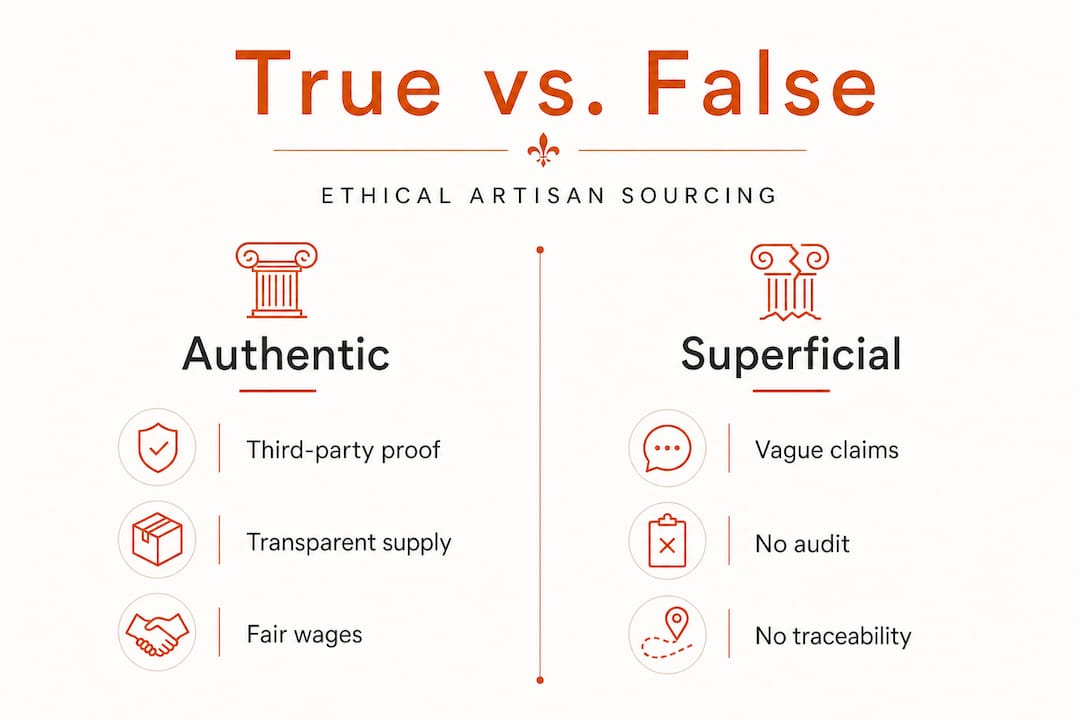
- People: Fair wages, safe working conditions, and respect for artisans’ rights at every level of the supply chain.
- Planet: Responsible use of raw materials, minimal environmental harm, and preference for sustainable inputs wherever possible.
- Provenance: Accurate, verifiable information about where goods come from and how they were made.
The challenge, as ethical sourcing commentators point out, is that “ethical” has become a label applied without evidence. A brand can claim ethical sourcing simply by using the word in its marketing. No law prevents this. No regulator automatically checks it. This is precisely why verifiable sourcing — backed by documentation, third-party review, and ongoing scrutiny — matters so much more than any particular adjective on a label.
“The difference between genuine ethical sourcing and green-washing often comes down to a single question: can the brand prove it?”
Understanding what artisan-made truly means is the first step in separating genuine craft from clever marketing. When a piece is truly artisan-made, it has a human story behind it — a specific person with specific skills working in a specific place. That story should be tellable and, ideally, traceable.
To help you orient yourself, here is a quick reference:
| Claim | What it means if genuine | Red flag if… |
|---|---|---|
| “Ethically sourced” | Third-party verified, documented supply chain | No certification or evidence provided |
| “Artisan made” | Identifiable craftspeople, traditional skills | Vague geographic reference, no workshop detail |
| “Sustainably produced” | Measurable environmental standards | No data, no reporting, no audits |
| “Made in Italy” | Legally defined origin, regulated use | Partially assembled, not fully manufactured |
| “Fair trade” | Certified under a recognised standard | Self-declared without certification |
For a deeper look at ethical textile sourcing across the fashion industry, researchers have documented how even well-intentioned brands struggle to maintain standards across complex supply chains.
Pro Tip: When evaluating an ethical sourcing claim, ask one direct question: “Can you show me the documentation?” A genuine brand will either provide it or explain clearly why certain details are kept private for artisan safety. Evasion or deflection is a reliable warning sign.
How leading frameworks ensure ethical sourcing
Definitions matter, but frameworks are where principles become practice. Reputable ethical sourcing standards do not simply ask brands to “do the right thing” — they specify exactly what that means, set measurable benchmarks, and require ongoing monitoring to verify compliance.
Established ethical sourcing frameworks such as those developed by Fairtrade operationalise these principles through specific steps: human-rights due diligence, environmental review, risk assessment, and management systems that actively track outcomes. These are not aspirational statements. They are operational requirements with auditing protocols attached.
The OECD’s practical framing for supply chain due diligence follows a clear progression. As their research confirms, the approach involves embedding responsible practices into policies and management systems before identifying, preventing, mitigating, and communicating about adverse impacts. This framework applies as meaningfully to a small leather goods atelier in Tuscany as it does to a global fashion conglomerate.
Here is how this looks in practice, step by step:
- Policy integration: The brand embeds ethical sourcing commitments into its foundational documents — supplier contracts, purchasing policies, and internal governance.
- Supplier mapping: Every tier of the supply chain is identified, from raw material producer to finished goods manufacturer. This is where many brands fall short, stopping at tier one.
- Risk identification: The brand assesses where human rights or environmental harms are most likely to occur, given the geography, industry, and materials involved.
- Prevention and mitigation: Identified risks are addressed through supplier training, contract requirements, or, when necessary, changing suppliers.
- Monitoring: Regular audits, either internal or by third parties, verify that standards are being maintained over time.
- Communication: Findings are reported publicly or to relevant stakeholders, creating accountability.
The comparison below shows how this framework maps onto some well-known ethical sourcing standards relevant to luxury goods:
| Framework | Human rights focus | Environmental standards | Third-party audit | Transparency reporting |
|---|---|---|---|---|
| Fairtrade Trader Standard | Strong | Moderate | Yes | Annual |
| OECD Due Diligence Guidance | Strong | Strong | Recommended | Ongoing |
| B Corp Certification | Moderate | Strong | Yes | Annual |
| Leather Working Group | Limited | Strong (tanneries) | Yes | By grade |
| Sedex SMETA | Strong | Moderate | Yes | Periodic |
Our authentic sourcing practices reflect the rigour these frameworks demand, and our Italian leather certification guide explains specifically what certification means when it comes to the leather used in our handbags.
For those interested in fabric and materials more broadly, an ethical fabric sourcing guide from industry researchers maps additional considerations for textile-based luxury goods.
Pro Tip: When a brand cites a certification, look it up directly on the certifying body’s website. Legitimate certifications are publicly searchable by brand name. If a brand claims Fairtrade or Leather Working Group status but does not appear in the official registry, that is a significant red flag.
Transparency, privacy, and the realities of artisanal supply chains
Here is something that surprises many shoppers: full transparency is not always the most ethical choice. That sounds counterintuitive, but it is an important nuance that separates seasoned ethical sourcing advocates from those who apply a simple “more disclosure equals more ethical” rule.
Small artisan workshops, particularly in Italy and across artisan-rich regions of Europe, can be vulnerable when their precise location, client list, or production capacity becomes publicly known. Theft, industrial espionage, and coercion are genuine concerns for skilled craft producers operating at the highest level. Some of the world’s most talented leather workers, embroiderers, and hardware makers deliberately keep a low profile precisely because their skills make them targets.
As Beyond Bohemian’s sourcing framework demonstrates, responsible brands explicitly limit overly detailed disclosures to avoid putting small producers at harm. This is not an excuse for opacity — it is a thoughtful balancing act.
“Responsible transparency means sharing enough to build trust, while protecting the people whose skills make the product possible.”
What does a well-balanced transparency practice actually look like in luxury goods? Here is what to expect from a brand that takes this seriously:
- General location, not precise address: A brand can confirm that leather goods are produced in the Florence region without publishing the exact atelier address.
- Artisan profile, not personal data: Sharing a craftsperson’s story, training background, and speciality adds genuine provenance without exposing private details.
- Material traceability: Confirming the tannery or mill that supplied leather or fabric demonstrates supply chain rigour without requiring artisan-level disclosure.
- Fair wage confirmation: A brand can state that all producers meet or exceed local fair wage standards, verified by audit, without disclosing individual salaries.
- Relationship tenure: Stating that a brand has worked with the same artisan partners for a defined number of years signals stability and genuine investment in those relationships.
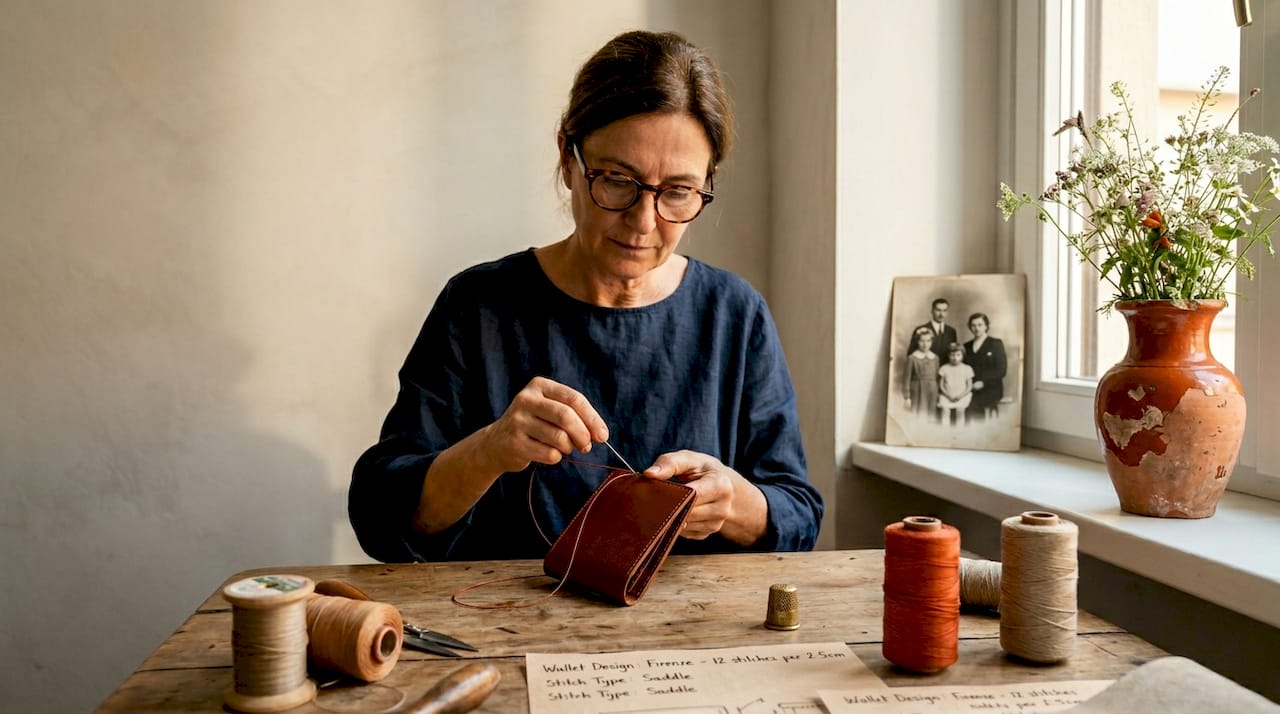
Understanding the world of traditional Italian artisans means appreciating that secrecy around certain techniques is itself part of a centuries-old tradition. Guild knowledge, passed from master to apprentice over generations, is valuable precisely because it is rare. A brand that respects this is often more trustworthy than one that publishes every detail for marketing purposes.
The local sourcing model used by ethical jewellers offers a useful parallel: proximity and long-term relationships often deliver better ethical outcomes than contractual arm’s-length arrangements with distant suppliers, even when the latter claim certification.
How to identify truly ethical artisan brands
Armed with an understanding of what ethical sourcing means and the challenges involved, you are ready to do your own evaluation. This is not about becoming an expert auditor. It is about asking the right questions and knowing what credible answers look like.
The most telling ethical sourcing signal is not a logo or a label — it is a brand’s willingness and ability to explain its sourcing in plain language, backed by specifics. Here is a practical research process to follow before making a significant luxury purchase:
- Search the brand name plus the certification claimed. If a brand says it is Fairtrade or Leather Working Group certified, verify this on the certifier’s official database. Most reputable certifiers maintain searchable public registries.
- Read the sourcing page carefully. Look for specifics: named regions, described processes, mentioned partnerships. Vague language like “we care about our makers” without any detail is a warning sign. Specific language like “our leather comes from a Leather Working Group Gold-rated tannery in Veneto” is encouraging.
- Look for annual reporting or impact data. Brands that take ethical sourcing seriously tend to publish measurable outcomes: how many artisan partners they work with, how long those relationships have lasted, what wages benchmarks they meet.
- Check for third-party recognition. Has the brand been featured in credible press coverage specifically about ethical sourcing? Has it won any independently judged sustainability or responsibility awards?
- Ask the brand directly. Send a short, polite enquiry asking which standards they adhere to and whether they can share documentation. The quality and specificity of the response is itself informative.
- Evaluate the price point. This is nuanced, but genuinely artisan-made goods with verified ethical sourcing have real costs. Prices that seem too low for claimed standards of craft and ethics deserve scrutiny.
Our own spotlight on ethical products walks through specific examples from our collection, and our notes on sustainable bag choices explain the material decisions behind each design. For guidance on what makes a truly ethical accessory purchase, our team has documented the questions worth asking in any boutique or online store.
The broader world of ethical apparel offers additional context for how these principles translate across product categories, from clothing to leather goods to jewellery.
Pro Tip: Save a brand’s sourcing page as a PDF before purchasing, and revisit it six months later. Genuine ethical brands update their sourcing pages as their practices evolve — this progression is itself evidence of genuine commitment rather than static box-ticking.
The Italian difference: what authentic craftsmanship means
Italy occupies a genuinely exceptional position in the world of ethical artisan sourcing. This is not national sentiment — it is a structural reality rooted in geography, regulation, and centuries of accumulated craft tradition that no amount of marketing can replicate overnight.
The “Made in Italy” designation carries legal weight. Under Italian and European Union law, a product must meet specific criteria to carry this label, with the substantial transformation of materials occurring in Italy. This is meaningfully different from jurisdictions where origin labelling is loosely enforced or self-declared.
Beyond regulation, Italian artisan supply chains tend to be shorter and more intimate than those in countries where fashion production has industrialised at scale. A leather goods house in Florence or the Marche region may work with a tannery an hour’s drive away, a hardware maker in the next town, and an embroiderer whose family has supplied the same type of buckle for three generations. This proximity creates natural accountability. When your supplier is your neighbour, corners are harder to cut.
As the OECD’s framework emphasises, genuine ethical sourcing requires documentation and verifiable traceability. Italian artisan traditions support this through several structural advantages:
- Consortia and trade bodies: Italian leather and textile producers are often members of trade bodies such as Unic (the Italian Tanners’ Association) or AIMPES, which maintain industry standards and support traceability initiatives.
- Geographic appellations: Regions like Tuscany’s Santa Croce sull’Arno tanning district have invested in collective quality and environmental standards that benefit all producers in the area.
- Master-apprentice continuity: Skills passed through formal apprenticeship mean that quality standards are preserved and documented in ways that ad-hoc manufacturing cannot replicate.
- Longstanding supplier relationships: Italian luxury brands frequently work with the same artisan families for decades, creating the kind of trust and accountability that short-term supplier relationships cannot generate.
- Environmental regulation: Italian and EU environmental standards for tanneries and dye houses are among the most stringent in the world, meaning that “Made in Italy” leather carries implicit environmental guarantees that many alternative origins cannot match.
“When you buy a piece made in Italy by a named artisan using documented materials, you are not just buying an object. You are buying a verifiable story.”
The craft of artisanal bag-making in Italy illustrates how these structural advantages translate into finished goods with genuine, demonstrable provenance. Each stage of production — from hide selection to edge finishing — reflects decisions made by skilled human hands, not automated systems optimising for speed and margin.
For ethical luxury shoppers, the Italian artisan supply chain represents something rare: a context in which the word “authentic” can actually be proved rather than merely claimed.
The uncomfortable truth about ethical sourcing in luxury fashion
We want to be honest with you, because we think you deserve it: ethical sourcing in luxury fashion is not a problem that any brand, including ours, has fully solved. And any brand that claims otherwise should make you sceptical.
Ethics in supply chains exist on a spectrum. A brand can do everything right at tier one — paying its direct artisan partners fairly, auditing their workshops, documenting their materials — and still have limited visibility into tier two or tier three of the supply chain. The farmer who raised the cattle whose hide became the leather. The chemical supplier who provided the tanning agents. These are real people and real environmental considerations, and the honest truth is that very few brands have complete visibility at this level.
This is not an excuse for complacency. It is a call for realistic expectations and ongoing scrutiny. The sustainable materials debate in fashion is filled with well-intentioned claims that turn out to be partial truths. Recycled materials can have high processing costs. Organic leather is not a simple category. “Natural” tanning methods vary enormously in their actual environmental impact.
What matters most, from our perspective, is not whether a brand has achieved some theoretical standard of perfect ethics. What matters is whether a brand is genuinely trying, whether it is making measurable progress, and whether it is honest when it falls short. Consumers who reward brands for demonstrated improvement rather than demanding impossible perfection create the conditions for the industry to actually change.
Ask brands hard questions. Reward honest, specific answers. Be sceptical of brands that claim to have everything figured out — supply chain ethics are genuinely complex, and anyone who makes it sound simple is probably cutting corners somewhere. The brands worth trusting are those that show you the work: the audits, the partnerships, the difficult decisions, and the measurable outcomes achieved year on year.
Discover authentic Italian craftsmanship with peace of mind
If this guide has made you more confident in evaluating artisan sourcing claims, that is exactly what it was designed to do. At San Rocco Italia, every one of our handbags and leather goods is made in Italy by skilled artisans using premium full-grain leather and traditional techniques — and we are committed to being specific about what that means rather than hiding behind vague promises.
When you explore the San Rocco Italia collection, you will find pieces with genuine provenance and transparent sourcing. Our complete ethical sourcing guide explains the standards we hold ourselves to and the questions you should feel free to ask us. We believe conscious luxury shopping should feel confident, not anxious — and we work hard to give you the specific, verifiable information that makes that confidence possible. Explore the collection and discover what authentic artisan luxury genuinely looks like.
Frequently asked questions
What proves artisan goods are ethically sourced?
Verifiable evidence such as traceable supply chains, recognised certification, and transparent documentation is what distinguishes genuine sourcing from marketing language — look for specifics, not adjectives.
Are all artisan “ethical” labels trustworthy?
No. Some brands use “ethical” as a buzzword without supporting evidence — the absence of third-party verification and clear supply chain details should always prompt further questions before purchasing.
Can brands always disclose exactly where artisan goods are made?
Not always — over-disclosure can expose small producers to genuine risk, so responsible brands balance meaningful transparency with the practical need to protect their artisan partners from harm.
What makes Italian artisan goods unique for ethical sourcing?
Italian artisan goods benefit from legally enforced origin labelling, shorter and more accountable supply chains, centuries of documented craft tradition, and some of the world’s most rigorous environmental regulations for leather and textile production.



