


Authentic sourcing explained: real Italian craftsmanship
TL;DR:
- Authentic sourcing involves transparent, traceable, and ethical production practices in Italy.
- Genuine Italian leather accessories are more durable, develop a patina, and last for decades.
- It supports sustainability, preserves traditional craftsmanship, and promotes long-term value.
If you have ever picked up a handbag labelled “Made in Italy” and wondered whether that claim means anything at all, you are not alone. The word “authentic” has been stretched so thin by marketing departments that it has nearly lost its shape. But for women who invest in Italian leather goods, the difference between genuine sourcing and clever storytelling is not just philosophical. It is visible in the stitching, felt in the leather, and measured in how long a bag lasts before it even thinks about showing its age. This article cuts through the noise to give you a clear, practical understanding of what authentic sourcing actually means and how to recognise it.
Table of Contents
- What is authentic sourcing?
- Why authentic sourcing matters in Italian handbags and accessories
- How retailers implement authentic sourcing in practice
- Authentic sourcing, sustainability, and lasting value
- Our perspective: Why authentic sourcing is more than a selling point
- Discover truly authentic Italian craftsmanship
- Frequently asked questions
Key Takeaways
| Point | Details |
|---|---|
| Real definition matters | Authentic sourcing is about true origins, ethics, and transparency, not just marketing. |
| Quality and longevity | Genuinely sourced Italian accessories are more durable, timeless, and valuable. |
| Look for transparency | A trustworthy retailer will always offer proof of provenance and artisan involvement. |
| Sustainability linked | Authentic sourcing and eco-friendly practices often go hand in hand for lasting impact. |
What is authentic sourcing?
Authentic sourcing is a precise practice, not a feeling. At its core, it means obtaining materials and finished goods through channels that are transparent, traceable, and ethical at every stage of production. When applied to Italian handbags and accessories, it means knowing which tannery produced the leather, which workshop cut the panels, and which artisan finished the edges by hand.
This is a meaningful distinction because much of what is sold as “Italian” or “artisanal” today is produced in bulk, often abroad, with only a final step completed on Italian soil to justify the label. Ethical sourcing explained in full detail clarifies exactly this point: authentic sourcing goes beyond simple product origin, incorporating ethical and transparent practices that trace the entire supply chain, not just its final address.
The four pillars of authentic sourcing are:
- Transparency: Every stage of production is documented and available to the buyer upon request.
- Provenance: The true geographic and cultural origin of materials and craftsmanship is verified, not assumed.
- Ethics: Workers at every level are fairly compensated and operate in safe, dignified conditions.
- Quality: Materials are chosen for their lasting properties, not their price point or convenience.
A common misconception is that a country-of-origin label is sufficient proof. It is not. A product can carry a “Made in Italy” tag and still be assembled from low-grade imported components using semi-automated processes. Equally, some retailers use “artisanal” as a synonym for “small batch,” when the term should indicate a specific set of traditional hand skills passed down within a craft community.
“Authentic sourcing is not a destination but a discipline. It requires constant attention to who makes a product, how they make it, and what they use. A beautiful object is only truly beautiful when its story holds up to scrutiny.” This principle underpins every purchasing decision made by reputable Italian leather houses and boutiques.
In practice, authentic sourcing for Italian handbags involves direct relationships with tanneries recognised by bodies such as the Consorzio Vera Pelle Italiana Conciata al Vegetale, as well as with small workshops in regions historically associated with leatherworking, including Tuscany, the Veneto, and Campania. These relationships take years to build and cannot be replicated quickly by brands chasing trends.
Understanding this foundation changes how you shop. You stop asking “Is this Italian?” and start asking “Can you show me where it was made and by whom?”
Why authentic sourcing matters in Italian handbags and accessories
With the definition clear, let us explore why authentic sourcing is so critical for Italian luxury accessories and why it should directly influence where you spend your money.
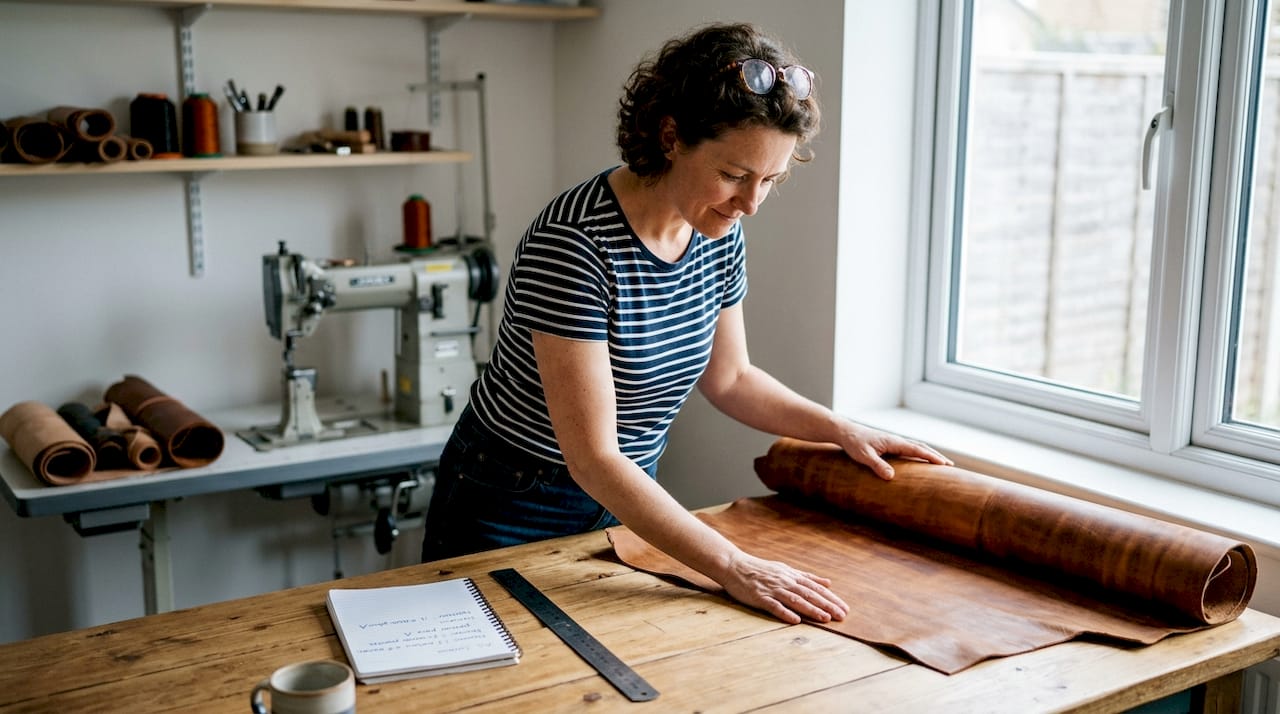
The most immediate impact is on quality and durability. Full-grain leather sourced from reputable Italian tanneries, worked by hand using traditional techniques, behaves entirely differently from corrected-grain or bonded leather processed at speed. It develops a patina over time, moulds gently to your habits, and strengthens rather than weakens with careful use. A bag produced through authentic sourcing can last decades. One produced through mass-market shortcuts may not survive a single season with dignity.
The contrast becomes clearer when you compare the two approaches directly:
| Feature | Authentic sourcing | Mass-market sourcing |
|---|---|---|
| Leather grade | Full-grain, vegetable-tanned | Corrected-grain or bonded |
| Production | Hand-finished by artisans | Semi-automated, high volume |
| Traceability | Full supply chain documented | Limited or unavailable |
| Lifespan | Decades with proper care | Often 1 to 3 years |
| Price transparency | Justified by visible quality | Often inflated by branding |
| Environmental impact | Lower through durability | Higher through waste |
Beyond durability, the emotional dimension of ownership is real and worth naming. Women over 35 who invest in quality accessories often describe a particular satisfaction in knowing the history of what they carry. That confidence comes from trust in the sourcing. Luxury authenticity insights show that consumers place high trust in brands that prioritise authenticity, and that this trust translates directly into long-term loyalty and satisfaction.
Authentic sourcing also supports timeless design. When a retailer commits to genuine materials and skilled makers, the resulting pieces tend to resist trend cycles naturally. Classic forms, honest construction, and enduring leathers simply look correct across decades in a way that fast-fashion alternatives cannot replicate.
If you want to verify authenticity before purchasing, work through these steps:
- Ask the retailer for the name or region of the tannery or workshop.
- Request a certificate of authenticity or documentation of origin.
- Examine the leather: full-grain leather has natural variations in texture and grain.
- Check the stitching: hand-stitched edges are slightly irregular in a deliberate, skilled way.
- Smell the leather: genuine vegetable-tanned leather has a warm, natural scent, quite different from synthetic coatings.
Seeking out retailers who value shopping locally for quality and who build direct supplier relationships is one of the surest ways to guarantee you are getting the real thing.
How retailers implement authentic sourcing in practice
Knowing why authenticity matters, let us look at how responsible retailers ensure every product is genuinely and ethically sourced from the very beginning of the supply chain.
The process starts before a single product is commissioned. Reputable retailers conduct supplier audits, reviewing not just product samples but the conditions under which those products are made. These audits assess workshop safety, worker pay relative to regional standards, environmental practices at tanneries, and the actual skill level of the artisans involved. This is not a one-time exercise. Established ethical retailers revisit their suppliers regularly, often annually.
Certification plays a supporting role. Leathers carrying certifications from the Leather Working Group or the Consorzio Vera Pelle are independently verified. However, certification alone is not the whole picture. Some of the finest small workshops in Italy are too small to pursue formal certification while still producing exceptional, entirely traceable work. This is why personal supplier relationships matter enormously and why case studies highlight strict supplier vetting and traceability as the backbone of successful authentic sourcing programmes.
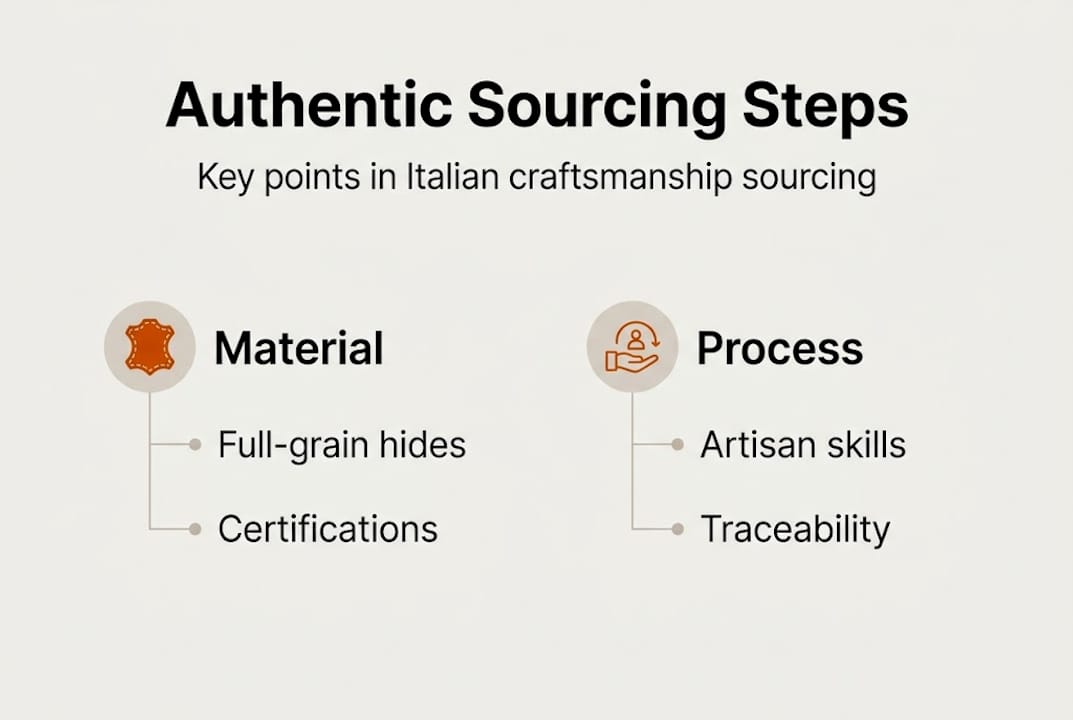
Here is a simplified picture of how a responsibly sourced Italian handbag moves from workshop to customer:
| Stage | What happens | Verification method |
|---|---|---|
| Hide selection | Tannery selects full-grain hides | Origin certificate, tannery visit |
| Tanning | Vegetable tanning over several weeks | Certification or direct inspection |
| Cutting | Artisan cuts panels by hand or precision die | Workshop audit, sample review |
| Assembly | Hand-stitching, edge painting, hardware fitting | Quality inspection, batch records |
| Final review | Piece assessed against quality standards | Brand quality checklist |
| Documentation | Provenance records compiled for buyer | Certificate of authenticity issued |
Local artisans and small workshops are not simply a charming detail in this process. They are the mechanism by which traditional skills survive. When a retailer chooses a small Florentine workshop over a large automated factory, that choice funds the continuation of techniques that cannot be recovered once lost.
Pro Tip: When speaking to a retailer, ask specifically: “Can you tell me where the leather was tanned and where the bag was constructed?” A confident, specific answer is a very good sign. Vague responses about “Italian craftsmanship” without names or regions are a reason to press further.
For customers wanting to go deeper before buying, learning to spot real Italian leather is a practical skill, and understanding how to spot fake leather is equally valuable when navigating the broader market.
Key questions to ask any retailer you are considering:
- Where was the leather tanned, and by whom?
- Are your workshops independently audited?
- Do you offer any documentation of provenance with purchase?
- How long have you worked with your current suppliers?
Authentic sourcing, sustainability, and lasting value
Beyond trust and quality, authentic sourcing also powers a more sustainable and responsible fashion industry, and the two ideas are more closely linked than most retailers admit.
The fashion industry as a whole is one of the more significant contributors to global waste. Fast fashion and low-quality accessories designed for short use cycles compound this problem. Authentic sourcing addresses it from a different angle entirely. When a handbag is made to last thirty years, it does not need to be replaced every two or three seasons. That single act of genuine quality removes dozens of inferior products from the consumption cycle over a lifetime.
Sustainable practices are integral to genuine sourcing and are increasingly valued by informed customers who understand the true cost of disposable fashion. Vegetable tanning, for example, uses natural plant-based compounds rather than heavy metals, producing leather that biodegrades far more responsibly at end of life. Workshops that operate at human scale consume less energy and generate less waste than industrial facilities.
The overlap between authentic sourcing and sustainability includes:
- Durability over disposability: Genuine materials and skilled construction produce pieces that need no replacement for decades.
- Ethical labour: Fairly paid artisans working in safe conditions represent a social sustainability that goes beyond environmental concerns.
- Local economies: Sourcing from small regional workshops keeps money within craft communities, sustaining cultural heritage.
- Reduced waste: Careful hide selection and hand-cutting minimise material waste compared to automated bulk processes.
- Transparency as accountability: When retailers document every stage of sourcing, they are also holding themselves accountable to ongoing improvement.
Pro Tip: Watch for “greenwashing,” where brands use sustainability language without substance. Ask for specifics: which tannery, which certification, which particular practice makes this product more sustainable than alternatives? Generalities are a warning sign. Precise, named answers are a signal of genuine commitment.
The connection between authentic sourcing and sustainable materials in fashion is not incidental. Responsible material selection is one of the earliest decisions in the sourcing process, and it shapes everything that follows. For women building a considered wardrobe rather than accumulating pieces, understanding this connection is what separates a purchase that gratifies momentarily from one that still feels right a decade later. The benefits of sustainable fashion extend well beyond environmental impact into personal satisfaction and long-term value.
Our perspective: Why authentic sourcing is more than a selling point
Marketing teams have adopted the language of authenticity so thoroughly that it risks becoming meaningless. Nearly every luxury brand now tells a story involving Italian villages, family workshops, and generations of skill. Some of those stories are true. Many are not. The difficulty is that a beautifully told lie and an honestly told truth can look identical on a website.
What we have come to understand, through years of working directly with Italian artisans and building supplier relationships that require trust on both sides, is that authentic sourcing is not primarily a selling point. It is a discipline that requires difficult choices. Choosing a small Tuscan workshop over a larger, cheaper alternative means accepting longer lead times and occasionally less predictable supply. It means paying fairly for exceptional skill, even when that raises the final price. It means being honest with customers about what they are buying and why it costs what it costs.
The ripple effect of these choices is something rarely discussed in luxury marketing. When you invest in a genuinely sourced Italian piece, you are sustaining a workshop that may employ five people, all of whom carry skills that took a decade to develop. Those skills, without demand, disappear within a generation. Why authenticity matters is ultimately a question about what we want to preserve, not just what we want to own.
Our challenge to you is simple: before your next investment purchase, ask one more question than you usually would. Then listen carefully to the answer.
Discover truly authentic Italian craftsmanship
Authentic sourcing is something we think about every single day at San Rocco Italia. As a woman-owned boutique, we have built our collection around a genuine commitment to Italian quality, sourcing all our handbags and leather goods from skilled artisans in Italy who work with premium full-grain leather and time-honoured techniques. The rest of our curated range comes from trusted European makers chosen for the same values: quality, honesty, and enduring style.
When you shop with us, you are not buying a story. You are buying a piece with a traceable origin, made by people who care deeply about their craft. We believe every woman deserves to know exactly what she is investing in, and we are happy to answer the questions that other retailers avoid. Explore the San Rocco Italia collection and discover what genuinely sourced Italian craftsmanship looks and feels like.
Frequently asked questions
What does authentic sourcing mean in luxury fashion?
Authentic sourcing means obtaining products or materials in a transparent, ethical, and traceable way that guarantees genuine origin and craftsmanship. As ethical sourcing involves transparency and ethical standards at every stage, it goes well beyond a simple country-of-origin label.
How can I check if a handbag is authentically sourced?
Ask for origin details, certificates of authenticity, and evidence of small-scale artisan production. Checking provenance is crucial to verifying genuine goods, and reputable retailers will provide this information without hesitation.
Why does authentic sourcing make luxury accessories last longer?
Because genuine materials and traditional techniques lead to higher-quality, more durable products. Lasting quality is a core benefit of authentic sourcing, with properly made Italian leather goods lasting decades rather than seasons.
Is authentic sourcing related to sustainability?
Yes, authentic sourcing closely overlaps with sustainable practices, ensuring ethical materials and fair support for small artisans. Sustainability is closely linked with responsible sourcing because durable, honestly made goods reduce long-term waste and environmental impact significantly.
Recommended
- Traditional Italian Artisans – Why Craftsmanship Matters – San Rocco Italia
- What Is Italian Craftsmanship? Complete Guide – San Rocco Italia
- Understanding Italian Handbag Craftsmanship Explained – San Rocco Italia
- Understanding Why Choose Made in Italy for Quality Style – San Rocco Italia
- Why craftsmanship create 100% excellence



