


Discover the meaning of artisan made for luxury handbags
TL;DR:
- True artisan-made products involve skilled craftsmanship, traditional techniques, and unique individual imprints.
- Italy’s certifications and regional traditions authenticate genuine artisan craftsmanship and sustainable practices.
- Recognizing authentic artisan handbags ensures durability, exclusivity, and a meaningful connection to craftsmanship.
The word ‘artisan’ appears on countless handbag labels, lookbooks, and brand manifestos today. Yet most of us have never stopped to question what it actually means, or whether the claim holds up. True artisan made is not simply a synonym for handmade. It refers to a convergence of individual skill, inherited technique, premium materials, and creative imprint that together produce something genuinely irreplaceable. This guide unpacks what artisan made truly means in the context of luxury handbags and accessories, examines Italian craftsmanship as the global gold standard, and gives you the tools to identify authenticity with confidence. Whether you are building a collection or making a single significant investment, understanding this distinction changes everything.
Table of Contents
- Defining artisan made: More than handmade
- The Italian standard: Tradition and certification
- Mastery and legacy: The craftsman’s signature
- Modern myth-busting: Craftwashing, innovation, and sustainability
- Why artisan made matters: Value for collectors and wearers
- The uncomfortable truth most luxury experts won’t tell you about artisan made
- Experience true Italian artisan made luxury with San Rocco Italia
- Frequently asked questions
Key Takeaways
| Point | Details |
|---|---|
| Artisan made redefined | Artisan made means skilled, creative, and traceable craftsmanship beyond ‘handmade’ labels. |
| Italian excellence | Italy sets the global benchmark for quality, tradition, and authenticity in artisan-made leather. |
| Beware craftwashing | Not all ‘artisan’ claims are equal—spot authenticity by looking for certifications and maker details. |
| Mastery brings value | A true artisan’s signature ensures exclusivity, longevity, and emotional connection for collectors. |
| Modern innovation | Hybrid techniques and sustainable practices shape the future of luxury artisan-made accessories. |
Defining artisan made: More than handmade
Walk into any department store and you will find bags described as ‘lovingly crafted’ or ‘hand-finished.’ The language sounds compelling. But language without substance is just marketing, and nowhere is this gap more visible than in the luxury handbag industry.
The importance of craftsmanship in luxury goods is not decorative. It is structural. True artisan made goods carry the creative fingerprint of a skilled individual, someone whose mastery was not acquired in a weekend workshop but built across years, often decades, of focused practice and mentorship.
As one detailed exploration of artisanal luxury notes, artisan-made refers to products created primarily by hand using skilled craftsmanship, traditional techniques, and high-quality materials, emphasising the individual maker’s imprint, limited production, and uniqueness over mass production. Notice the emphasis on individual imprint and limited production. These are not accidental qualifiers.
Here is where many buyers are misled. A bag that is assembled by hand on a production line is not automatically artisan made. Assembly and artisanship are not the same thing. Assembly follows a set sequence to produce a uniform result. Artisanship involves judgement, adaptation, and a level of creative investment that leaves each piece subtly distinct from the last.
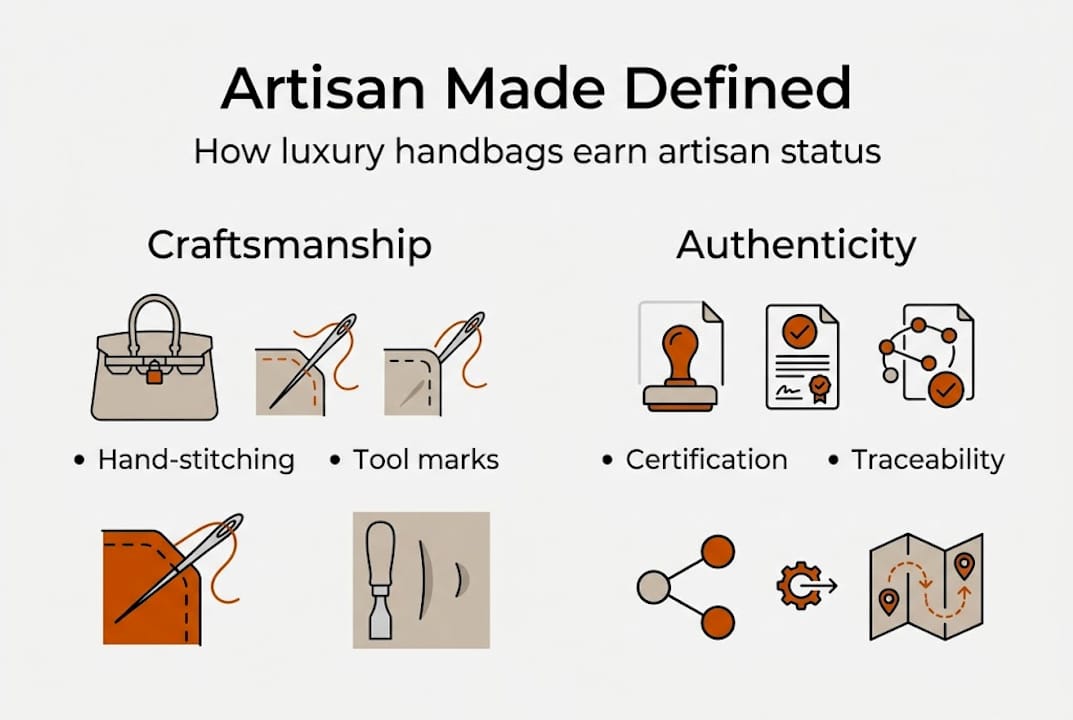
The key criteria that define truly artisan-made goods include:
- Handwork performed by a skilled individual with documented mastery
- Use of traditional methods passed down through recognised lineages or schools
- High-quality raw materials with traceable provenance
- Limited production volume that preserves quality control
- A visible creative imprint: the maker’s touch is discernible in the finished piece
- Individuality: no two pieces are precisely identical
Contrast this with what the industry sometimes calls designer bags produced at scale. A luxury logo does not guarantee artisan production. Many globally recognised brands manufacture the majority of their volume in large factories, with handwork reserved for finishing touches or flagship pieces. The branding suggests heritage; the production reality is often very different.
This brings us to an important concept: the artisanal halo effect. This is the tendency for brands to use the language and imagery of artisanship, handmade workshops, master craftsmen, generational tradition, while their actual production bears little resemblance to that narrative. The halo effect is not always intentional deception. Sometimes it reflects genuine heritage now diluted by scale. Either way, it places the burden of discernment firmly on you as a buyer.
“True artisan made is not a marketing category. It is a commitment to a way of working that prioritises quality over quantity, individuality over uniformity, and skill over speed.”
The most reliable way to navigate this is to ask specific questions: Who made this? Where? Using which materials and methods? Can those claims be verified? Genuine artisan producers welcome these questions. Those relying on the halo effect tend to offer vague answers.
The Italian standard: Tradition and certification
If artisan made has a spiritual home, it is Italy. This is not sentiment. It is a fact rooted in centuries of manufacturing culture, regional specialisation, and a system of official certifications that give the term genuine legal and ethical weight.
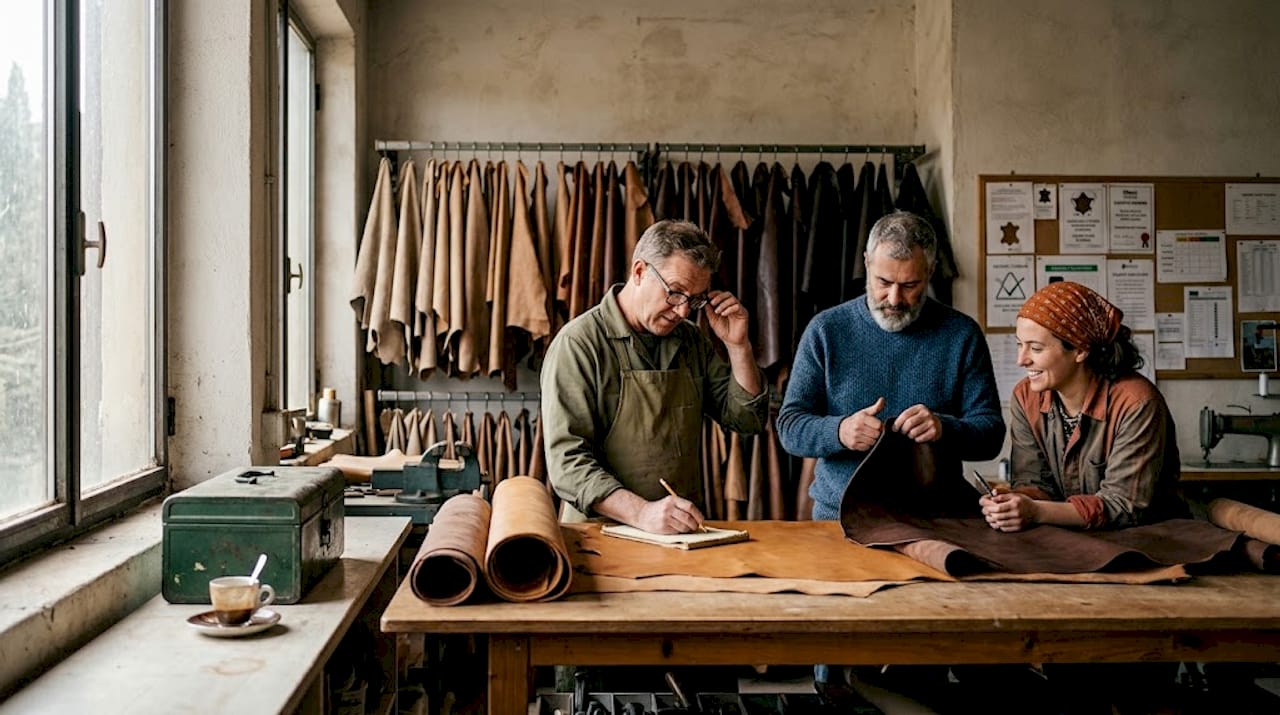
Italy’s leather goods tradition is concentrated in specific regions: Tuscany for vegetable-tanned leather, the Veneto for luxury footwear, Campania for bespoke accessories. Each region carries its own techniques, material preferences, and generational knowledge. When Italian artisans speak of their work, they speak of a territorio, a territory whose identity is inseparable from what they make.
But cultural reverence alone is not enough. Italy has developed formal certification frameworks to protect authenticity and guide discerning buyers. The Italian leather certification guide sets out the key standards clearly. These include UNI EN 16484, Pelle Conciata al Vegetale in Toscana, Made in Italy Full Cycle, and Eco-Leather certifications, each ensuring a different aspect of authenticity and sustainability.
| Certification | What it verifies |
|---|---|
| UNI EN 16484 | Italian leather production standards and traceability |
| Pelle Conciata al Vegetale in Toscana | Traditional Tuscan vegetable tanning methods |
| Made in Italy Full Cycle | Entire production chain located within Italy |
| Eco-Leather | Environmental and ethical supply chain compliance |
This matters enormously when you are investing in a handbag or leather accessory. A bag labelled ‘Made in Italy’ may have been assembled in Italy from components manufactured elsewhere. The Full Cycle certification closes this loophole by confirming that every stage of production, from raw hide to finished goods, takes place on Italian soil.
The Italian craftsmanship guide explains how these standards connect to daily workshop practice. Artisans working within certified frameworks are not simply following rules. They are part of a living tradition that demands continuous skill development, responsible sourcing, and honest representation of their work.
Full-grain leather, the highest grade available, retains the complete natural surface of the hide, including its grain and unique characteristics. This is the material of choice for serious Italian artisans because it accepts hand-finishing beautifully and develops a rich patina over years of use. Top-grain leather, the next grade down, has the surface lightly sanded for a more uniform appearance. Both are legitimate luxury materials; full-grain simply rewards the owner with greater longevity and a more pronounced personal patina.
Pro Tip: When examining any bag claiming Italian artisan credentials, look for the specific certification mark rather than a generic ‘Made in Italy’ label. Ask the retailer or brand to confirm which certification applies and what it guarantees. A reputable seller will provide this information without hesitation.
Mastery and legacy: The craftsman’s signature
Behind every genuinely artisan-made handbag is a person. Not a machine, not a team assembled for efficiency, but an individual whose accumulated skill shapes every stitch, edge, and finish. This is what gives artisan-made pieces their particular quality: the presence of a human being who cared deeply about the outcome.
The art of Italian craftsmanship is inseparable from the concept of the maestro, the master artisan who has typically spent fifteen to twenty years developing their expertise before being entrusted with the most complex work. This mastery is visible in the finished piece if you know where to look.
Signs of a genuine artistic signature in a luxury handbag include:
- Hand-stamped or hand-tooled logos with slight variation between pieces
- Saddle stitching with consistent tension that no machine can perfectly replicate
- Edges that are hand-bevelled and burnished, not simply dyed
- Lining attached by hand with visible, even stitches
- Hardware that is hand-set and individually tested
- A subtle, deliberate asymmetry that marks human involvement
These details are not flaws. They are evidence. A slight variation in stitch spacing or a uniquely hand-polished edge tells you that a skilled person was present throughout the process, making decisions and applying judgement.
The challenge facing the industry is a generational one. Hermès employs 7,000 craftsmen as part of its commitment to handmade production, but even at that scale, the pipeline of genuinely skilled artisans is under pressure. In Italy particularly, older masters are retiring faster than apprentices can reach equivalent skill levels. This is creating real scarcity, not manufactured scarcity of the kind luxury brands use to drive desire, but genuine scarcity of irreplaceable human expertise.
| Factor | Impact on value |
|---|---|
| Years of artisan experience | Higher mastery, finer detail, greater collector appeal |
| Individual signature techniques | Unique character, authenticity, investment potential |
| Use of full-grain leather | Develops patina, improves with age, longer lifespan |
| Limited production volume | Exclusivity, rarity, sustained or increasing resale value |
This is one reason why truly artisan-made pieces from reputable Italian workshops hold or appreciate in value over time. Understanding Italian leather craftsmanship helps collectors recognise the difference between a bag that will age beautifully and one that will simply age.
The brands that understand this invest seriously in their artisans. Bottega Veneta’s signature intrecciato weave, for example, requires years of practice to execute at the level expected of their workshops. It cannot be automated without losing the quality entirely. This is mastery as competitive advantage, and it is exactly the kind of thing a discerning collector should seek out.
Modern myth-busting: Craftwashing, innovation, and sustainability
Despite the romance of the artisan narrative, challenges and misconceptions remain in today’s luxury market. The most significant of these is craftwashing, a practice that borrows the language and aesthetic of artisanship without the substance to support it.
Craftwashing happens when a brand positions itself as artisan-led through imagery, storytelling, and vocabulary, while its actual production relies heavily on factory automation, low-skill labour, or opaque supply chains. It exploits the artisanal halo effect that surrounds genuinely handmade goods, borrowing credibility without earning it. Hybrid modern methods such as CNC cutting combined with hand-finishing are emerging across the industry, and while these can be legitimate, they require honest disclosure.
The luxury craft insights published by Vogue Business confirm that as prices have risen sharply in recent years, buyers are increasingly scrutinising what they actually receive. Craftwashing is not just misleading; it is becoming a commercial liability as awareness grows.
How to distinguish genuine artisan goods from craftwashed alternatives:
- Ask for specific maker information, not just a country of origin
- Request documentation of certifications relevant to the materials and production method
- Look for transparency about production volume; true artisan workshops are small by definition
- Research the brand’s history: how long have they worked with the same artisans or workshops?
- Examine the piece itself: are the finishing details consistent with hand involvement, or uniformly mechanical?
- Check whether sustainability claims are certified or simply stated
- Seek out brands that name or profile their artisans publicly, this is one of the strongest signals of genuine commitment
Sustainability is increasingly central to the artisan conversation. True artisan made, in its fullest sense, must account for the ethical and environmental dimensions of production. An ethical craftsmanship guide points out that responsible sourcing, fair wages, and traceable materials are part of the artisan commitment, not optional extras.
Sustainable Italian leather production, particularly the vegetable-tanning tradition of Tuscany, offers a compelling model. Vegetable tanning uses natural plant extracts rather than harsh chemicals, takes several months rather than days, and produces leather of superior quality and environmental profile. It is slower, costlier, and more skilled work. Which is precisely why it remains the hallmark of serious artisan producers.
Pro Tip: When a brand uses the word ‘sustainable,’ ask specifically which certification backs that claim. Look for Eco-Leather, OEKO-TEX, or Leather Working Group certification. A brand that genuinely operates sustainably will have the paperwork to prove it.
Why artisan made matters: Value for collectors and wearers
With pitfalls and innovations clarified, let’s focus on the real-world benefits and joys of choosing artisan made. Because beyond the due diligence and the certifications, owning something truly artisan made is a different kind of experience.
There is an emotional quality to carrying a bag you know was made with exceptional care by a skilled individual. It connects you to a tradition, a place, and a way of working that is genuinely rare. This is not nostalgia. It is the recognition that most things in the modern world are made for speed and scale, and that something made for excellence stands apart in a way you feel every time you use it.
The cultural influence of Italian design is built on exactly this quality. Italian artisans have long understood that an object made with complete attention to craft becomes more than functional. It becomes meaningful.
Practical benefits of choosing artisan-made handbags and accessories include:
- Durability: Premium materials and skilled construction outlast mass-produced alternatives by years, often decades
- Patina: Full-grain leather develops a unique surface character over time, making each bag increasingly personal
- Exclusivity: Limited production ensures your piece is not replicated thousands of times over
- Repairability: Artisan-made pieces can usually be repaired and restored by skilled workshops, extending their life indefinitely
- Heritage value: A well-documented artisan piece carries provenance that supports resale and collector interest
As craft becomes luxury’s core currency, with brands like Bottega Veneta and Loewe centring their artisans in campaigns and events, the market is recognising what discerning collectors have always known: the value of an artisan-made piece is not just in its appearance on day one, but in what it becomes over years of use.
“Craft is the one dimension of luxury that cannot be faked at scale. You either have it or you don’t.”
The importance of why craftsmanship matters extends to collection building as well. A thoughtfully assembled collection of genuinely artisan-made pieces tells a coherent story: of taste, knowledge, and a refusal to settle for the ordinary.
The uncomfortable truth most luxury experts won’t tell you about artisan made
Here is what the industry rarely acknowledges openly: the term ‘artisan made’ is being diluted in real time, and most buyers do not yet realise it. The overuse of this language has created a marketplace where genuinely extraordinary craftsmanship sits side by side with products that borrow its vocabulary without its substance.
The uncomfortable reality is that true artisanship is endangered. Not because the skills are disappearing entirely, but because the commercial incentives increasingly favour imitation over authenticity. It is far cheaper to tell an artisan story than to actually invest in artisan production.
We believe that buyers hold real power in this situation. When collectors insist on traceability, ask for certifications, and choose brands that name their artisans and stand behind their methods, they create the conditions for genuine craft to survive and thrive. You can read about the history of Italian leather and see clearly how centuries of accumulated knowledge are worth protecting.
The market responds to demand. Demand that is educated, specific, and uncompromising about standards does more to preserve real artisanship than any regulation alone. As collectors, you are not passive recipients of what the industry decides to offer. You are active participants in what the industry becomes. Choose with that awareness.
Experience true Italian artisan made luxury with San Rocco Italia
For those ready to experience the difference themselves, nothing compares to true Italian luxury. At San Rocco Italia, every handbag and leather accessory in our collection is made in Italy by skilled artisans using premium full-grain leather and time-honoured techniques. We are a woman-owned boutique built on a single conviction: that genuine craftsmanship is worth seeking out, and worth paying for.

Our carefully curated collection reflects everything this article has explored: certified materials, traceable production, and the unmistakable quality of individual artisan work. When you carry a San Rocco Italia handbag, you carry the result of generations of Italian skill. Explore our collection and discover what Italian craftsmanship truly looks and feels like. You deserve nothing less than the real thing.
Frequently asked questions
How can I know if a handbag is truly artisan made?
Look for specific certifications such as UNI EN 16484 or Made in Italy Full Cycle, clear information about the individual maker, traceable materials, and concrete evidence of traditional methods rather than vague ‘handmade’ claims.
Is every handcrafted bag considered artisan made?
No. True artisan made requires creative mastery, traditional techniques, and a visible individual imprint, not simply assembly by hand, which is a meaningfully different and lesser standard.
Do artisan made handbags last longer than others?
Yes. Bags crafted by skilled artisans using full-grain or top-grain leather and traditional construction methods typically offer far greater durability, repairability, and longevity than mass-produced alternatives.
What is craftwashing and how can I avoid it?
Craftwashing occurs when brands use artisan-style language for marketing purposes without genuine skill, traceability, or sustainability behind their claims. Avoid it by demanding validated certifications and transparent maker information, since the artisanal halo effect can be convincing without being real.
Recommended
- Artisanal Bag Making – The Craft Behind Ethical Luxury – San Rocco Italia
- Luxury vs Mass-Produced Bags: Complete Comparison Guide – San Rocco Italia
- What Makes a Handbag Luxury: Complete Guide – San Rocco Italia
- Complete Guide to What Makes a Bag Luxury – San Rocco Italia
- How Craftsmanship Shapes Luxury Watch Value and Artistry – OP



