


Why choose ethical accessories: timeless, responsible luxury
TL;DR:
- Ethical accessories are characterized by fairness, transparency, and durability, reflecting genuine craftsmanship.
- Consumers now prioritize social sustainability, artisan fairness, and provenance over environmental claims.
- Choosing truly ethical luxury supports artisans, reduces waste, and aligns with timeless design principles.
There is a persistent myth that buying ethically means accepting less. Less beauty, less prestige, less pleasure. Yet the sustainable luxury market is projected to grow from $10.4 billion in 2024 to $17.8 billion by 2032, driven overwhelmingly by affluent women who refuse that trade-off. The reality is that ethical accessories are not a compromise. They are a more considered form of desire. This guide unpacks what ethical accessories actually mean, how to identify them with confidence, and why the choices you make today carry personal, social, and environmental weight that no trend-chasing purchase ever could.
Table of Contents
- The meaning and evolution of ethical accessories
- The value of Italian craftsmanship and timeless design
- What separates truly ethical accessories from greenwashed luxury
- Why ethical choices matter: personal, social, and environmental impacts
- A new vision of luxury: what most overlook about ethical accessories
- Discover timeless ethical luxury with San Rocco Italia
- Frequently asked questions
Key Takeaways
| Point | Details |
|---|---|
| Ethics redefine luxury | Modern accessories blend conscience and quality, aligning with personal values and social responsibility. |
| Timeless design endures | Choosing well-crafted, ethical pieces ensures durability, elegance, and lasting satisfaction. |
| Transparency is essential | Genuine ethics are proven by supply chain transparency, not just marketing claims. |
| Impact goes beyond style | Supporting ethical accessories uplifts artisans, protects the environment, and fosters premium experiences. |
The meaning and evolution of ethical accessories
The word “ethical” gets applied to almost everything in fashion now, which has made it nearly meaningless in some circles. So let us be precise. An ethical accessory is one produced with fairness to every person in its supply chain, made from materials sourced with transparency, and designed with a longevity that respects both the maker’s craft and the planet’s resources. It is not simply a bag made from recycled plastic. It is a piece with a verifiable story.
This definition has three pillars worth understanding clearly:
- Artisan fairness: The craftspeople who cut, stitch, and finish your accessory are paid a living wage, work in safe conditions, and have their skills recognised and protected.
- Sustainable materials: Whether full-grain leather tanned using low-impact methods, or natural fabrics traced to responsible farms, the raw materials have been chosen with care rather than convenience.
- Supply chain transparency: A brand should be able to tell you where its materials originate, who made the piece, and under what conditions. Vagueness is a warning sign.
Consumer attitudes towards these standards have shifted significantly over the past decade. What was once a niche concern held by environmental activists is now a defining quality expectation among discerning luxury buyers. Investing in understanding sustainable luxury is no longer an act of advocacy. It is an act of taste.
The data supports this shift emphatically. Research into social sustainability in luxury markets reveals that 80% of consumers are willing to pay a premium for verified sustainable goods. More tellingly, it is the social dimensions of sustainability, artisan fairness, honest brand relationships, community impact, that most powerfully drive brand trust and customer loyalty. Environmental credentials matter, but the human story behind a product matters more to the modern luxury buyer.
“Sustainable luxury is not a category. It is a standard that the entire industry is moving towards, whether it chooses to or not.”
This evolution means that when you choose an ethical accessory today, you are not shopping at the fringe of luxury. You are shopping at its leading edge. The brands that understood this early have built reputations that outlast seasons. Those that ignored it are now scrambling to catch up, often with superficial gestures that informed buyers can see straight through.
Understanding the definition and momentum behind ethical accessories gives you a clearer lens for everything that follows. It also gives you power as a buyer, because knowing what real ethics looks like makes it very difficult for a brand to fool you with the alternative.
The value of Italian craftsmanship and timeless design
When we talk about ethical accessories, Italian craftsmanship belongs at the centre of that conversation. Not because Italy has a marketing advantage, though it certainly does, but because the country’s artisanal traditions are structurally aligned with ethical practice in ways that matter deeply.
Italian leather goods, in particular, are shaped by a model of production that prioritises skill over speed. Family-run workshops in Tuscany, the Veneto, and Campania pass techniques across generations. The craftspeople are not anonymous factory workers. They are specialists whose professional identity is bound up in the quality of what they make. That relationship between maker and material is itself an ethical act, because it values human skill rather than treating it as a cost to be minimised.
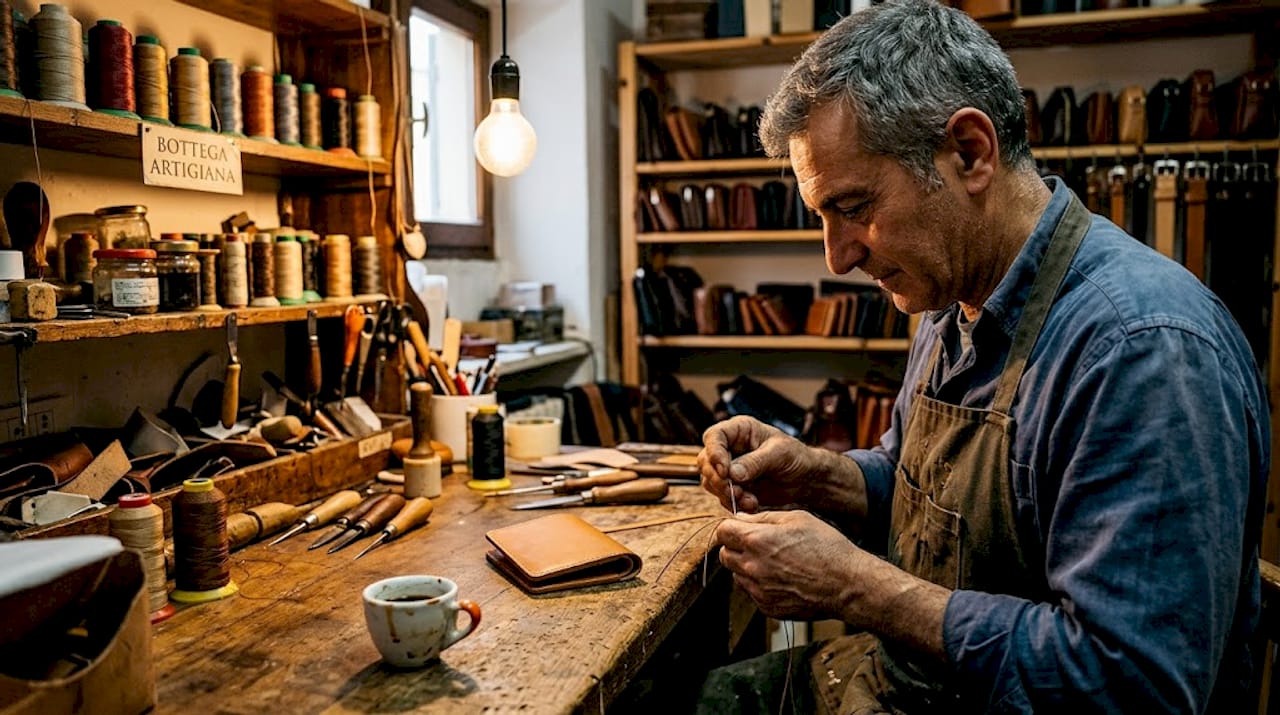
Research into luxury consumer behaviour confirms that affluent consumers prioritise artisan fairness and heirloom value over environmental credentials alone. This is not surprising. A bag made by a skilled artisan who is fairly compensated, using leather that will last twenty years, embodies a form of sustainability that is both social and environmental simultaneously. It is simply expressed through excellence rather than activism.
Timeless design reinforces this further. The philosophy of buying less but choosing better is not new, but it has gained urgency. An accessory designed with clean lines, quality hardware, and proportions that resist trend cycles does not need to be replaced. That longevity is one of the most honest environmental claims a luxury brand can make. You can explore these ideas further through luxury craftsmanship insights that examine why construction quality is the foundation of genuine value.
What defines a truly timeless piece? Consider these markers:
- Full-grain leather: The highest grade of leather, retaining the natural grain and developing a rich patina with age rather than peeling or cracking.
- Hand-stitched construction: A stitch density and consistency that machines cannot replicate, making the seam stronger and the finish finer.
- Unlined or clean-lined hardware: Brass or solid metal fittings that age gracefully rather than plating that chips within a season.
- Considered proportions: A silhouette that works across decades, not just the current runway moment.
Pro Tip: When assessing provenance, ask for a certificate of origin or look for a made-in stamp on interior hardware or lining labels. Reputable Italian makers are proud to confirm where and by whom their pieces were made. If a brand hesitates or deflects, treat that as informative. The essence of quiet elegance in an accessory is inseparable from knowing its story.
What separates truly ethical accessories from greenwashed luxury
Greenwashing in the luxury sector has become sophisticated. Brands have learnt that vague commitments to sustainability are good for press releases and far easier than actual change. The challenge for the informed buyer is developing an eye for the difference between genuine ethical practice and carefully worded theatre.
The most common greenwashing tactics in luxury retail include:
- Using one sustainable material, such as an organic cotton dust bag, while the main product involves unverified leather.
- Citing carbon offset programmes without disclosing the supply chain emissions they are supposedly offsetting.
- Featuring artisan imagery in marketing while offering no verifiable information about wages or conditions.
- Applying self-awarded labels like “eco-conscious” or “responsible” that carry no third-party verification.
“True ethical practice in luxury requires transparent supply chains, and the tools to verify them, from third-party certification to NFC-enabled provenance tracking, now exist and are increasingly expected.”
As noted in research on sustainable luxury, true ethics requires transparent supply chains, increasingly verified through NFC technology or independent certifications. The barrier to genuine transparency has lowered significantly. There is no longer a credible excuse for opacity.
Here is a comparison to help you evaluate what you see versus what is real:
| Claim | Genuinely ethical | Greenwashed version |
|---|---|---|
| Artisan-made | Named workshop, verifiable location | Vague “handcrafted” with no details |
| Sustainable leather | Tannery named, process disclosed | “Eco leather” with no further information |
| Fair wages | Third-party verified, living wage standard | Brand self-reports “fair” conditions |
| Supply chain transparency | Full traceability available on request | One-line statement on website |
| Certifications | Recognised third-party bodies (e.g. B Corp) | Proprietary internal badge |
Pro Tip: Look for NFC chips or QR codes on newer luxury pieces. These link directly to verified production records and allow you to confirm origin at the point of purchase. Some Italian makers are already using this technology. For a deeper look at what to ask and where to look, the ethical sourcing guide is a practical resource worth bookmarking.
Armed with this knowledge, you are not just a more ethical buyer. You are a more powerful one.
Why ethical choices matter: personal, social, and environmental impacts
Understanding what makes an accessory authentically ethical lets us appreciate the meaningful impacts of our choices, personal, social, and global. These impacts are not abstract. They are tangible, traceable, and cumulative.
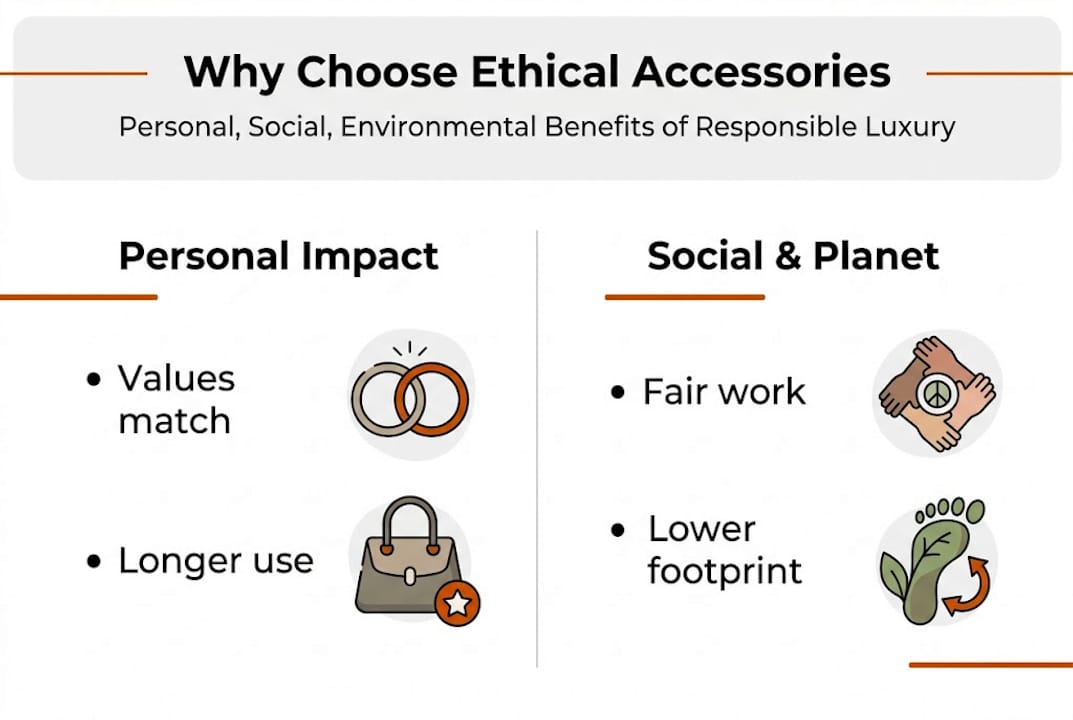
On a personal level, your accessories are expressions of your values as much as your aesthetic. There is a documented form of satisfaction that comes from purchasing something you can fully stand behind. It is different in quality from the temporary pleasure of a trend purchase. The accessory becomes part of a considered wardrobe rather than a seasonal discard, and that relationship with your belongings tends to feel richer and more rewarding over time.
On a social level, choosing ethically made accessories directly supports artisan livelihoods. In Italy, the leather goods industry supports tens of thousands of skilled craftspeople. When you choose a genuinely made-in-Italy piece, you are part of the economic system that keeps those workshops open, those skills alive, and those communities viable. Fair labour is not a footnote. It is the backbone of everything.
On an environmental level, responsible material sourcing and durable design reduce the volume of accessories that end up as waste. A full-grain leather bag that lasts thirty years does not need to be replaced three times. That is a meaningful environmental outcome, even before you consider the tanning and finishing processes involved.
Here is a practical checklist for assessing an accessory’s real-world impact:
- Can the brand name the workshop or region where this piece was made?
- Is the leather or material source verifiable and responsibly managed?
- Are the artisans covered by fair wage standards, confirmed by a third party?
- Is the design genuinely timeless, or is it trend-specific and likely to date?
- Does the brand offer repair or care guidance to extend the life of the piece?
The market data reinforces just how seriously affluent buyers are taking these questions. The sustainable luxury market is expanding at 9.9% annually, reflecting a structural shift in purchasing behaviour rather than a passing trend. This growth is being led by women over 35 who have both the resources and the discernment to choose differently.
| Impact area | What ethical choices achieve |
|---|---|
| Personal | Greater satisfaction, values alignment, investment-grade pieces |
| Social | Artisan income security, preservation of craft heritage |
| Environmental | Reduced waste, responsible material use, longer product lifespans |
| Economic | Supports brands building genuine ethical infrastructure |
For those who extend their conscious choices beyond accessories, reading about sustainable leather travel tips offers a natural extension of this thinking into how you travel and what you carry.
A new vision of luxury: what most overlook about ethical accessories
Most coverage of ethical luxury stops at the surface. It celebrates recycled materials, counts carbon credits, and moves on. What rarely gets said is this: ethical accessories are not a lesser version of luxury. They are a more evolved one.
The conventional view positions ethics as a sacrifice, something you accept in exchange for doing the right thing. We find that framing not just wrong but actively unhelpful. When you invest in a piece made by a named artisan in Florence, using leather from a tannery that has operated responsibly for decades, finished with hardware that will outlast you, you are not compromising on luxury. You are experiencing its fullest expression.
Trend-chasing and ethical investment are fundamentally incompatible. Not because ethical brands lack creativity, but because genuine quality is never seasonal. The timeless handbag icons that women still covet decades after their introduction were not made to chase a moment. They were made with the quiet confidence that good design endures.
There is also an emotional dimension to this that mainstream conversation consistently underestimates. Owning something you understand fully, something whose origins you can trace and whose makers you can respect, changes how you feel about carrying it. It becomes part of your story rather than a purchase you eventually forget. That is the version of luxury worth building towards.
Discover timeless ethical luxury with San Rocco Italia
If this guide has clarified what ethical accessories genuinely look like, the next step is finding them without compromise.
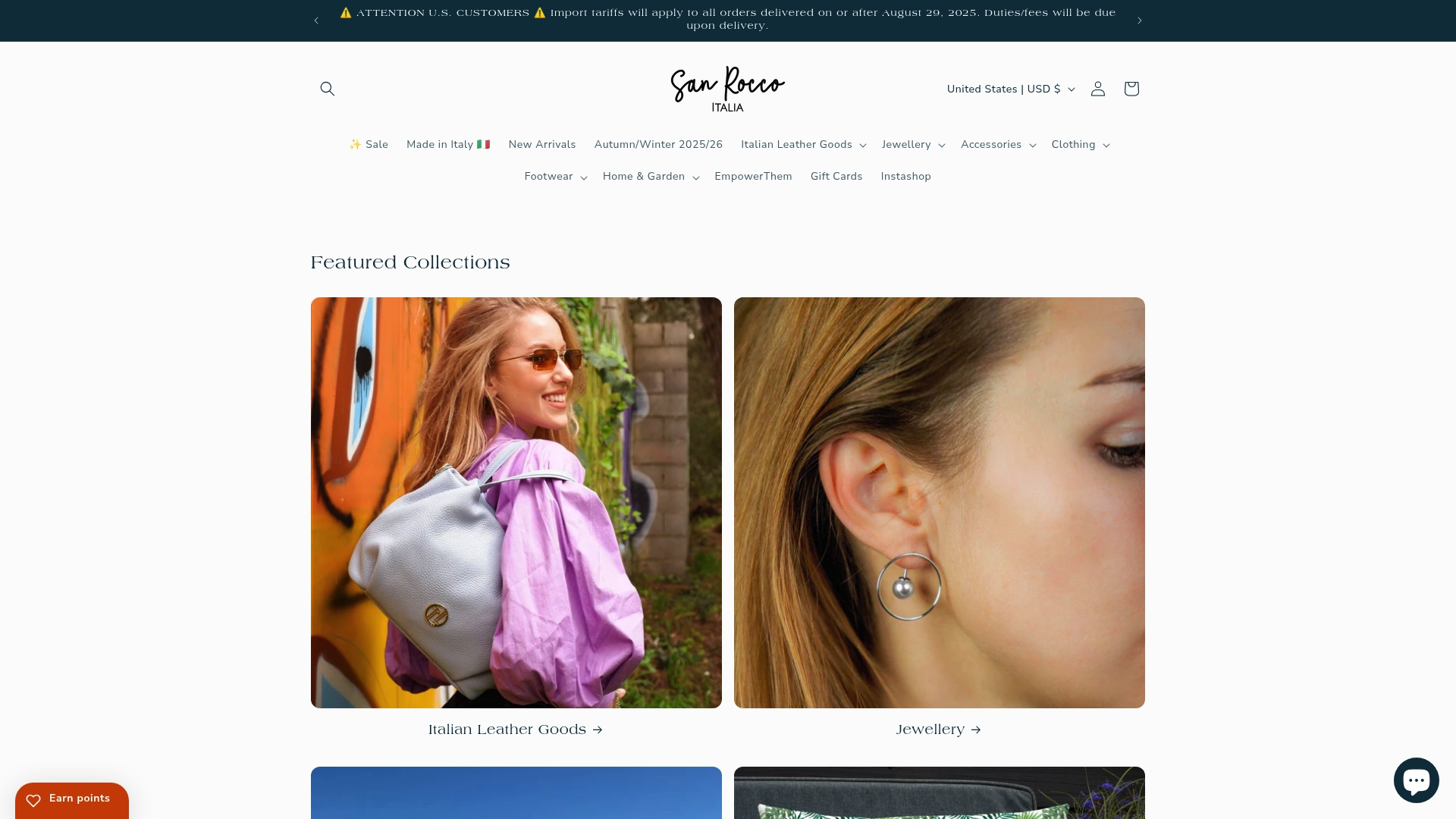
At San Rocco Italia, every handbag and leather good is made in Italy by skilled artisans using premium full-grain leather and traditional techniques. The brand was founded by a woman who believes that beautiful things should come from honest origins, and that conviction shapes every piece in the collection. The remainder of the curated range is sourced from trusted European makers chosen for quality and authenticity, not convenience. When you explore ethical Italian accessories at San Rocco Italia, you are not just shopping. You are making an informed investment in craftsmanship, heritage, and the kind of lasting beauty that no trend can touch.
Frequently asked questions
What makes an accessory truly ethical?
Genuine ethical accessories combine fair artisan treatment, transparent supply chains, and verified sustainable materials. True ethics requires transparent supply chains, increasingly confirmed through NFC technology or independent certifications rather than self-reported claims.
Is ethical luxury really worth the higher cost?
Yes, and the market agrees: 80% of consumers are willing to pay more for sustainable goods, citing stronger brand trust and long-term value. An ethically made piece that lasts decades also costs far less over time than repeated fast-fashion replacements.
How can I avoid buying greenwashed accessories?
Look for third-party certifications, full supply chain transparency, and artisan stories backed by traceable proof rather than vague brand language. If a brand cannot name its workshop or disclose its tannery, that opacity is itself an answer.
Why are Italian-made accessories seen as more ethical and luxurious?
Italy’s artisanal traditions favour fair wages, heirloom quality, and responsible sourcing, embodying both ethical and luxury standards in a single piece. The generational craft model keeps skill valued and production human in a way that industrial manufacturing structurally cannot replicate.
