


Why invest in European accessories: timeless value and quality
TL;DR:
- European luxury accessories are valued as long-term investments due to durable craftsmanship, brand reputation, and scarcity. Verifiable supply-chain traceability enhances their resale appeal, authenticity, and ethical standards. Successful investment relies on classic designs, meticulous maintenance, proper documentation, and honest assessment of restoration costs.
There is a quiet contradiction at the heart of luxury shopping. A beautifully crafted Italian handbag or a pair of hand-stitched leather gloves from a respected European atelier can feel like an indulgence, yet the evidence increasingly suggests these pieces behave less like splurges and more like carefully considered assets. European luxury accessories are often positioned as long-term investments because buyers expect quality, durability, and brand value that help them maintain worth over time. This guide moves beyond the headline claim and examines exactly how that process works, what can go wrong, and how to make genuinely informed choices.
Table of Contents
- Why European accessories are considered investment pieces
- Supply-chain traceability and regulatory compliance: the new value drivers
- Risks, restoration, and reality checks
- How to practically invest in European accessories: strategies and tips
- What most guides miss: a nuanced approach to investment in European accessories
- Explore Italian accessory excellence with San Rocco Italia
- Frequently asked questions
Key Takeaways
| Point | Details |
|---|---|
| Quality and durability | European accessories are valued for their superior craftsmanship, offering longevity and investment potential. |
| Traceability increases value | Supply-chain transparency and EU compliance now support resale value and authenticity in luxury accessories. |
| Beware restoration risks | Trend-driven purchases and costly restorations can undermine expected returns if not carefully managed. |
| Invest with strategy | Choosing classic, well-documented pieces maximises both enjoyment and potential future value. |
Why European accessories are considered investment pieces
Most conversations about luxury accessories focus on aesthetics. The cut of a leather strap, the weight of a well-made clasp, the silhouette of a structured bag. These are real pleasures. But the investment conversation begins in a different place entirely: durability, repairability, and the kind of craftsmanship that resists the passage of time rather than surrendering to it.
Mass-market accessories are designed within a fast-production model. Margins are protected by lowering material costs, automating stitching, and cycling through trend-led silhouettes every season. The result is a product that may look appealing at purchase and feel hollow eighteen months later, both aesthetically and structurally. European luxury accessories operate from an entirely different philosophy. Full-grain leather, hand-finished edges, brass hardware tested for longevity, and construction techniques passed between generations of artisans — these are not marketing phrases. They are the practical foundation upon which authenticity and value are built over years of ownership.
The investment logic also depends on brand reputation and scarcity. Established European houses cultivate desirability deliberately. Limited production runs, controlled distribution, and consistent design language mean that iconic pieces are not easily replaced by the next trend. Scarcity, combined with enduring demand, creates the resale conditions that allow certain accessories to hold or even appreciate in value. This is not speculation. Secondary markets for verified vintage and pre-owned European leather goods have grown steadily, rewarding buyers who chose classics over novelty.
“The pieces that hold value longest are those where craft, heritage, and restraint converge. They were never about the moment. They were always about decades.”
Key factors that underpin investment potential in European accessories:
- Full-grain leather construction: Develops a rich patina over time, improving appearance with age rather than deteriorating
- Repairability: Skilled artisans can replace hardware, re-stitch seams, and refinish surfaces, extending life considerably
- Classic design language: Avoids trend dependency and maintains appeal across changing seasons
- Provenance documentation: Original receipts, authenticity cards, and brand records support resale value
- Limited production: Controlled supply prevents market saturation and maintains desirability
Pro Tip: When building a collection for long-term value, focus on iconic silhouettes from established European houses rather than seasonal capsule releases. The bag that looked quietly elegant in 2005 often commands more respect on the secondary market than the piece that dominated social media in 2023. You can explore the Italian craft investment benefits behind this principle in more detail.
It is worth noting that most buyers underestimate how strongly provenance and craftsmanship influence long-term value. The origin of a bag, the name of the atelier, the region in Italy where the leather was tanned — these are not incidental details. They are the biography of an object, and that biography matters enormously to future buyers.
Supply-chain traceability and regulatory compliance: the new value drivers
Understanding what drives value is only part of the picture. The regulatory landscape across the European Union is now reshaping the investment thesis in ways that most buyers have not yet registered, but that will become increasingly significant over the next several years.
The EU’s Ecodesign for Sustainable Products Regulation (ESPR) and the Digital Product Passport (DPP) initiative are creating a framework in which every product sold in the European market may eventually need to carry verifiable information about its materials, origins, and production processes. For luxury accessories, this is not a burden. It is an advantage. Brands that have always maintained transparent supply chains, sourced leather from traceable origins, and documented their production practices are already positioned to meet these standards. As EU supply-chain traceability requirements increase through ESPR and related sustainability rules, the value of accessories with verifiable supply chains grows, favouring established European operators with compliance processes already in place.
The practical implication for buyers is significant. An accessory accompanied by full supply-chain documentation is not merely easier to resell. It is harder to counterfeit convincingly, more straightforward to authenticate, and more attractive to the growing segment of buyers who weigh ethical sourcing alongside aesthetics. Traceability and European leather standards now confer both ethical and financial benefits simultaneously.
Ferragamo’s approach offers a useful real-world illustration. The brand has publicly invested in mapping leather origins used in its products, acknowledging openly that leather is harder to trace than many textiles. This kind of transparency, while commercially demanding, signals seriousness to regulators and to informed buyers alike. It sets a standard that buyers can use as a benchmark when evaluating other brands.
Comparison: accessory supply chain types
| Feature | Fully traceable supply chain | Opaque supply chain |
|---|---|---|
| Material origin | Documented and verified | Unknown or unverifiable |
| Production location | Named atelier or facility | Generic or undisclosed |
| EU regulatory readiness | High | Low to medium |
| Fraud/counterfeit resistance | Strong | Weak |
| Resale appeal to informed buyers | Elevated | Reduced |
| Long-term investment security | Greater | Uncertain |
The table above makes visible what is often invisible at the point of purchase. Buyers who ask questions about supply-chain documentation before purchasing are not being overly demanding. They are applying the same due diligence that any sensible investor would bring to a financial decision. Supporting documentation for your purchase, including any available bag trends and documentation around production provenance, becomes part of the asset’s permanent record.
Risks, restoration, and reality checks
Investment thinking is only valuable if it is honest about risk. The luxury accessories market has genuine pitfalls, and glossing over them does buyers no favours.
The first reality check is that not all European accessories are equally investible. The label “made in Italy” covers an enormous range of quality, from pieces that genuinely meet the artisanal standard to items that technically cross the border for a finishing stitch. Brand reputation, specific model history, and material quality all determine whether a given piece has genuine investment credentials or simply benefits from geographic association.

Restoration costs present another genuine challenge. A well-maintained classic leather bag can often be brought back to excellent condition by a skilled artisan, and this can support resale value meaningfully. However, the arithmetic does not always favour restoration. If a bag requires new hardware, full re-stitching, dye refinishing, and structural repair, the combined cost can approach or exceed its realistic resale value. Investment framing can diverge from reality when restoration costs and authenticity risks outweigh resale or hold value — this is a genuine edge case that prospective investors need to understand.
Restoration ROI: indicative cost versus value scenarios
| Scenario | Restoration cost estimate | Estimated value gain | Net ROI |
|---|---|---|---|
| Icon bag, 1990s, minor wear | £150 to £300 | £500 to £1,200 | Positive |
| Classic bag, 2000s, moderate wear | £300 to £600 | £400 to £700 | Marginal |
| Trend piece, 2010s, heavy wear | £400 to £800 | £100 to £400 | Negative |
| Unknown maker, any era | £200 to £500 | Minimal | Strongly negative |
Authenticity concerns are a further layer of risk that buyers must treat seriously. The secondary market for luxury accessories is lucrative, which makes it attractive to counterfeiters. A piece purchased without proper documentation, or sourced through unverified channels, carries authentication risk at every subsequent resale. This is where the investment logic of provenance documentation, discussed earlier, becomes practically important rather than theoretically interesting. Understanding authenticity risks before you buy is not optional. It is essential.
Common risks worth tracking carefully:
- Trend dependency: Pieces that reflect a specific cultural moment rather than enduring design rarely hold value beyond that moment
- Over-restoration: Stripping original finishes or replacing original hardware can reduce collector appeal
- Documentation gaps: Missing receipts, cards, or original packaging lower resale value and raise authentication concerns
- Market saturation: Some “iconic” designs have been re-issued so frequently that secondary values have softened
- Storage neglect: Improper storage accelerates deterioration, sometimes irreversibly
Pro Tip: Before commissioning any restoration, obtain two or three independent valuations. If the combined quotes for handbag care and restoration work exceed forty percent of the piece’s estimated resale value, reconsider whether the investment logic genuinely holds. The goal is to support the piece, not to sink further capital into a diminishing return.
Thinking about ethical accessories also forms part of this honest calculation. A piece whose production methods were ethically sound from the outset is simply a better-rounded asset. It satisfies both the financial and the personal values dimension of ownership, and that alignment matters more than many buyers initially expect.
How to practically invest in European accessories: strategies and tips
Bringing clarity to the decision-making process makes the difference between a thoughtful collection and an expensive wardrobe with uncertain resale potential. Here is a practical framework for approaching European accessory investment with the rigour it deserves.
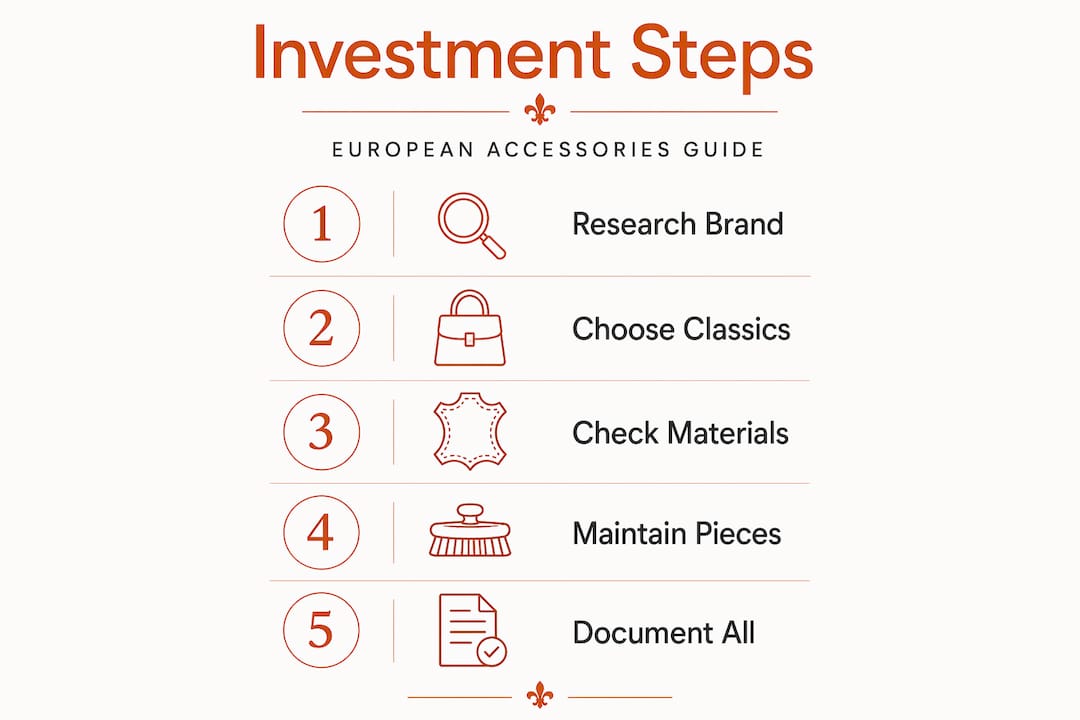
1. Research before you buy
Understand the brand’s history, its position in the secondary market, and which specific models have demonstrated value retention. What defines luxury is not simply a high price tag. It encompasses heritage, production standards, and market positioning. Use auction records, specialist resale platforms, and brand histories to build a picture of secondary demand before committing.
2. Prioritise classic, iconic designs
Seasonal pieces, collaborations, and trend-led designs rarely outperform classics on the secondary market. A clean, structured leather bag in a neutral colour from a brand with a long lineage will almost always represent a more resilient choice than this season’s limited-edition novelty. The boutique craftsmanship that defines these pieces is a measurable quality, not a feeling.
3. Inspect materials and construction
Full-grain leather, quality hardware, even stitching, and clean internal finishing are markers of genuine investment-grade construction. Ask specifically about the leather’s origin and tanning process. European accessories can justify investment thinking via craftsmanship durability and repairability, brand scarcity and reputation, and increasing compliance requirements that reward documented production systems.
4. Maintain rigorously
Store leather pieces in breathable dust bags, away from direct light and humidity. Condition regularly with products appropriate to the leather type. Maintain the original shape using tissue or a bag insert. These habits are not complicated. They are simply the difference between a piece that looks magnificent in twenty years and one that requires expensive intervention.
5. Document everything
Keep every piece of original documentation: receipts, authenticity cards, brand certificates, and original packaging. Photograph the piece from multiple angles when you purchase it. If provenance supports resale value — and it unquestionably does — then documentation is the physical record of that provenance.
6. Review and reassess periodically
Investment collections are not static. Review your pieces every few years in light of market conditions, brand developments, and your own priorities. This is not about chasing returns. It is about making considered decisions rather than passive ones.
Pro Tip: Build a simple record for each piece you own. Include the purchase date, retailer, price paid, condition notes, and any care or restoration work undertaken. This record transforms a beautiful accessory into a documented asset and makes future resale or insurance far more straightforward.
What most guides miss: a nuanced approach to investment in European accessories
Here is something that most investment guides for luxury accessories quietly sidestep: the investment narrative can be deeply misleading if you are not applying it carefully. Brands benefit from buyers believing their purchases will hold value. Market reports cite broad trends. But the actual outcome for any individual piece depends on specifics that no general guide can guarantee.
The uncomfortable truth is that investment value in European accessories is earned, not assumed. It requires the right brand, the right model, the right condition, the right documentation, and the right timing on any eventual resale. When all of those factors align, the results can be impressive. When even two or three are missing, the return evaporates. Actual outcomes depend on the specific product, condition, and whether the accessory’s market supports resale after restoration — this is a critical nuance that many glossy investment guides omit entirely.
What we have observed at San Rocco Italia, working with and alongside the women who invest thoughtfully in their wardrobes, is that the most successful approach is not speculative at all. It is rooted in genuine appreciation. The women who build collections that hold value are not primarily thinking about exit strategies. They are thinking about tradition in luxury bag making, about the pleasure of owning something made with real skill and intention, about the way a well-chosen piece becomes more personal and more beautiful with each year of use.
The financial dimension follows almost as a consequence of that approach, rather than preceding it. Pieces chosen for their lasting relevance, crafted from materials that improve with age, maintained with care and documented with diligence — these are the pieces that sustain their worth. The speculative buyer who chases whichever brand or silhouette is attracting attention tends to overpay, under-document, and find themselves holding something whose market has moved on.
Pro Tip: If you cannot imagine still loving a piece in fifteen years, it is probably not an investment. Real longevity in luxury accessories comes from the same source as real longevity in anything: an absence of compromise at every stage of its creation and care.
Explore Italian accessory excellence with San Rocco Italia
Knowing what to look for is the first step. Finding it is the second, and that is where sourcing from a trusted, values-driven boutique makes a genuine difference.
At San Rocco Italia, every piece in our collection is chosen with exactly the standards outlined in this guide in mind. Our handbags and leather goods are made in Italy by skilled artisans using premium full-grain leather and time-honoured construction techniques. The remainder of our European-sourced pieces come from makers chosen for authenticity, quality, and style rather than volume or price point. When you invest in an accessory through our curated Italian accessories boutique, you are not navigating an anonymous marketplace. You are buying from a woman-owned, craft-focused brand that stands behind every piece it offers.
Frequently asked questions
Are European accessories likely to retain their value over time?
Well-crafted, iconic European accessories typically hold value better than mass-market items, especially when sourced with full provenance and brand documentation. European luxury accessories are positioned as long-term investments precisely because quality, durability, and brand reputation support that expectation.
Does supply-chain transparency matter when investing in luxury accessories?
Yes, robust documentation and traceability increase the security and resale appeal of European accessories in light of new EU compliance standards. EU regulatory momentum around supply-chain verification actively favours brands and buyers with established documentation systems.
What are common risks when investing in European accessories?
Overpaying for trend-driven pieces and failing to account for restoration costs or authenticity issues can seriously undermine expected returns. Investment framing can diverge from reality when repairs, authenticity risks, or market softness outweigh the anticipated hold value.
What features should I prioritise when buying for investment?
Look for craftsmanship, brand reputation, compliance documentation, and classic design to maximise investment potential. Brand scarcity, repairability, and traceability are the three pillars that most reliably support long-term value in European accessories.
Recommended
- Investing in luxury bags: timeless value and Italian craft – San Rocco Italia
- Why choose ethical accessories: timeless, responsible luxury – San Rocco Italia
- European leather standards explained for luxury handbags – San Rocco Italia
- Blue Leather Purse: Defining Timeless European Luxury – San Rocco Italia



