


How tradition shapes luxury bag making: Italian craft
TL;DR:
- Italian artisanal tradition ensures genuine craftsmanship, quality, and unique character in luxury bags.
- Modern manufacturing focuses on consistency and scale, often reducing each piece’s individuality.
- Authentic traditional bags are valued for their historical techniques, sensory qualities, and emotional significance.
How tradition shapes luxury bag making: Italian craft
Not every expensive handbag tells a story worth owning. Walk into any high-end department store and you will find shelves lined with bags bearing four-figure price tags, each claiming to represent the pinnacle of luxury. Yet seasoned collectors know immediately that price alone is a deeply unreliable measure of quality. What separates a bag you treasure for decades from one that disappoints within a season is something far more nuanced: the presence or absence of genuine tradition. Italian artisanal tradition, in particular, carries a weight of knowledge, skill, and cultural memory that no price tag can manufacture. Understanding how that tradition operates, and what it actually produces, transforms the way you choose, wear, and pass on a luxury handbag.
Table of Contents
- Why tradition matters in luxury bag making
- Traditional craftsmanship vs modern innovation
- How Italian tradition shapes quality and exclusivity
- The emotional value of tradition for collectors and connoisseurs
- What most bag lovers miss about tradition
- Experience Italian tradition with San Rocco Italia
- Frequently asked questions
Key Takeaways
| Point | Details |
|---|---|
| Tradition signals authenticity | Bags made using time-honoured methods possess unique character and lasting appeal. |
| Heritage means exclusivity | Scarcity and artistry rooted in tradition create prestige and investment value for collectors. |
| Italian craft elevates luxury | Genuine Italian tradition ensures uncompromised quality and memorable emotional connection. |
| Modern vs tradition is nuanced | While innovation brings efficiency, tradition keeps alive the artistry and soul of luxury bags. |
Why tradition matters in luxury bag making
The word ‘tradition’ is used so liberally in luxury marketing that it has nearly lost its meaning. Brands slap heritage language onto everything from mass-produced totes to logo-heavy accessories, hoping the association alone will do the work. But tradition, in the truest sense of artisanal bag making, refers to something specific and verifiable: the intergenerational transfer of specialised knowledge, refined over decades or even centuries, that cannot be replicated by a machine or compressed into a training manual.
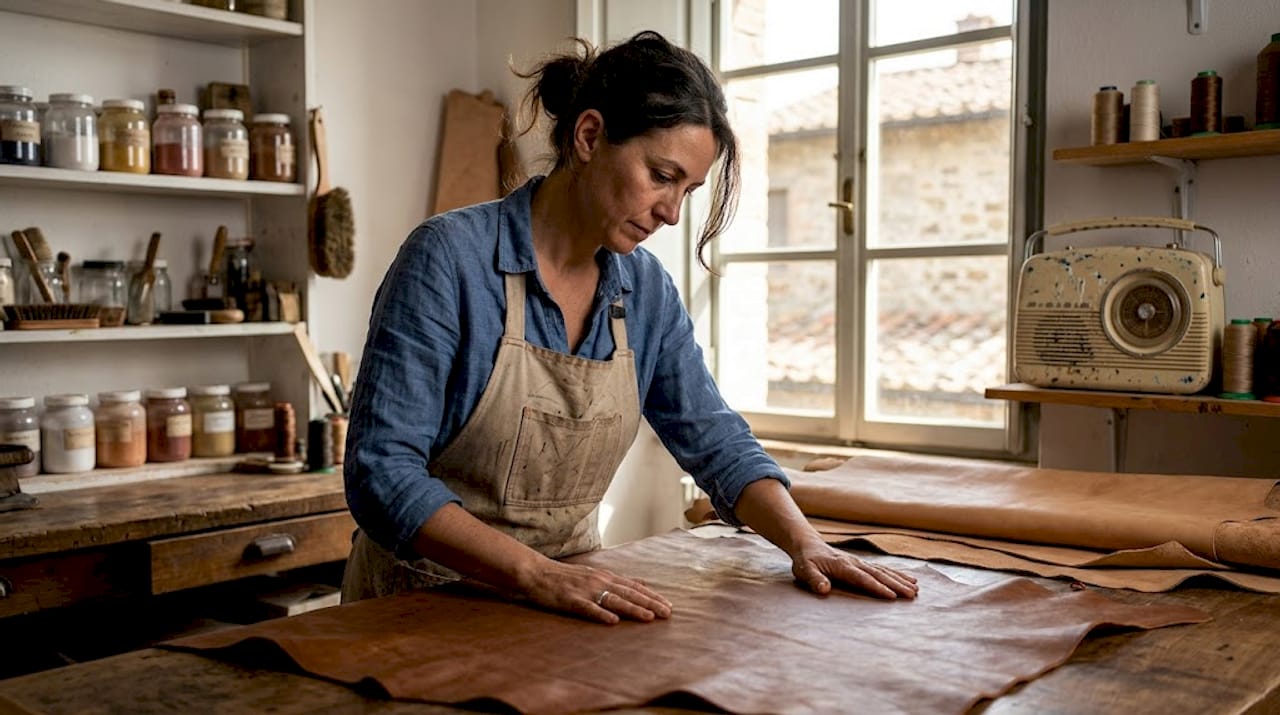
For luxury bag makers, tradition encompasses the tanning processes handed down within family-run tanneries in Tuscany, the hand-stitching methods taught master to apprentice in small Florentine ateliers, and the edge-finishing techniques that require years of muscle memory before they produce a truly clean result. These are not simply nostalgic practices preserved for aesthetic reasons. They are functional methods that genuinely produce superior outcomes: leather that ages beautifully, seams that do not fray, and hardware that sits flush and true for the life of the bag.
For the sophisticated buyer, tradition also carries significant emotional and status value. Owning a bag made through these processes is not just a purchase; it is a participation in something larger than oneself. It signals discernment. It communicates that you understand the difference between what is expensive and what is genuinely excellent. This distinction resonates deeply with women who have moved beyond the impulse buy and towards a more considered, curatorial approach to their wardrobes.
Tradition also functions as a trust signal in a market rife with ambiguity. As Dana Thomas has written about the world’s most enduring luxury houses, integrity in craftsmanship drives loyalty and prioritising products over profits is what sustains heritage against the tide of mass luxury. This insight cuts to the heart of why tradition matters: it places the integrity of the object above commercial convenience.
Understanding what makes a bag luxury begins precisely here, with the recognition that tradition is not a marketing strategy but a commitment to a way of working.
Key traditional artisan practices that define genuine luxury bags include:
- Hand-cutting leather panels using individual templates, ensuring each piece is shaped according to the grain and character of that specific hide
- Saddle stitching with two needles and waxed linen thread, producing a seam that holds even if one side is broken
- Vegetable tanning, a slow process using natural plant extracts that produces leather with depth, firmness, and exceptional patina over time
- Hand-painted edges applied in multiple layers, dried between each application, for a finish that is both durable and refined
- Hand-set hardware, positioned and secured by the artisan rather than pressed in by machine, ensuring alignment and longevity
“Integrity in craftsmanship drives loyalty; prioritising products over profits sustains heritage against mass luxury.” — Dana Thomas, author and luxury industry analyst
Pro Tip: When examining a bag for traditional craftsmanship, turn it inside out if possible and inspect the interior seams. Machine-stitched bags often show uniform, slightly mechanical spacing. Genuine saddle stitching has a subtle diagonal lean to alternate threads, the unmistakable signature of two-needle hand work.
Traditional craftsmanship vs modern innovation
Modern manufacturing has achieved extraordinary things. Computer-guided cutting tables eliminate waste. Bonded leather composites offer consistency at scale. Ultrasonic welding replaces stitching in performance accessories. These innovations serve legitimate purposes in many industries, and even within fashion they have their place. But in the context of fine handbags, the question is not whether modern methods are impressive. It is whether they produce the same result as heritage handcraft. And the honest answer is: no, they do not.
Heritage-focused brands operate on a fundamentally different logic from technology-centred manufacturers. Where a modern production facility prioritises consistency, throughput, and replicability, a heritage atelier prioritises the individual object. Every bag that leaves a traditional workshop is, in a genuine sense, unique. The grain pattern of the leather is unrepeatable. The hand of the artisan who stitched it leaves a subtle signature. Even minor variations in edge colour or handle tension are accepted as part of the character of the piece, not defects to be corrected.
Modern innovation, by contrast, is largely in the service of elimination: eliminating variation, eliminating time, eliminating cost per unit. The result is a product that is technically excellent and visually consistent but lacks the depth that comes from human engagement. You can examine two bags from a high-volume modern production line and find them virtually identical. Two bags from a traditional Italian atelier, made in the same week by the same artisan, will differ in ways that are subtle but real, and those differences are part of what you are paying for.
The Hermès example is instructive here. The house’s deliberate limitation of output, its resistance to scaling Birkin and Kelly production despite overwhelming demand, is not simply a clever scarcity play. As discussions of Prada’s manufacturing evolution have noted, tradition limits scale in ways that modern engineering for consistency cannot replicate, and purists prefer heritage character over technical perfection. Scarcity, in this context, is the natural consequence of doing things properly.
For those exploring luxury vs mass-produced bags, the comparison table below clarifies the core differences:
| Feature | Traditional heritage craft | Modern innovation |
|---|---|---|
| Production volume | Limited, atelier-controlled | High, factory-scaled |
| Material character | Variable, individual hides | Standardised, treated composites |
| Stitching method | Hand saddle-stitched | Machine or ultrasonic |
| Finish quality | Hand-painted, multi-layer | Sprayed or bonded |
| Ageing behaviour | Rich patina, improves over time | Fades or peels with wear |
| Repairability | Fully rebuildable by hand | Often difficult to repair |
| Uniqueness | Each piece varies naturally | Near-identical replication |
What purists notice when choosing between the two approaches:
- The weight of the leather — full-grain vegetable-tanned hide has a substance that bonded or corrected leather simply cannot replicate
- The smell — genuine natural leather has a complex, warm scent; treated composites smell chemically flat
- The stitching tension — hand-sewn seams feel firm but yielding; machine stitching can feel rigid or uneven under the fingers
- The hardware movement — hand-set clasps and rings have a precise, smooth action; machine-pressed hardware can feel slightly loose or stiff
- The interior finish — traditional bags line their interiors with care, often using suede or fine cotton in colours that complement the exterior
- The provenance documentation — heritage ateliers typically include cards, stamps, or certificates identifying the region and, in some cases, the workshop
How Italian tradition shapes quality and exclusivity
Italy’s position at the summit of leather goods craftsmanship is not accidental. It is the product of centuries of accumulated expertise, a thriving network of specialist suppliers, and a culture that genuinely prizes the well-made object. The Tuscan region alone is home to some of the world’s most respected tanneries, many of which have operated continuously for over a century, refining their processes across multiple generations.
The techniques that Italian artisans practise are not merely old; they are optimal. Vegetable tanning, for instance, takes between 30 and 60 days to complete using traditional pit methods. Chrome tanning, the industrial alternative, achieves a similar surface result in hours. But the leather produced by the two processes is profoundly different. Vegetable-tanned leather is firmer, develops a richer patina with age and use, and responds well to conditioning and repair. It is also the material of choice for any bag intended to last a lifetime. Understanding the history of luxury handbags reveals that the finest houses have always specified vegetable tanning precisely because of these long-term qualities.
Hand stitching is another area where Italian tradition produces measurably superior results. The saddle stitch, performed with two needles working simultaneously through pre-punched holes, creates a figure-of-eight thread path that locks itself in place. If one thread breaks, the other holds. Machine stitching, by contrast, uses a looped thread structure that can unravel progressively if a single point is compromised. For a bag carried daily and loaded with the weight of a full life, this distinction matters enormously.
Edge painting is a further discipline that rewards the traditional approach. A well-finished edge is built up through four to six applications of hand-applied paint or wax, each dried before the next is added, then burnished smooth. This creates a surface that flexes with the leather without cracking, retains its colour, and protects the raw edge from moisture. Bags that use machine-applied single-coat edge treatment show wear far more quickly, and often cannot be easily refinished.
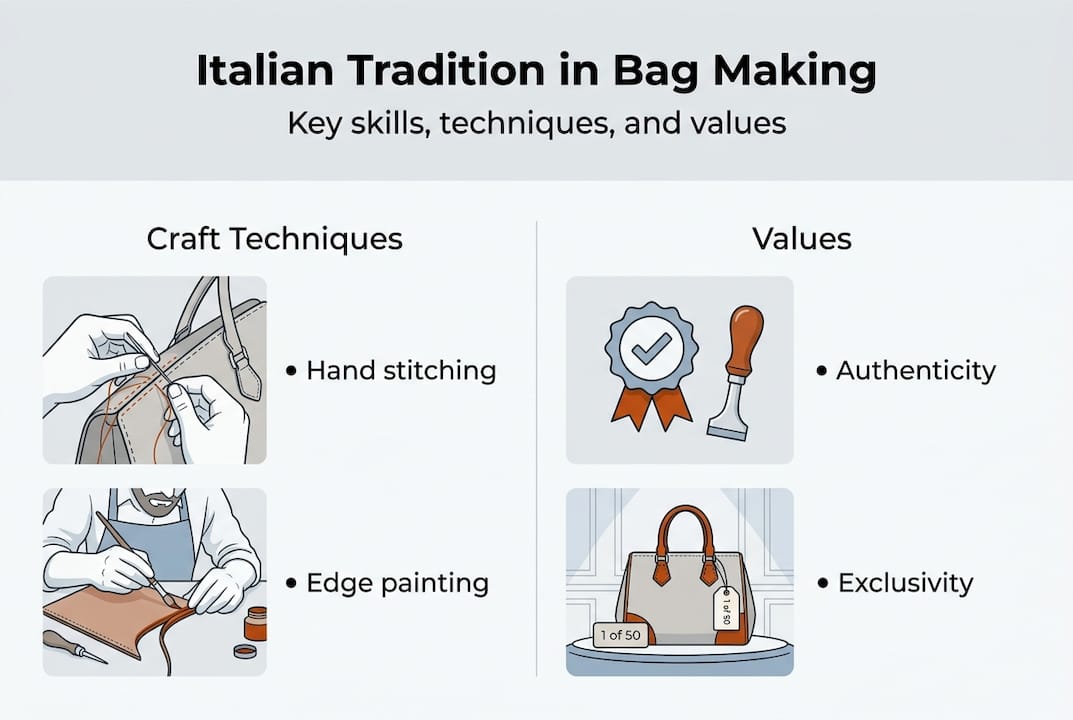
As with Italian vs French leather bags, the distinction in outcome is visible to any trained eye. Italian tradition also begets exclusivity through the natural constraints of skilled labour. A master artisan can produce only a limited number of bags per month, and the apprenticeship system means that expertise cannot be rushed or manufactured. This creates genuine scarcity, not artificial marketing scarcity, but the real kind that results from doing things properly.
The craftsmanship integrity noted in studies of heritage houses reinforces this point: prioritising products over profits is what sustains heritage and produces the quality that collectors trust.
Signs of genuine Italian artisanal quality:
- Provenance clearly stated, with region, tannery, or atelier identified
- Full-grain leather with natural grain variation visible across the surface
- Hand-stitched seams with the characteristic diagonal thread pattern of saddle stitching
- Burnished or multi-coat painted edges, firm and smooth to the touch
- Structured interior architecture, with shaped bases, reinforced corners, and quality lining
- Weight and substance that reflects the density of genuinely tanned leather
Pro Tip: When considering an Italian-made bag, ask the seller or brand three specific questions: Where was the leather tanned, and by what method? Was the bag hand-stitched or machine-stitched? Can you provide documentation of the atelier or workshop? A reputable house with genuine traditional credentials will answer these questions without hesitation.
The emotional value of tradition for collectors and connoisseurs
There is a dimension of tradition in luxury bags that goes beyond the technical and the tangible. For seasoned collectors, the emotional resonance of owning an object made through centuries-old methods, by hands that learned from other hands, is a significant part of its value. This is not sentiment for its own sake. It is a recognition that some objects carry meaning in ways that transcend their material composition.
Collecting traditionally made Italian bags is, in many ways, a form of storytelling. Each bag in a serious collection represents a chapter: a moment of decision, a reward for achievement, a gift from someone who understood your taste, or a deliberate investment in beauty that will outlast trends. The bag itself becomes a record of the life lived alongside it, acquiring scratches and patina that are not flaws but evidence. This is something a bag made on a production line, with components sourced from a dozen different countries and assembled by process rather than person, simply cannot offer.
The emotional benefits that tradition confers on the collector include:
- Pride of ownership rooted in knowing the object was made with genuine skill and care
- A sense of belonging to a longer tradition of discerning women who have prized craft over logo
- Nostalgia and continuity, particularly when a bag has been passed from mother to daughter across generations
- Confidence in value, both financial and personal, knowing that quality made this way holds and often appreciates
- Narrative richness, the ability to tell the story of where, how, and by whom your bag was made
- Generational gifting, the pleasure of giving something that will still be beautiful and functional decades from now
The logic of investing in luxury bags is underpinned by this emotional dimension. A bag that holds its integrity over time, that can be restored and re-loved by the next generation, is not just an accessory. It is an heirloom in the making.
“Integrity in craftsmanship drives loyalty; prioritising products over profits sustains heritage against mass luxury.” — Dana Thomas
This loyalty, built through generations of makers and collectors alike, is what gives tradition its most enduring power. It is not nostalgia. It is trust, earned slowly and expressed through objects that last.
What most bag lovers miss about tradition
Here is the uncomfortable truth that even experienced luxury buyers often overlook: modern perfection can be deeply misleading. A bag with immaculate, machine-even stitching, a surface so uniform it looks almost digital, and hardware so precisely placed it appears manufactured by algorithm might feel like superior quality. It is not. What you are seeing is the absence of the human hand, and in the world of true artisanal luxury, that absence is a loss, not an achievement.
Authentic traditional bags carry what Italians sometimes call difetti nobili, noble imperfections. A slight variation in stitch spacing. A grain pattern that deepens unevenly as the bag ages. A handle that develops a slightly different tone from the body of the bag because it receives more oil from your hand. These are not defects. They are the evidence of materials behaving as nature intended and of human skill at work rather than mechanical repetition.
The mistake many buyers make, even knowledgeable ones, is to confuse legibility with quality. A prominent logo, a price point that signals status, and a finish that photographs beautifully are all legible signals. They communicate luxury at a glance. But the deeper qualities of a truly traditional bag, its structural integrity, the way the leather moves, the firmness of the edge finish, the precision of the stitching tension, are things you feel before you see.
Practical advice: stop leading with your eyes and start leading with your hands. Pick up the bag. Feel the weight. Run your thumb along the edge finish. Press the hardware. Open and close the clasp ten times. Smell the interior. These sensory tests tell you far more than any marketing language. Understanding what makes a handbag luxury at this level moves your collecting from trend-following into something that genuinely lasts: a legacy of objects chosen with knowledge, not just taste.
Experience Italian tradition with San Rocco Italia
Understanding tradition at this depth changes what you look for and what you will settle for. It raises the standard, rightly, and points you towards makers who are genuinely committed to the craft rather than simply borrowing its language.

At San Rocco Italia, every handbag and leather good in our collection is made in Italy by skilled artisans using premium full-grain leather and the traditional techniques this article has explored. We are a woman-owned boutique with a straightforward commitment: to offer bags that justify the investment with genuine craftsmanship, not marketing. Our collection is curated rather than vast, because we believe depth matters more than breadth. Whether you are building a serious collection or seeking your first truly made-in-Italy piece, we invite you to explore what Italian artisanal craftsmanship looks and feels like when it is done with complete integrity.
Frequently asked questions
What makes an Italian artisan bag traditional?
Traditional Italian bags are crafted using heritage techniques such as hand-stitching and vegetable tanning, overseen by expert artisans, with the integrity of craftsmanship placed above volume and commercial speed.
Why is tradition important in luxury bags?
Tradition ensures every luxury bag maintains a unique identity, trusted quality, and lasting value recognised by collectors worldwide, because makers who prioritise heritage over mass production create objects that genuinely endure.
Is a traditional bag always better than a modern one?
Traditional bags offer unique character and exclusivity, while modern methods prioritise consistency and scale — as discussions of Prada’s manufacturing history have shown, purists often prefer heritage character over technical uniformity.
How do I verify a bag’s traditional craftsmanship?
Look for hand-finished details such as saddle-stitched seams, natural leather smell, multi-coat painted edges, and clear provenance from a named artisan atelier or tannery.



