


How to recognise authentic Italian home décor craftsmanship
TL;DR:
- Authentic Italian craftsmanship reflects centuries of tradition, emphasizing durability, aging, and signature imperfections.
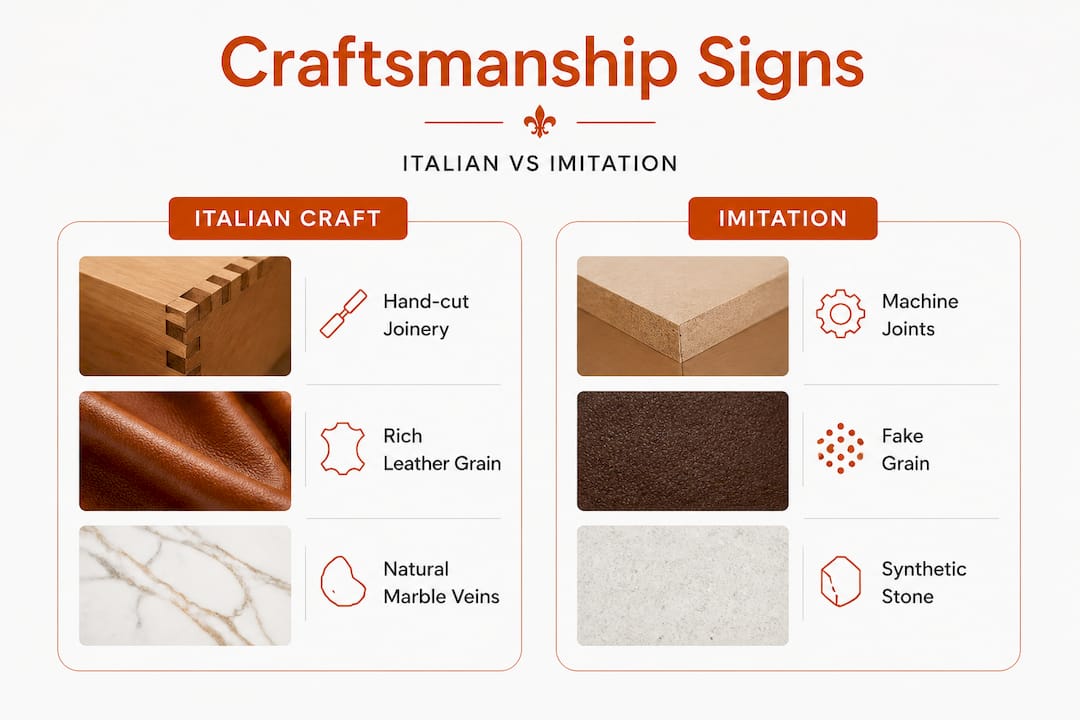
- Physical signs include hand-cut joints, natural leather textures, visible veining in marble, and subtle surface variations.
- Verifying provenance through certifications like UNI 11674, COSMOB, and detailed documentation is essential for confirmation.
There is a persistent and costly misconception in the luxury décor world: that a “Made in Italy” label is sufficient proof of genuine craftsmanship. It is not. The global market for home furnishings and accessories is saturated with pieces that bear Italian-sounding names, reference Italian regions, or carry vague origin labels that obscure far more than they reveal. For discerning buyers who want their homes to reflect genuine heritage and lasting quality, the ability to distinguish true artisanal Italian work from an attractive imitation is not a luxury skill — it is an essential one. This guide gives you the concrete frameworks to do exactly that.
Table of Contents
- Why home décor authenticity matters
- Key signs of authentic Italian craftsmanship
- How to confirm provenance: certifications and documentation
- Decoding materials: what sets Italian luxury apart
- Expert tips for avoiding imitation
- Our perspective: what most guides miss about authenticity
- How to source authentic Italian décor with confidence
- Frequently asked questions
Key Takeaways
| Point | Details |
|---|---|
| Look for tactile details | Inspection of construction, stitching, and material texture reveals true Italian artisanship. |
| Demand documented provenance | Insist on certifications, certificates, and maker’s marks to confirm genuine Italian origin. |
| Material matters | Premium materials like Carrara marble and Tuscan leather, paired with FSC or PEFC certification, signal luxury and authenticity. |
| Rely on reputable sources | Only buy from trusted dealers with a clear, transparent supply chain and proven heritage. |
Why home décor authenticity matters
As buyers look beyond surface appeal, it is vital to redefine what makes a piece truly authentic. Authenticity in home décor is not a marketing concept. It is a commitment to cultural heritage, material integrity, and generational value. When you invest in a genuinely handcrafted Italian piece, you are acquiring something that carries the knowledge of artisans who have refined their techniques over centuries. That knowledge is embedded in every joint, every surface treatment, every material choice.
“Durability and timelessness define authentic pieces — they are built to be repaired, restored, and passed down rather than replaced.”
This is a fundamentally different approach to objects than the disposable aesthetics of mass production. A handcrafted Italian cabinet or ceramic piece is meant to improve with age, not deteriorate. The patina that develops on a well-made leather surface or a hand-finished wooden table tells a story that factory-produced replicas simply cannot replicate.
Understanding Italian décor style principles reveals that the Italian design philosophy has always prioritised longevity over trend. This orientation towards lasting beauty is precisely why authentic pieces hold and often increase their value over time. Imitations, by contrast, rarely appreciate, and frequently deteriorate in ways that are costly and irreversible.
The practical consequences of choosing imitation over authenticity extend well beyond aesthetics. Here is what is genuinely at stake:
- Investment value: Authentic pieces command premium resale prices and can be insured as valuables; imitations cannot.
- Repairability: Genuine materials and joinery can be restored by skilled craftspeople; synthetic or poorly constructed alternatives often cannot.
- Health and environmental impact: Authentic Italian pieces typically use natural materials with lower chemical off-gassing than mass-produced equivalents.
- Aesthetic coherence: Genuine pieces contribute to a curated interior that reflects considered taste; imitations often clash subtly with genuine items.
- Emotional resonance: Knowing the provenance of a piece adds meaning to your home — something thoughtful décor selection recognises as central to a well-composed interior.
The decision to prioritise authentic Italian craftsmanship is not extravagance for its own sake. It is a deliberate, informed choice to invest in objects that honour both your home and the heritage behind them.
Key signs of authentic Italian craftsmanship
With an understanding of why authenticity matters, let us explore how to recognise the genuine article through its physical details. The good news is that genuine Italian craftsmanship leaves clear, tangible evidence. You do not need specialist training to spot the most telling signs — you need patience, curiosity, and a willingness to look closely.

Verified Italian techniques include hand-cut dovetail joints, precise hand-stitching, full-grain textures, and the subtle irregularities that confirm human hands were involved in creation. These are not flaws — they are signatures.
What to look for: a ranked guide
-
Joinery in wooden pieces: Turn furniture upside down or look at the interior corners of drawers. Authentic Italian woodwork uses hand-cut dovetail joints (where interlocking wedge-shaped pieces of wood hold a drawer together) or mortise-and-tenon joints (where a projecting piece fits into a corresponding cavity). Machine-cut joints are uniform to an almost eerie degree; hand-cut ones show slight variation in spacing and angle.
-
Stitching on leather goods and upholstery: Hand-stitching on genuine Italian leather pieces sits evenly but not robotically. Each stitch is consistent in direction and tension, but under close inspection you will notice tiny, natural variations. Machine stitching, by contrast, is metronomic and often slightly tighter on one side than the other due to mechanical tension differences.
-
Surface texture and material feel: Full-grain leather retains the natural surface of the hide, including subtle variations in grain pattern, small natural marks, and a warmth to the touch that corrected or bonded leathers simply do not possess. Genuine marble has veining that runs through the stone, not merely across the surface — a detail you can verify by examining the edges of a piece.
-
Subtle imperfections: This is the most counterintuitive sign for many buyers. Perfection is suspicious. A hand-thrown ceramic bowl that is fractionally asymmetric, a wooden panel where the grain required a slightly different routing approach, a leather edge that shows a human decision in its burnishing — these are the marks of genuine craft. Explore our Italian craftsmanship guide for deeper examples of what these details look like across different categories.
-
Finishing quality: Authentic pieces are finished with restraint and confidence. The lacquer on a genuine Italian console table will be thin enough to show the wood beneath it; the paint on a Florentine ceramic will sit within the piece rather than sitting on top of it like a coating.
Pro Tip: When evaluating a leather piece, hold it near a natural light source and tilt it at different angles. Genuine full-grain leather will show subtle changes in how light catches the surface — this is the natural topography of the hide. Corrected leather, which has been sanded and coated, looks uniform regardless of the angle. You can learn more about this through our resource on traditional Italian artisans.
| Feature | Authentic Italian craft | Mass-produced imitation |
|---|---|---|
| Joinery | Hand-cut, slight variation | Machine-perfect, uniform |
| Leather surface | Full-grain, natural variation | Corrected or bonded, uniform |
| Stitching | Even but subtly varied | Metronomic, mechanical |
| Marble veining | Runs through the stone | Surface-printed or applied |
| Finish | Thin, shows material beneath | Thick, masks material beneath |
| Imperfections | Present, intentional | Absent or artificially added |
How to confirm provenance: certifications and documentation
Spotting craft techniques is crucial, yet authenticating Italian origin requires formal verification. Physical inspection tells you a great deal, but it cannot confirm where a piece was actually made. For that, you need documentation — and knowing which documents carry genuine weight is essential.
The UNI 11674:2017 standard, alongside voluntary certification marks like IT01, and verification by independent laboratories such as COSMOB and CATAS, represents the most rigorous proof of Italian origin currently available. These are not self-declared labels; they involve third-party audits of the production process, material sourcing, and manufacturing location.
CATAS certification goes further still, with documentation that specifies the manufacturer’s location, production date, materials used, and the artisan or studio responsible for the piece. This paper trail is precisely what distinguishes a provenance-verified Italian piece from one that merely claims Italian heritage.
When you are considering a significant purchase, request the following:
- Certificate of authenticity: This should name the manufacturer, their location within Italy, and the specific piece being certified.
- Material provenance documents: For leather, this means confirmation of the tannery of origin (ideally within Tuscany, where the Conceria certification system operates). For marble, confirmation of the quarry.
- Production method documentation: A description of which techniques were used, ideally referencing the artisan or workshop responsible.
- Maker’s mark or studio stamp: Physical marks on the piece itself, cross-referenced with the documentation.
| Certification | Issuing body | What it confirms |
|---|---|---|
| UNI 11674:2017 | Italian National Standards Body | Full production within Italy |
| IT01 mark | Voluntary industry scheme | Italian-made, audited claim |
| COSMOB certification | COSMOB laboratory, Pesaro | Materials and construction standards |
| CATAS certification | CATAS laboratory, Udine | Origin, materials, production process |
| Confartigianato mark | Italian craftspeople’s association | Genuine artisan production |
Sourcing from retailers who prioritise authentic Italian provenance is the most practical shortcut for buyers who do not wish to navigate this documentation landscape alone. A trusted retailer handles this verification process on your behalf, presenting you with pieces that have already passed scrutiny.
Decoding materials: what sets Italian luxury apart
Authenticity is not just about origin — material quality is central to Italian luxury. Italian artisans are famously selective about their raw materials, and this selectivity is not merely aesthetic. It reflects a deep understanding of how materials age, how they respond to use, and how they interact with the environments they inhabit.
Solid walnut can be refinished multiple times across decades, making it a genuinely long-term investment. Carrara marble, quarried in Tuscany, has a specific crystalline structure that gives it a translucency no engineered stone can replicate. Timber certified by the FSC (Forest Stewardship Council) or PEFC (Programme for the Endorsement of Forest Certification) guarantees that the wood was responsibly sourced — a consideration increasingly important to buyers who care about both quality and conscience.
Here is how to distinguish premium Italian materials from substitutes:
- Leather: Genuine Tuscan leather has a distinctive, clean, slightly sweet aroma when new. It feels supple but structured. Identifying authentic Italian leather involves checking the cut edges — full-grain leather will show the natural layers of the hide, while bonded leather reveals a fibrous, composite interior.
- Marble: Run your fingertips across the surface. Genuine Carrara marble is cool, faintly rough at a microscopic level, and the veining will feel ever so slightly raised or recessed relative to the surrounding stone. Printed or resin-composite surfaces are uniformly flat.
- Solid vs engineered wood: Solid wood is not always superior — engineered wood (layers of real wood veneer bonded over a stable core) is actually more dimensionally stable for large table tops and is used extensively by reputable Italian manufacturers. The distinction matters for refinishing and repair potential, not for authenticity itself.
- Natural stone ceramics: Authentic Italian ceramics from regions like Faenza or Deruta use locally sourced clays and mineral-based glazes. The colour palette tends towards earthy, slightly muted tones — deep terracotta, warm ivory, cobalt — rather than the saturated primaries of industrial production.
Pro Tip: Ask for the name of the specific tannery, quarry, or timber supplier when purchasing high-value pieces. Reputable Italian artisans and retailers know exactly where their materials come from and will share this information readily. Reluctance to name sources is itself a red flag. You can explore the full context of material quality in our Italian leather luxury guide, which covers how tanning methods affect both quality and longevity.
When you consider how to incorporate these materials into your home, practical décor ideas for well-composed spaces consistently recommend anchoring a room with one or two genuinely high-quality material pieces rather than attempting to fill a space with numerous lesser items. Italian artisans would agree with this philosophy entirely.
Expert tips for avoiding imitation
Armed with this knowledge, affluent buyers can confidently select décor that truly reflects Italian heritage whilst avoiding the pitfalls that catch even experienced collectors. The luxury décor market is sophisticated precisely because imitations have become more convincing. The response is not suspicion but methodical, confident verification.
“Experts consistently advise buying only from reputable dealers, inspecting pieces in person, and prioritising voluntary certifications over surface-level labels when assessing Italian authenticity.”
This advice is grounded in practical reality. The following steps form a reliable framework for any significant purchase:
-
Visit a showroom or request a physical sample. Photographs, however well-produced, cannot convey the weight, texture, or aroma of a genuine piece. A reputable retailer will always accommodate an in-person inspection or provide material samples for leather and fabric pieces.
-
Request the full certification portfolio before committing. If a seller cannot produce UNI, COSMOB, or CATAS documentation — or a comparable provenance trail — treat this as a serious concern rather than a minor omission.
-
Examine artisan marks systematically. Look for maker’s stamps, workshop signatures, or regional hallmarks. These marks should correspond with the documentation provided. Cross-reference the studio name against Italian craft directories if you have any doubt.
-
Be wary of over-polished perfection. A piece that looks entirely flawless, with no variation in grain, stitching, or surface texture, is almost certainly machine-produced. Genuine Italian craft has confidence — it does not need to hide behind a coating of artificial uniformity.
-
Match material to intended use. An authentic Italian artisan will guide you toward the right material for your context. Marble for a fireplace surround, solid oak for a dining table that will bear weight and use over decades, full-grain leather for pieces that will be touched and appreciated daily. Inappropriate material choices — leather that is too thin for upholstery, marble that is too porous for a kitchen surface — signal a retailer more focused on aesthetics than on genuine craft knowledge.
-
Understand the San Rocco Italia standard for what a committed provenance approach looks like in practice. Brands that take craftsmanship seriously are transparent about their sourcing, production methods, and the artisans they work with.
Pro Tip: Before any significant purchase, spend ten minutes researching the retailer’s supply chain. A brand that names its workshops, shares photographs of its production process, and openly discusses its artisan relationships is doing exactly what a genuine purveyor of Italian craftsmanship should do. Vagueness at this level is always worth investigating further. For insights into functional home décor, consider how authenticity supports not just aesthetics but practical, lasting use.
Our perspective: what most guides miss about authenticity
Most articles on this subject focus heavily on what to look for in a piece — the joints, the stitching, the grain. This is useful, necessary even, but it misses something more fundamental. The most reliable signal of genuine Italian craftsmanship is not any single physical detail. It is the coherence of the entire story surrounding a piece.
Genuine Italian luxury has always been sustained by lineage and storytelling. The workshop in Pesaro that has been making the same style of cabinet since the 1950s does not need to shout about its heritage — it is embedded in every decision from material selection to finishing technique. When a retailer can tell you the name of the artisan, the name of the workshop, and the name of the supplier who provided the timber or leather, that coherence is itself the strongest assurance you can receive.
We find that buyers often underestimate the importance of full documentation, partly because it feels bureaucratic alongside the visceral pleasure of selecting a beautiful object. But documentation is not bureaucracy — it is respect. A maker who provides a complete provenance record is telling you that they stand fully behind every decision that went into creating the piece. That confidence is rare, and it is worth seeking.
There is also a subtle but important distinction between heritage claims and heritage reality. Many brands reference Italian culture, Italian regions, or Italian aesthetic traditions without any verifiable Italian production. This is not necessarily dishonest, but it is not the same as genuine Italian craft. The cultural influence on Italian design runs deeper than aesthetic borrowing — it is about a philosophy of making that values the object for its own integrity, not its commercial appeal.
What we believe most strongly, from years of working with genuine Italian artisans and makers, is this: authentic Italian craft is understated. It does not announce itself. It does not need to. The quality is evident to anyone who takes the time to look carefully, touch deliberately, and ask the right questions. Our role, and the role of any serious purveyor in this space, is to make that process as transparent and accessible as possible.
How to source authentic Italian décor with confidence
With knowledge in hand, choosing authentic décor should be an empowering, rewarding process rather than an anxious one.
At San Rocco Italia, we believe that provenance should never be a question mark. Every piece in our collection that carries Italian origin comes with transparent sourcing, artisan relationships we maintain directly, and the documentation to back every claim we make.

Our curated Italian collection brings together luxury leather goods and accessories from skilled Italian artisans using premium full-grain leather and traditional techniques — the same hallmarks this guide has outlined. We are a woman-owned boutique, and our commitment to authenticity is personal. We source only from makers whose workshops we know, whose techniques we have verified, and whose materials meet the standards our clients deserve. When you choose a piece through San Rocco Italia, you are choosing with confidence, backed by the full provenance story. Browse our collection and experience the difference that genuine Italian craftsmanship makes.
Frequently asked questions
What is the most reliable certification for Italian home décor authenticity?
The UNI 11674:2017 standard, verified by independent laboratories such as COSMOB and CATAS, is currently the most rigorous proof of Italian origin available for furniture and décor pieces. It involves third-party auditing rather than self-declaration.
Can I check the authenticity of Italian décor without visiting Italy?
Yes. By requesting certificates of authenticity that detail the manufacturer’s location, production date, and materials used, alongside inspecting artisan marks on the piece itself, you can verify provenance reliably from anywhere in the world.
Do solid or engineered woods better indicate Italian authenticity?
Both solid and engineered woods appear in authentic Italian pieces; the choice depends on the intended application and required stability. Material type alone does not determine authenticity — the quality of the material and the skill of its application do.
What are the signs of a fake Italian décor piece?
Key warning signs include the absence of provenance documentation, machine-perfect finishes with no natural variation, synthetic or composite materials presented as natural, and a complete lack of the subtle imperfections that confirm genuine handcraft. When in doubt, ask for the full certification trail.



