


Artisanal luxury: the true meaning behind exceptional craft
TL;DR:
- Artisanal luxury emphasizes craftsmanship, tradition, and human involvement over mere exclusivity and high prices. Genuine pieces are identified by named makers, documented processes, and high-quality materials, contrasting mass-produced goods’ uniformity and automation. The future of luxury lies in valuing depth, story, and durability rather than logo recognition or transient trends.
There is a persistent assumption in luxury culture that a higher price tag is the surest sign of quality. Many buyers have walked away from boutiques carrying bags that cost a small fortune, only to watch the stitching separate within a year or the hardware tarnish by the following season. Artisanal luxury is defined not by exclusivity or cost, but by the maker’s imprint, skill honed over a lifetime, and the time and patience invested in each piece. Understanding this distinction is not merely academic. For women who buy carefully and carry their choices with confidence, it changes everything about how you shop, what you keep, and why it matters.
Table of Contents
- What artisanal luxury really means
- How artisanal luxury sets itself apart from mass-produced goods
- How to spot genuine artisanal luxury (and avoid ‘craftwashing’)
- The Italian standard: why heritage matters in artisanal luxury
- Beyond the price tag: why craftsmanship, not cost, creates real value
- Why craftsmanship and story outshine the logo in modern luxury
- Experience authentic Italian artisanal luxury
- Frequently asked questions
Key Takeaways
| Point | Details |
|---|---|
| Craft over price | Artisanal luxury is defined by the skill and intention behind a product, not merely its cost. |
| Proof matters | Authentic artisanal goods provide evidence of craft, technique, and origin you can trace. |
| Unique character | Variations and subtle imperfections are hallmarks of handcraft not found in mass-produced luxury. |
| Heritage counts | Italian tradition and generational expertise underpin lasting value in luxury fashion. |
| Smart purchasing | Evaluating craftsmanship, not price or logo, leads to smarter, more satisfying luxury choices. |
What artisanal luxury really means
Now that you’re rethinking what makes something truly luxurious, let’s clarify what artisanal luxury means in practice.
Most of us have been conditioned to equate luxury with scarcity and price. A bag costs more, therefore it must be better. A brand name appears on a billboard, therefore it must be superior. Artisanal luxury dismantles this logic entirely and replaces it with something far more interesting: the idea that an object’s worth is carried within the hands that made it.
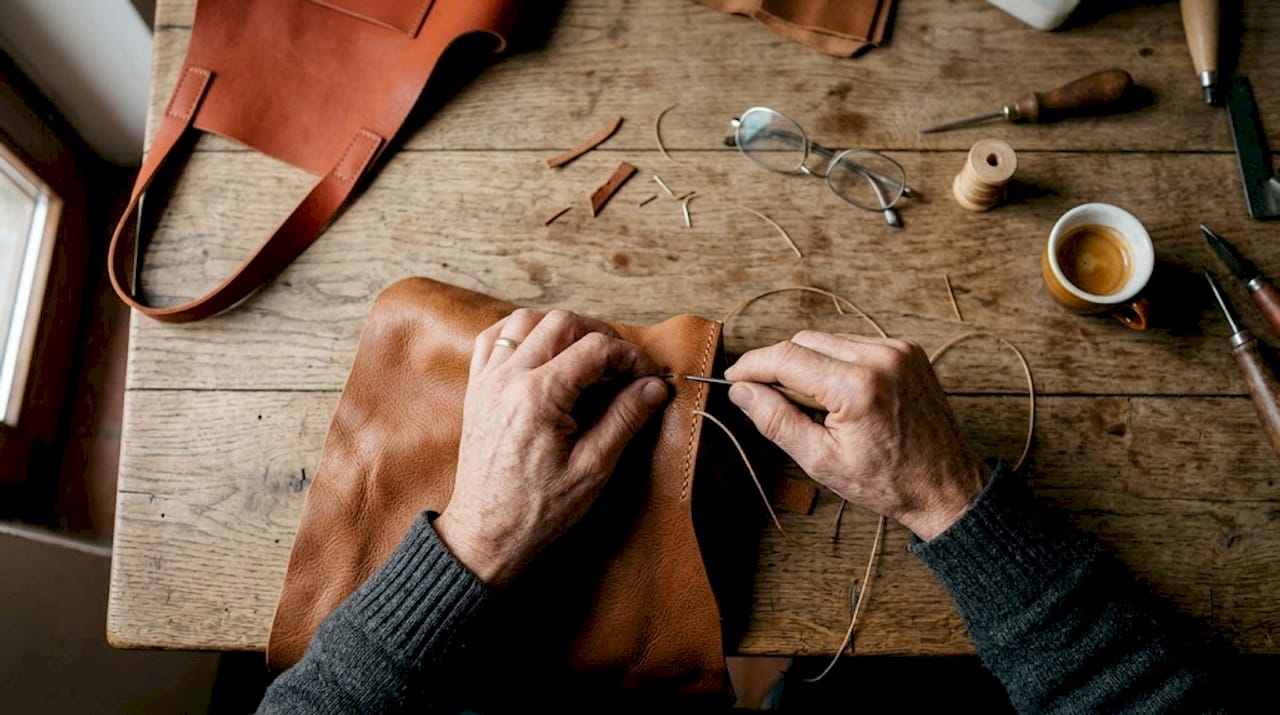
Artisanal luxury is, at its core, about handmaking and craftsmanship, where skill-intensive processes shift the conversation away from pricing strategies and towards the people and traditions behind the object. A trained artisan brings decades of muscle memory, aesthetic judgement, and cultural knowledge to every piece. That is not replicable by a production line, regardless of how expensive the machinery is.
What sets artisanal luxury apart, in practice, includes the following qualities:
- Individual maker involvement: A specific person, with a specific set of skills, is responsible for the piece.
- Time-intensive process: Each stage takes as long as it needs to take. Corners are not cut because corners cannot be cut.
- Heritage techniques: Methods passed down through generations, often specific to a region or tradition.
- Material integrity: Full-grain leathers, natural fibres, and raw materials chosen for longevity rather than appearance alone.
- Visible uniqueness: Subtle variations in texture, colour, or stitching that speak to human creation rather than mechanical uniformity.
- Cultural and geographic connection: The piece carries the identity of where and by whom it was made.
“Artisanal luxury centres handmaking and time-intensive processes, shifting the conversation from price to craftsmanship and the people behind the object.” This is not a marketing position. It is a philosophy that has guided exceptional makers for centuries.
When you hold a truly artisanal piece, you feel it before you can articulate it. The weight is right. The leather gives in a particular way. The stitching sits with a tension that only comes from a trained hand pulling thread at precisely the right angle. These are the qualities you find in timeless luxury handbags that are built to last decades rather than seasons.
How artisanal luxury sets itself apart from mass-produced goods
With the basics established, it’s time to see how artisanal luxury stands in contrast to mass-market notions of luxury.
The word “luxury” has been stretched far beyond its original meaning. Today, it appears on fast-fashion accessories, on department store own-brands, and on factory-produced items dressed in premium packaging. The contrast between genuine artisanal luxury and its mass-produced counterpart is not subtle once you know what you’re looking at.
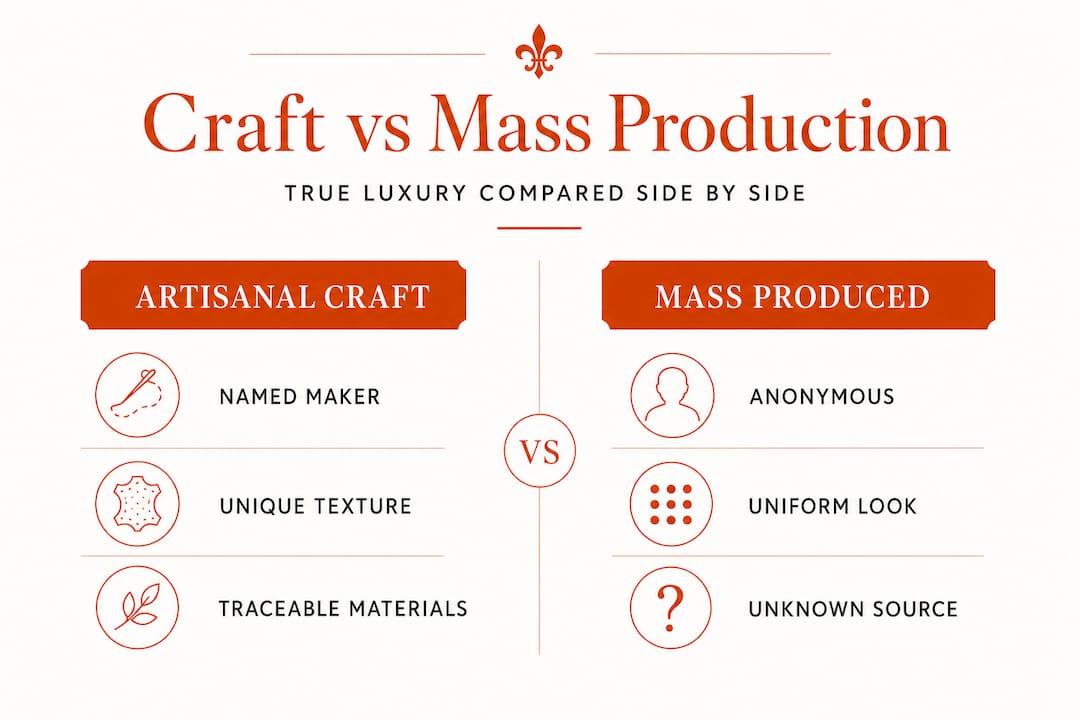
Artisanal craftsmanship is detail-intensive and hand-guided, producing unique textures and subtle imperfections that machines simply cannot replicate. Mass-produced luxury, by contrast, relies on high-volume output and automation, prioritising consistency and margin over individuality and durability.
| Feature | Artisanal luxury | Mass-produced luxury |
|---|---|---|
| Production method | Handcrafted by trained artisans | Factory-automated with some hand-finishing |
| Materials | Full-grain leather, natural fibres, regional sourcing | Corrected-grain leather, synthetic blends, global supply chains |
| Uniqueness | Each piece has subtle individual character | Designed for uniformity across thousands of units |
| Durability | Built to last decades with proper care | Often designed around a seasonal lifecycle |
| Traceability | Named maker, documented process, known origin | Supply chain often opaque |
| Price driver | Skill, time, and materials | Brand equity, marketing, and perceived status |
The journey from raw material to finished artisanal piece follows a process that takes time and intention. Here is what that process typically involves:
- Material selection: The artisan or workshop owner sources hides personally, selecting only full-grain leather from specific tanneries with long relationships and consistent standards.
- Preparation and cutting: Leather panels are hand-cut using traditional patterns, with grain direction and natural markings taken into account for both aesthetics and durability.
- Edge work: Before assembly, each edge is burnished, painted, or waxed by hand, a process that can take hours on a single bag.
- Stitching: Saddle-stitching by hand uses two needles and creates a lock-stitch that is structurally superior to machine stitching. If one thread breaks, the seam holds. A machine stitch, by contrast, unravels.
- Assembly and shaping: The piece is assembled over a form and shaped to its final silhouette. This stage requires experienced judgement at every turn.
- Finishing and inspection: Hardware is set, linings are secured, and the piece is inspected against the maker’s own standard, not a corporate quality checklist.
Pro Tip: When evaluating a piece in a boutique, turn it over. Examine the interior seams, the base corners, and the underside of the handle attachments. These are the areas where shortcuts appear first in mass-produced goods and where quality is most apparent in genuine artisanal work.
You can learn more about what really separates luxury from mass-produced bags and what to look for when buying artisan-made luxury handbags before making a significant investment.
How to spot genuine artisanal luxury (and avoid ‘craftwashing’)
Recognising these qualities in the real world demands critical attention, especially given the pervasiveness of craftwashing in luxury marketing.
Craftwashing is the practice of using artisanal language and imagery in marketing without the underlying substance to support it. A brand might show a craftsperson at a workbench in its campaign imagery while the actual product is assembled in a factory elsewhere. The vocabulary of craft, words like “handmade,” “artisan,” and “heritage,” has been so widely borrowed that it has lost much of its meaning without evidence to back it up.
Here are the signs of genuine artisanal craftsmanship to look for:
- Named makers: Authentic brands name the individuals or family workshops responsible for their pieces, not just the country of origin.
- Documented process: Look for detailed descriptions of how the product is made, including specific techniques, tools, and stages. Vague language is a warning sign.
- Traceable materials: The tannery, the region, and often the breed of animal can be identified in genuinely artisanal goods.
- Visible hand-finishing: Edges that are painted or burnished by hand show a slightly organic quality. Machine-finished edges are perfectly uniform, which sounds desirable but signals automation.
- Cultural specificity: A piece with authentic heritage connects to a place and a tradition. “Made in Italy” means more when accompanied by the name of the Florentine workshop where it was created.
- Willingness to explain: Genuine artisanal brands welcome questions about their process. Those with nothing to hide have everything to share.
Proof of genuine craft includes named makers, documented processes, traceable materials, and visible links with place and culture. When brands apply “artisanal” loosely, they risk not just misleading consumers but eroding the very concept of luxury itself.
The following table shows how marketing claims compare to what genuine proof looks like:
| Marketing claim | What it might mean | What genuine proof looks like |
|---|---|---|
| “Handcrafted” | Machine assembled with hand-finished details | Named artisan, video of process, specific technique described |
| “Heritage brand” | Old logo, no documented history | Archive records, multi-generational workshop, regional lineage |
| “Premium leather” | Corrected-grain with surface coating | Named tannery, full-grain specification, visible natural markings |
| “Artisan-made” | Assembled in a large factory | Identifiable maker, small batch numbers, documented stages |
| “Made in Italy” | Designed in Italy, assembled overseas | Italian workshop address, artisan name, regional craft tradition |
Pro Tip: Ask the brand directly: “Can you tell me who made this and where?” A confident answer with specifics is the hallmark of an authentic artisanal brand. Hesitation or generalities should prompt further questions.
To deepen your understanding of how these principles apply specifically to Italian goods, explore what handcrafted luxury in Italian fashion genuinely represents and what the tradition of artisan bag making looks like in practice.
The Italian standard: why heritage matters in artisanal luxury
Nowhere is the difference between surface-level and genuine luxury clearer than in Italian craftsmanship, a true benchmark for the world.
Italy’s reputation in artisanal luxury is not marketing mythology. It is the product of centuries of regional specialisation, guild traditions, and a deeply embedded cultural value placed on making things well. Different regions of Italy have historically concentrated expertise in particular crafts. Florence and Tuscany for leather goods. The Veneto for wool and tailoring. Campania for shoemaking. This geographic specificity means that when an Italian artisan works in leather, they are drawing on a living tradition, not a brand story invented in a marketing department.
The markers of genuinely Italian-made artisanal luxury include:
- Generational knowledge: Skills passed from master to apprentice across multiple generations within a single region.
- Regional tanneries: Italy is home to some of the world’s most respected tanneries, many of which supply exclusively to small workshops rather than large corporations.
- Named workshops: Authentic Italian artisanal goods often carry the name of the bottega, the workshop, alongside the brand.
- Traditional joinery and stitching techniques: Italian leather workers are known for specific techniques, including saddle-stitching and hand-burnished edges, that have remained consistent for generations.
- Slow production cycles: Italian artisanal workshops produce in small numbers because quality takes time. This is a feature, not a limitation.
“Heritage houses substantiate the value of craft with facts, emphasising materials and the people making products to prove value beyond branding.” The evidence, not the legend, is what convinces the truly discerning buyer.
There is also the question of trust. When a brand can trace its leather to a specific Tuscan tannery and name the artisan who cut and stitched your bag, it is not merely providing provenance. It is inviting you into a relationship with the object and its origin. That relationship has a depth that no logo, however storied, can replicate.
Understanding how Italian artisans and craftsmanship sustain this tradition gives important context for evaluating what you buy. It also clarifies why a luxury accessory and its heritage are inseparable in the best examples of the form.
Beyond the price tag: why craftsmanship, not cost, creates real value
With heritage and proof in mind, savvy buyers understand that cost is not always the best proxy for actual luxury.
There is a growing and uncomfortable conversation happening within the luxury industry right now. Some of the most expensive items on the market have begun to show cracks, literally and figuratively, in their quality. High prices do not always guarantee durability or superior workmanship. Concerns have mounted in recent years that certain luxury goods lack the enduring quality their prices imply, creating a troubling tension between cost and actual craft.
This is not a fringe complaint. It reflects a wider market dynamic in which brand equity and marketing spend have driven prices upward without a corresponding investment in materials or technique. The result is a tier of “luxury” goods that carry prestigious labels but are unlikely to survive a decade of regular use.
Evaluating lasting value in a luxury piece requires a different kind of attention. Here is a practical framework for doing it well:
- Start with the material: Touch the leather before you look at the label. Full-grain leather has a natural, slightly irregular surface. Corrected-grain leather feels perfectly smooth because its surface imperfections have been buffed away and a coating applied. The latter is more vulnerable to peeling and cracking over time.
- Examine the stitching: Run your finger along the seams. Hand-stitching has a consistent but not mechanically identical tension. Each stitch is slightly individual. Machine stitching is uniform to a point that feels almost synthetic.
- Test the hardware: Quality hardware is weighty and moves with resistance. Lightweight clasps and zips that operate too easily often signal cost-cutting at the component level.
- Check the interior finishing: A genuinely well-made bag treats the interior with the same care as the exterior. Raw edges, unfinished seams, or glued linings rather than stitched ones are signs of compromise.
- Research the brand’s production story: If a brand cannot or will not explain how their pieces are made, that absence of information is itself informative.
- Consider cost-per-wear: A bag that costs more initially but lasts twenty years and improves with age is demonstrably better value than one that costs half as much but deteriorates within three seasons.
Pro Tip: When assessing what makes a bag truly luxurious, focus on the construction rather than the branding. A plain, well-made bag in genuine full-grain leather will outlast and outperform an elaborately branded bag made with shortcuts every single time.
The importance of craftsmanship as a value driver, rather than marketing as a price driver, is the most important distinction a sophisticated buyer can learn to make. It requires slowing down, asking questions, and trusting your own senses over a price tag.
Why craftsmanship and story outshine the logo in modern luxury
Having examined the essentials of artisanal luxury, it is worth exploring a perspective that challenges the habits most of us have inherited from decades of luxury marketing.
The logo-driven model of luxury worked beautifully for a generation. It was legible, aspirational, and social. You could signal membership in a particular world through a monogram or a recognisable clasp. But something has shifted among women who buy thoughtfully and accumulate deliberately. The logo is beginning to feel less like a statement and more like a shortcut.
Authentic craft means moving beyond marketing to proven skill and a traceable story. When you know that a specific artisan in a Florentine workshop hand-stitched your bag using techniques she learnt from her mother, who learnt them from her teacher, you carry something that a logo simply cannot match. That story is yours. It connects you to a human being, to a place, to a tradition that exists independent of trend cycles and brand refresh campaigns.
There is a deeper satisfaction available to the buyer who values quiet elegance in luxury. It comes not from recognition by others, but from the private knowledge of what you are holding and what it took to make it. The subtle imperfection in the grain. The way the leather has already begun to develop a patina that is specific to how you live with it. These are not flaws. They are evidence of real making.
“The future of artisanal luxury is not about acquiring more. It is about knowing what you have, understanding where it came from, and choosing depth over display.”
We believe this shift is not a trend but a maturation. Sophisticated buyers in 2026 are less interested in broadcasting wealth and more interested in possessing objects that reward attention and age with them. The most compelling luxury is the kind that reveals itself slowly, over years of use, rather than announcing itself loudly from the moment of purchase.
Experience authentic Italian artisanal luxury
For those ready to upgrade their collection, true artistry awaits.
At San Rocco Italia, every handbag and leather good we offer is made in Italy by skilled artisans working with premium full-grain leather and time-honoured techniques. We are a woman-owned boutique, and we built our collection around a single conviction: that genuine craftsmanship, not marketing, is the only worthy foundation for luxury.
The remainder of our collection is sourced from trusted makers across Europe, chosen for quality, authenticity, and the kind of understated elegance that rewards the discerning eye. We can tell you where each piece was made, who made it, and what makes it worth carrying for decades. Explore the San Rocco Italia collection and discover what it means to own something that was made, truly made, with care for you.
Frequently asked questions
What defines a product as artisanal luxury?
Authentic artisanal luxury is defined by skilful handcrafting, visible maker involvement, traceable materials, and proof of traditional craft. Proof of genuine craft includes named makers, documented processes, and a visible link between the object and its place of origin, not just a high price.
Are all handmade luxury items truly artisanal?
No. “Handmade” does not guarantee artisanal quality on its own. Credible artisanal luxury requires verifiable craft details, named makers, and transparent processes rather than vague language designed to sound authentic.
How can I tell if a brand’s luxury claim is genuine?
Look for transparent sourcing, named artisans, evidence of specific technique, and details about a piece’s heritage and origin. Proof points should be specific and verifiable, including named makers and documented production stages, not generalised claims.
Does price always reflect quality in artisanal luxury?
Not always. High price does not always guarantee durability or superior workmanship, and some expensive goods lack enduring quality. Examine the materials and construction methods rather than relying on cost as your guide.
Why is Italian heritage especially celebrated in artisanal luxury?
Italian tradition carries generational expertise, painstaking technique, and traceable origins that support enduring luxury value. Heritage houses substantiate craft value with facts, emphasising the materials and the people who make the products rather than branding alone.
Recommended
- Discover the meaning of artisan made for luxury handbags – San Rocco Italia
- Discover the meaning of handcrafted luxury in Italian fashion – San Rocco Italia
- Artisanal Bag Making – The Craft Behind Ethical Luxury – San Rocco Italia
- Boutique craftsmanship: The secret behind timeless luxury handbags – San Rocco Italia
