


Why handcrafted décor is worth the investment
TL;DR:
- Authentic handcrafted décor is created by skilled artisans using traditional techniques that cannot be efficiently mass-produced. Genuine pieces exhibit subtle imperfections, natural variations, and evidence of human effort, which enhance emotional and aesthetic value. Choosing authentic craftsmanship involves scrutinizing provenance, materials, and maker reputation to ensure long-term quality and meaningful ownership.
There is a quiet confidence that comes with surrounding yourself with things that were made with intention. Not assembled by machine or shipped in identical batches, but shaped by a skilled pair of hands that understood exactly what they were creating. Luxury décor, in its truest sense, is never just about price or recognisable logos. Research confirms that consumers interpret handmade cues as signals of human care and perceived uniqueness, which deepens emotional connection and willingness to invest. This guide explores why handcrafted pieces offer something that mass production simply cannot replicate.
Table of Contents
- What truly defines handcrafted décor?
- The psychology of handmade: Emotional and aesthetic advantages
- Quality and authenticity: Beyond the ‘handmade’ label
- Handcrafted décor in practice: Elevating your home
- Why the value of handcrafted décor is more than a label
- Discover artisan décor through San Rocco Italia
- Frequently asked questions
Key Takeaways
| Point | Details |
|---|---|
| Unique emotional value | Handcrafted décor offers personal connection and lasting satisfaction that mass-produced items cannot match. |
| Quality is not automatic | Authenticity and quality depend on craftsmanship, materials, and guarantees, not just a handmade claim. |
| Smart buying tips | Look for evidence of origin, artisan signatures, and restoration guarantees before investing. |
| Elevates interiors | Thoughtful selection and display of handcrafted pieces give homes a distinctive and luxurious feel. |
What truly defines handcrafted décor?
The word “handcrafted” is used so freely in marketing that its meaning has been diluted. Walk through any high street home store and you will find pieces labelled as artisan, handmade, or hand-finished that bear very little evidence of genuine human craftsmanship. So what does the term actually mean when used with integrity?
Authentic handcrafted décor is made by skilled artisans who apply traditional techniques that cannot be replicated efficiently at scale. These are people who have spent years, sometimes decades, perfecting a single discipline: whether that is hand-thrown ceramics, carved wooden frames, hand-stitched textiles, or hammered metalwork. The process is slow and intentional. Every decision is made by a person, not an algorithm. This is fundamentally different from volume manufacturing, where consistency and speed are the priorities and individual expression is treated as a flaw rather than a feature.
One of the most distinctive characteristics of a genuinely handcrafted piece is its gentle imperfection. A slight variation in glaze on a ceramic bowl, the barely perceptible asymmetry of a hand-carved frame, or the unique grain pattern preserved in a leather-bound journal — these are not defects. They are evidence. They tell you that a person, not a press or a mould, created this object. And that is precisely why identifying genuine craftsmanship before you purchase is so important. Skilled buyers know what to look for.
The psychological link between handmade cues, perceived craftsmanship, and the sense of uniqueness is well established. When an object carries the visible mark of human effort, we assign it more value — emotionally and financially.
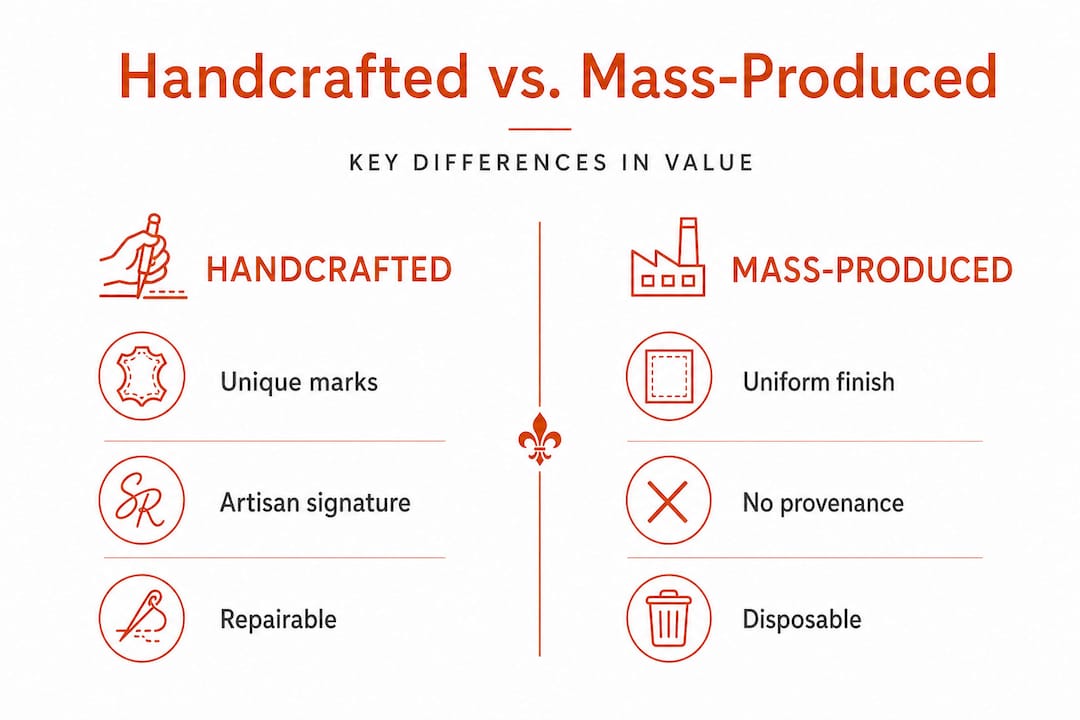
Handcrafted versus mass-produced: A direct comparison
| Feature | Handcrafted décor | Mass-produced décor |
|---|---|---|
| Personality | Unique, individual, expressive | Uniform, interchangeable |
| Materials | Premium, often natural and traceable | Synthetic, composite, or mixed quality |
| Quality assurance | Artisan-inspected at every stage | Factory QC at end of line |
| Repairability | Often restorable by skilled artisans | Typically unrepairable; replaced instead |
| Cost | Higher upfront, greater long-term value | Lower upfront, depreciates quickly |
| Environmental impact | Smaller batches, less waste | High-volume production, more waste |
Key signs of authentic handcrafted pieces
- Artisan signature or maker’s mark visible on or beneath the piece
- Natural material variation such as grain, texture, or tonal shifts that are impossible to replicate exactly
- Evidence of hand-finishing, including slight brush marks, stitch variation, or tool marks
- Provenance documentation from a named workshop, region, or maker
- Weight and substance that reflect solid materials rather than lightweight composites
- A story attached — the maker, the region, the technique, the heritage
When you hold a genuine handcrafted piece, you feel the difference immediately. The weight sits differently in your hands. The surface has character. This is not sentiment; it is material evidence.
The psychology of handmade: Emotional and aesthetic advantages

Having clarified what sets handcrafted décor apart, let us look at why these pieces create deeper meaning and satisfaction for their owners. The emotional experience of living with a handcrafted object is genuinely different from that of a mass-produced one — and that difference compounds over time.
Psychologists and consumer researchers have studied this extensively. Consumers interpret “handmade” cues as signalling human care and affection, which increases both attractiveness and willingness to pay. This is not irrational. It reflects something deeply human: we are wired to value what required effort, time, and skill. We form attachments to objects that carry stories.
“The ‘handmade effect’ is not merely sentimental — it reflects a documented psychological mechanism by which objects made by human hands are perceived as containing more care, more uniqueness, and therefore more intrinsic worth.”
This effect matters enormously when you are curating a home. The goal of a truly beautiful interior is not to look like a showroom; it is to feel like your life, expressed in space. Handcrafted pieces make that possible in a way that identical, mass-produced objects cannot.
Emotional and experiential benefits of owning handcrafted décor
-
A connection with the artisan. Knowing that a person shaped, painted, or stitched what sits on your shelf creates a silent relationship between maker and owner. That connection has genuine emotional warmth.
-
An object with a story. A hand-thrown vase from a small studio in Tuscany carries the story of that region, that tradition, and that individual maker. Your home becomes a curated narrative, not a catalogue.
-
Pride in ownership. There is a particular kind of quiet pride in owning something made with extraordinary skill. It is not about showing off; it is about knowing the difference yourself.
-
Lasting satisfaction. Mass-produced pieces lose their appeal quickly. Handcrafted objects tend to deepen in meaning and aesthetic pleasure over time as they develop character.
-
A sense of heritage. When you invest in handcrafted décor, you are also investing in the continuation of traditional skills. That sense of cultural participation adds a layer of meaning that no fast-furniture brand can offer.
-
Emotional memory and resonance. Handcrafted pieces become anchors for memory. They mark moments, travels, and milestones in ways that flat-pack alternatives simply do not.
Understanding the value of real craftsmanship is the first step towards making purchasing decisions that bring lasting satisfaction rather than the temporary novelty of something new and shiny. And if you are considering investing in handmade luxury as part of a broader collection strategy, the emotional and financial returns are remarkably aligned.
Handcrafted interiors also photograph differently — and not because they are styled for the camera. They possess depth. Texture. A tactile quality that photographs and descriptions can hint at, but only presence can confirm.
Quality and authenticity: Beyond the ‘handmade’ label
The emotional connection matters, but quality and provenance must match heart with head. Here is how to ensure true excellence when buying artisan décor.
The unfortunate reality is that “handmade” has become a marketing term rather than a guarantee. Some brands apply the word loosely to items that involve minimal human involvement in the process. Buyers who rely solely on the label without deeper scrutiny risk paying premium prices for something that does not deliver premium quality. Research makes this plain: “handmade” is not automatically better quality — genuine value depends on materials, technique, and the care behind the process, not the label alone.
This is where discerning buyers earn their reputation. They ask questions. They look for policies. They request evidence.
Pro Tip: Always ask a retailer or artisan directly about their repair and restoration policy. A maker who stands behind their work will offer clear answers. One who cannot is telling you something important.
Red flags and green flags when reviewing artisan décor
Green flags:
- Named artisan or workshop with a verifiable address or heritage
- Detailed description of materials and their source
- Clear repair or restoration service offered
- Certificate of authenticity or provenance
- Limited production numbers or bespoke availability
- Photographs of the making process on the maker’s website or social channels
Red flags:
- Vague phrases like “artisan-inspired” or “crafted in the style of”
- No information about where or how an item was made
- Identical pieces available in large quantities
- Reluctance to answer questions about origin or materials
- No after-sales service or guarantee whatsoever
When assessing artisan quality, pay particular attention to the materials used. Full-grain leather, solid hardwood, hand-blown glass, natural stone, and hand-spun fibres all behave differently over time than synthetic alternatives. They age with grace.
Common materials and what they signal for long-term value
| Material or technique | What it signals |
|---|---|
| Full-grain leather | Durability, natural character, improves with age |
| Hand-blown glass | Uniqueness, skilled artistry, irreplaceable detail |
| Solid hardwood (hand-carved) | Structural integrity, repairability, generational use |
| Hand-stitched textile | Precision, time investment, longevity |
| Cold-cast bronze or resin composite | Lower skill threshold, often not restorable |
| Kiln-fired ceramic (hand-thrown) | Heritage technique, unique finish, food-safe options |
Italian tradition deserves particular mention here. Italy has maintained some of the world’s most rigorous artisan standards across leather goods, ceramics, glasswork, textiles, and furniture for centuries. The systems of apprenticeship, regional specialisation, and quality verification that underpin Italian craftsmanship are not marketing mythology — they are a functioning cultural infrastructure. This is precisely why luxury décor trends that endure almost always have an Italian thread running through them.
Handcrafted décor in practice: Elevating your home
With insight into quality and provenance, you are ready to choose and care for exceptional pieces. Here is how to do it beautifully, practically, and with confidence.
Bringing handcrafted pieces into your home is not about replacing everything at once. The most considered interiors are built gradually, with intention. Each piece is chosen because it adds meaning, not merely because it fills a space or follows a trend. Handmade pieces are most valuable when their originality, craftsmanship, and functionality become central to your interior style rather than decorative afterthoughts.
Blending handcrafted pieces with existing décor is more natural than many people expect. A beautifully made ceramic lamp base brings warmth to a room of clean, modern furniture. A hand-stitched leather tray on a marble sideboard adds tactile contrast. These combinations work because genuine materials and genuine craft speak a common visual language: authenticity. The pieces do not need to match in style; they need to share in quality.
Steps for curating a collection of luxury artisan décor
-
Identify your style anchor. Before you purchase anything, understand the mood and visual language of your space. Are you drawn to warm Mediterranean tones, cool Nordic restraint, or layered English country elegance? Your handcrafted pieces should amplify this, not fight it.
-
Research provenance thoroughly. For each piece you consider, trace it back as far as you can. Who made it? Where? Using which techniques? The more specific and verifiable the answers, the more confident your purchase will be.
-
Visit studios or ateliers when possible. There is no substitute for seeing a maker at work. Many Italian studios, French ateliers, and independent European workshops welcome visitors. The experience transforms an object from a purchase into a memory.
-
Request certificates or documentation. Ask for a provenance certificate, maker’s card, or care guide before finalising any significant purchase. Reputable makers and curated retailers will always provide this without hesitation.
-
Consider both functionality and display. The best handcrafted pieces serve a purpose as well as pleasing the eye. A hand-thrown bowl used daily for fruit. A leather-bound journal on your writing desk. Functionality deepens your connection to an object.
-
Plan for care and longevity from day one. Ask your retailer how to clean, condition, or restore the piece over time. Build a small care kit if appropriate and make maintenance part of your relationship with the object.
Pro Tip: When purchasing a significant handcrafted piece, ask the artisan or retailer directly about restoration options for ten or twenty years hence. Pieces worth investing in are pieces worth preserving, and a maker who thinks in decades is a maker worth trusting.
For abundant luxury accessory inspiration across every room, it helps to explore what experienced curators consider essential. And for practical guidance on caring for artisan materials including leather, consider this a foundation, not an afterthought.
The question of heirlooms is worth addressing directly. Handcrafted pieces, properly cared for, do not depreciate in the way that mass-produced items do. Many of them appreciate. More importantly, they carry emotional currency that passes from one generation to the next. A hand-carved wooden bowl or a supple full-grain leather piece owned and loved for thirty years tells a richer story than anything bought in a seasonal sale. That story is the real inheritance.
Why the value of handcrafted décor is more than a label
There is a perspective that rarely gets aired in the world of luxury interiors, and it is one we feel strongly about: the most dangerous trap for a discerning buyer is not buying the wrong thing. It is buying the right-looking thing for the wrong reasons.
The luxury décor market is extraordinarily good at creating desire. Beautifully lit campaigns, carefully chosen language, and aspirational lifestyle imagery can make almost anything feel worth wanting. But desire and value are not the same thing. We have spoken with many women who built their interiors around trends they loved at the time and felt faintly embarrassed by three years later. That is not a failure of taste; it is what happens when style is prioritised over substance.
True luxury, in our experience, is defined by origin, repairability, and authenticity. Not by how well an item photographs or how recognisable the logo is. A piece with no maker’s name, no story, and no repair pathway is not a luxury purchase regardless of its price. It is an expensive placeholder.
What we find most interesting is that the buyers who feel the greatest satisfaction with their interiors are almost never those who followed trends carefully. They are the ones who chose quietly and wisely. A single exceptional piece, bought after real research, from a maker whose work they genuinely admired, always outperforms a room filled with this season’s choices. This is the philosophy behind understanding what defines luxury accessories at a deeper level.
There is also something worth saying about conspicuousness. The desire to be seen to have good taste is understandable, but it produces a very different kind of interior from the desire to actually have good taste. Mature collectors tend to collect quietly. Their homes are warm, layered, and deeply personal. Nothing screams. Everything earns its place. Handcrafted décor is perfectly suited to this mode of living, because its value is felt rather than announced.
The stories behind handcrafted pieces matter just as much as the design. A lamp made in a small Venetian glassblowing studio carries decades of regional skill. A leather piece cut and stitched by a third-generation artisan in Florence carries something that no amount of marketing can manufacture: genuine continuity. That is what makes the difference, long after the first impression has settled.
Discover artisan décor through San Rocco Italia
For those inspired to make thoughtful, lasting choices, here is where your journey can begin.
At San Rocco Italia, we curate with exactly this philosophy in mind. Every piece in our collection has been chosen for the quality of its making, the integrity of its materials, and the authenticity of its origin. Our leather goods and handbags are made in Italy by skilled artisans using premium full-grain leather and time-honoured techniques. The rest of our collection is sourced from trusted European makers chosen for exactly the same reasons: quality, authenticity, and enduring style.
We believe that buying well means buying with knowledge, and our explore craftsmanship insights section is designed to give you exactly that. Browse our curated selection with confidence, knowing that provenance, care guidance, and genuine quality underpin everything we offer. This is not about trends. It is about pieces that will still matter to you in twenty years.
Frequently asked questions
How can I confirm that a décor piece is genuinely handcrafted?
Look for artisan signatures, one-of-a-kind details, and certificates of authenticity, and always verify the maker’s origin and materials; authenticity often involves clear evidence of craftsmanship and traceable material sourcing rather than marketing language alone.
Are handcrafted pieces always a better investment than mass-produced ones?
Not always — investment value relies on craftsmanship, material quality, and after-sales guarantees, not just the handmade label, as value depends on materials, technique, and the maker’s commitment to longevity.
What makes Italian handcrafted décor especially desirable?
Italian pieces are celebrated for their centuries of heritage, precise regional techniques, and the cultural infrastructure of quality that backs them; heritage and craftsmanship together increase both the perceived and enduring value of handmade items in ways that marketing alone cannot achieve.
How do I care for luxury handcrafted décor?
Follow the specific care instructions provided by the artisan or retailer, and invest in professional cleaning or restoration for delicate materials such as full-grain leather, hand-blown glass, or hand-stitched textiles to preserve their beauty for decades.
Recommended
- Boutique craftsmanship: The secret behind timeless luxury handbags – San Rocco Italia
- How to recognise authentic Italian home décor craftsmanship – San Rocco Italia
- Discover the meaning of handcrafted luxury in Italian fashion – San Rocco Italia
- Investing in Handcrafted Jewellery: Timeless Beauty – San Rocco Italia
