


What makes a truly premium accessory worth owning
TL;DR:
- True premium accessories focus on quality, craftsmanship, and ethical sourcing, not just price.
- Italian artisans excel in slow, detailed production, using full-grain leather and natural tanning methods.
- Timeless design and limited production enhance durability and lasting value beyond fleeting trends.
You could spend a fortune on a bag stamped with a famous name and still walk away with something that starts to peel at the seams within a year. That uncomfortable truth catches even the most discerning shoppers off guard. The luxury market is vast, and not everything that carries a four-figure price tag has earned it. Real premium quality lives in the details that most people never think to look for: the provenance of the hide, the number of stitches per centimetre, the way a zip closes with quiet certainty. This article unpacks those details so that you never confuse marketing for mastery again.
Table of Contents
- Defining premium: More than just a high price tag
- Italian craftsmanship: The soul of premium accessories
- Material mastery: The role of ethical quality and innovation
- Design for a lifetime: Timeless style and conscious production
- The personal touch: What premium means for you
- Why true luxury has nothing to prove
- Discover Italian premium accessories for yourself
- Frequently asked questions
Key Takeaways
| Point | Details |
|---|---|
| True luxury is crafted | Premium accessories unite Italian skill, ethical sourcing, and timeless design beyond just price. |
| Materials and ethics matter | Responsible materials and production ensure both quality and lasting value. |
| Choose with confidence | Knowing what to look for helps you select accessories that genuinely fit your values and style. |
| Italian tradition leads | Generational skill and regional focus make Italian-made pieces sought-after worldwide. |
Defining premium: More than just a high price tag
The most persistent myth in the accessories world is that cost and quality are the same thing. They are not. Price reflects many things: advertising budgets, celebrity endorsements, retail overheads, and seasonal demand. None of those factors have anything to do with how a bag is cut, stitched, or finished.
What actually separates a premium accessory from an ordinary one comes down to a handful of interconnected qualities:
- Authenticity: the accessory is exactly what it claims to be, with honest materials and transparent origins
- Provenance: the story of where and how it was made matters enormously to lasting value
- Craftsmanship: the technical skill invested in its construction determines how it ages
- Timelessness: the design remains relevant beyond the season in which it was purchased
Overt logos are, in many cases, the opposite of these qualities. A bag that shouts its brand name across every surface is designed to signal spending power, not to last decades. When you strip away the branding and look purely at the object, the difference between genuine premium and expensive mediocrity becomes immediately obvious.
“A truly premium accessory is not dressed for the room it enters. It earns attention through restraint, proportion, and an honesty of material that speaks without words.”
Europe has long led the world in this quiet understanding. The Europe Luxury Bag Market Report confirms that Europe holds approximately 30% of global luxury handbag market share, a dominance rooted in centuries of craftsmanship heritage rather than clever marketing. That tradition matters because it produces an ecosystem of skilled artisans, specialist tanneries, and rigorous quality standards that simply does not exist elsewhere at the same scale. For those beginning to explore this world, accessible Italian luxury offers a compelling entry point without compromise.
Italian craftsmanship: The soul of premium accessories
Italy occupies a singular position in the world of accessories. This is not national pride speaking. It is a statement backed by centuries of organised, regionally specific artisan knowledge. Florence is associated with leather goods of extraordinary refinement. The Veneto region produces some of the finest saddlery-grade hides in Europe. Naples brings tailoring sensibility to everything it touches. Each region has its own traditions, its own vocabulary, and its own standards.
What distinguishes Italian artisan work from mass-market production is not just skill. It is the culture of slow making. A family atelier might produce a few hundred bags per year. Each piece passes through the hands of multiple craftspeople: the cutter, the stitcher, the finisher, the quality examiner. Compare that with a factory producing thousands of units daily, and the difference in attention becomes self-evident.
| Factor | Italian artisan accessories | Global mass-market accessories |
|---|---|---|
| Skills | Generational, regionally specific | Standardised factory training |
| Materials | Full-grain and top-grain leathers, natural tanning | Split leather, PU coatings, synthetic linings |
| Design time | Seasons of prototyping and refinement | Weeks from trend to production |
| Sustainability | Small-batch, low-waste, long-life design | High-volume, disposable lifecycle |
| Stitching | Hand-finished, tight and consistent | Machine-only, variable tension |
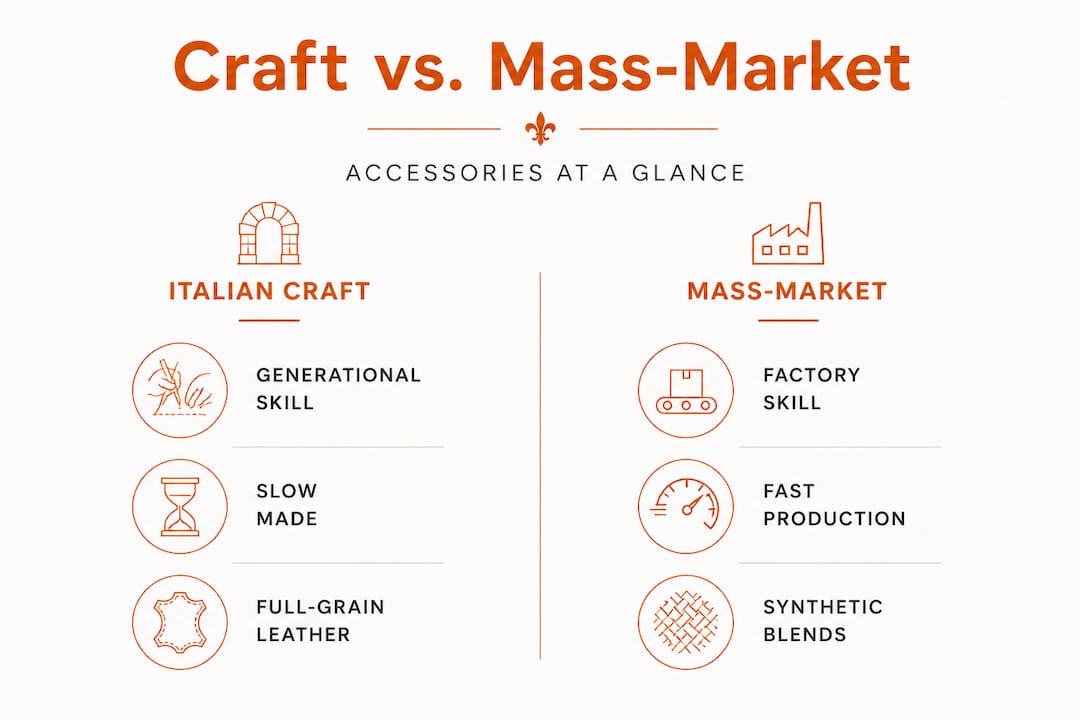
The contrast is stark when you see it laid out plainly. Understanding Italian handbag craftsmanship in depth reveals just how many decisions go into each centimetre of a well-made bag. The approach taken by boutique craftsmanship producers preserves these standards while keeping pieces accessible to those who know what to look for.
Key markers of exceptional Italian work include:
- Tight, even stitching with consistent tension and thread that matches the leather tone precisely
- Burnished edges rather than painted ones, sealed by hand with friction and wax
- Natural patina potential: the leather should feel alive, not coated, and should develop character with age
- Hardware weight: solid brass or sterling fittings have a satisfying heft that plated zinc simply cannot replicate
- Interior finishing: the lining should be sewn cleanly at every corner, not glued or left raw
Pro Tip: Lean in close to a leather accessory and breathe in. Authentic vegetable-tanned Italian leather has a warm, slightly earthy smell. A chemical or plasticky scent usually indicates synthetic coatings or chrome tanning of lower quality. Your nose is a surprisingly reliable quality instrument.
Knowing how to identify real Italian craftsmanship from imitations protects your investment and deepens the pleasure of owning something genuinely made with purpose.
Material mastery: The role of ethical quality and innovation
Skill without the right material is like cooking without fresh ingredients. The leather, hardware, thread, and lining chosen for a premium accessory are as important as the hands that shape them. In this area, the best Italian makers apply standards that would surprise most shoppers.
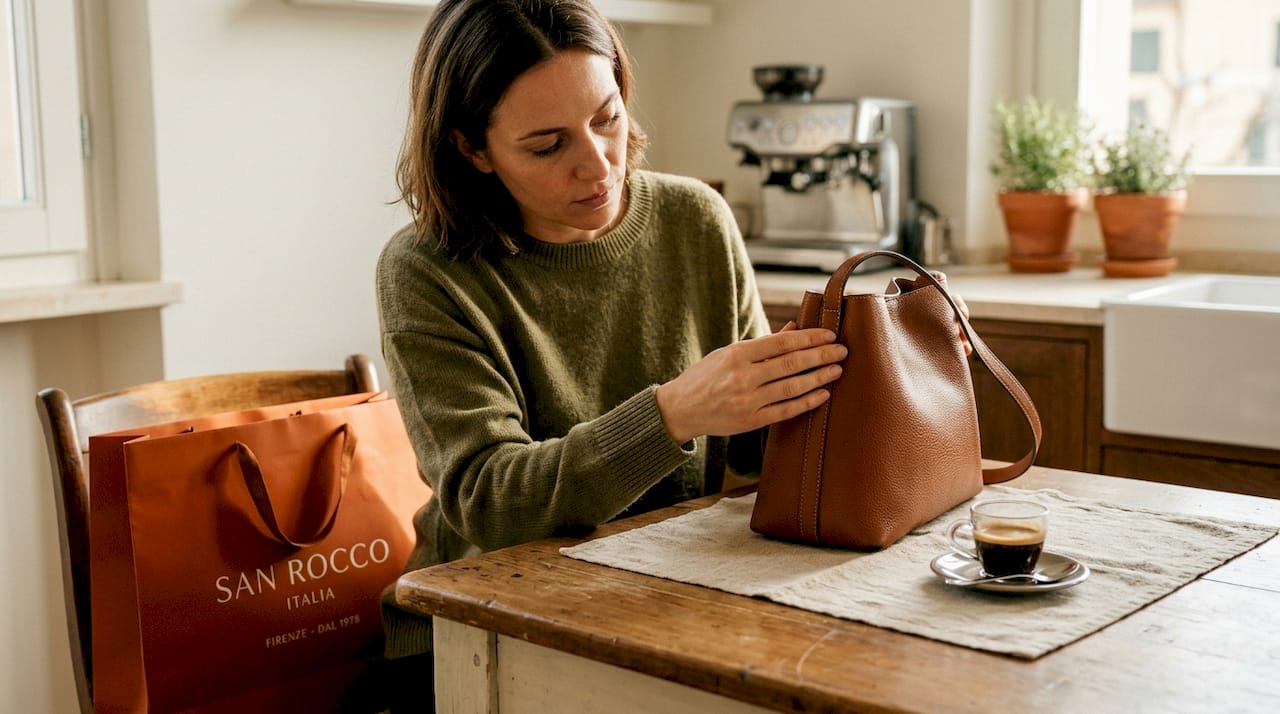
Full-grain leather is the benchmark. It uses the outermost layer of the hide, the layer where the natural grain is entirely intact, giving it superior strength, breathability, and the ability to develop a beautiful patina over years of use. It is harder to work with because it cannot be sanded to hide imperfections, which means only hides of excellent natural quality are suitable. Top-grain leather is the next tier, buffed slightly to remove surface marks, still excellent, still vastly superior to split leather or bonded leather composites found in lower-priced accessories.
Vegetable tanning is the traditional method used by the finest Italian tanneries, some of which have been operating for over a century. Ethical sustainability via traceable vegetable tanning, lab-grown elements, and limited production are now recognised hallmarks of responsible luxury, and for good reason. The process uses plant-derived tannins, takes weeks rather than days, and produces leather that is safer for artisans, better for the environment, and far more durable than chrome-tanned alternatives.
| Material | Traditional approach | Modern ethical approach | Key benefit |
|---|---|---|---|
| Leather | Chrome-tanned, fast process | Vegetable-tanned, weeks-long | Longer life, lower toxicity |
| Hardware | Plated zinc alloys | Solid brass, recycled metal | Durability, recyclability |
| Lining | Synthetic satin | Organic cotton or suede | Breathability, longevity |
| Thread | Synthetic polyester | Waxed linen or nylon | Strength, resistance to rot |
When evaluating a potential purchase, work through this checklist before committing:
- Ask specifically about the leather grade (full-grain or top-grain are the marks of quality)
- Enquire about the tanning method (vegetable-tanned is the ethical and durable choice)
- Examine the hardware by weight and finish (solid metals feel heavier and retain their finish)
- Check the lining at every seam (glued linings lift over time; sewn linings endure)
- Look at the stitching under good light (premium pieces show no loose threads, skipped stitches, or glue residue)
- Ask for provenance documentation (reputable makers provide it readily)
Pro Tip: Be wary of vague certifications or labels that say only “genuine leather.” In the industry, this phrase can legally apply to the lowest grade of processed hide. Look instead for specific terms: “full-grain,” “vegetable-tanned,” or references to named Italian tanneries such as Badalassi Carlo or Conceria Walpier.
Choosing ethical accessories is not a compromise. It is an upgrade in every sense. The best artisan tradition producers have always understood that quality and responsibility are two sides of the same coin.
Design for a lifetime: Timeless style and conscious production
There is a particular kind of design confidence that says nothing flashy and everything essential. You recognise it in a bag with a clean silhouette, hardware placed exactly where the eye expects it, and proportions that feel balanced whether carried in hand or slung over a shoulder. This is timeless design, and it is the final deciding factor in whether a premium accessory is genuinely worth the investment.
Timeless pieces share certain characteristics:
- Neutral or classic colour palette: cognac, navy, black, chocolate, and natural tan endure across decades
- Functional elegance: every external pocket, strap, and closure serves a purpose, with nothing added purely for decoration
- Restrained hardware: a single, well-proportioned clasp or turn-lock is more refined than rows of decorative studs
- Proportional balance: the bag works visually at rest, in movement, and against multiple outfit styles
- Interior organisation: thoughtful pockets and dividers that reflect how women actually carry their lives
Limited production runs amplify all of these qualities. When a maker produces only a few hundred pieces of a particular style, that scarcity is not manufactured for marketing purposes. It reflects genuine capacity constraints, careful sourcing, and a refusal to compromise by scaling beyond what quality allows. A bag made in these conditions holds its design integrity because the maker has had the time to get it right.
“European heritage brands account for a 30% luxury market share not through volume, but through the sustained trust built by generations of consistent quality. That trust is the real currency of luxury.”
The relationship between slow production and lasting value is one that experienced collectors understand intuitively. A style that was refined over several seasons and produced in limited numbers will likely outlast ten trend-driven pieces made in a rush. When you learn to embrace your style with Italian leather, you begin to see the difference between a purchase and an acquisition. The finest Italian leather bags are often made by names that do not appear on billboards, which is precisely why they remain worth owning.
The personal touch: What premium means for you
All of this knowledge is useful only if you apply it with confidence. Premium accessories are not abstract objects to be admired from a distance. They are things you carry, use, and depend upon. The relationship between a woman and a well-made bag is as practical as it is aesthetic.
Here is a structured approach to evaluating any accessory before you buy:
- Hold it: weight tells you immediately about material density and hardware quality
- Open every closure: the action should be smooth, firm, and satisfying, never stiff or loose
- Inspect the stitching under direct light: look for consistent tension, equal spacing, and thread that is anchored cleanly at every end
- Press the leather gently: premium full-grain leather springs back; poor-quality material creases and stays creased
- Check the lining at the base corners: this is where construction shortcuts show first
- Ask for provenance: a maker proud of their work will tell you exactly where and how it was made
- Assess the emotional response: does this piece feel like it has a story? Does it feel worth passing on?
That last question matters more than most people admit. A premium accessory should carry a sense of intention. You should feel that someone put thought not just into how it was made, but into why it was made this way, for whom, and for how long it should last. The best pieces feel like an introduction to a maker you want to know. There is a particular quality to artisan elegance that you recognise immediately, and the recognition builds your confidence in every subsequent purchase.
Ethical sourcing matters here too. The Europe Luxury Bag Market Report highlights that ethical sustainability through traceable vegetable tanning and limited production has become a defining marker of genuine premium. Knowing that your purchase did not come at a hidden cost to the environment or to the people who made it adds a dimension of satisfaction that no logo can replicate.
Pro Tip: Invest in a quality leather conditioner from day one. Full-grain leather fed with a natural conditioner every few months develops a richer patina, stays supple, and resists cracking for decades. The five minutes you spend maintaining a premium piece ensures that it rewards you for years.
Why true luxury has nothing to prove
Here is something that took us time to say plainly, though we have always believed it: the most genuinely luxurious accessories you will ever own are the ones that nobody immediately recognises.
We live in a moment when conspicuous branding has been elevated to an art form. Enormous logos, signature prints covering every surface, hardware engraved with house initials large enough to read at a distance. All of this is branding, not craftsmanship. It is designed to communicate one thing: that money was spent. It says nothing about how the piece was made, who made it, or how long it will last.
The Italian artisan tradition represents an entirely different philosophy. A small Florentine atelier producing three hundred bags a year is not interested in being on every shoulder. It is interested in being on the right shoulder for the next thirty years. When you hold a piece made this way, you are holding the accumulated knowledge of generations. That knowledge is invisible to anyone who has not sought it out, and that invisibility is precisely where its value lives.
There is also an ethical dimension that we find impossible to separate from true premium. Choosing pieces from makers who pay fair wages, use traceable materials, and refuse to scale beyond their quality standards is a statement about the kind of consumption you want to participate in. Italian accessories from principled producers lead in this regard because their heritage demands it. Their reputation was built slowly, over generations, and it can only be protected by the same patience.
The names that outshine the biggest brands in terms of actual quality often do so quietly. They are discovered by women who look beyond advertising, who ask the right questions, and who have learned to trust material evidence over market noise. If you are reading this, you are already that kind of shopper.
Discover Italian premium accessories for yourself
Everything we have discussed, from the ethics of tanning to the silence of restrained design, comes together in the pieces we curate at San Rocco Italia. As a woman-owned boutique, we understand exactly what you are looking for because we look for the same things ourselves.
Our Italian handbag collection is made by skilled artisans using full-grain leather and time-honoured techniques, with every piece reflecting our commitment to timelessness, transparency, and genuine quality. We source nothing that we would not carry ourselves. We describe nothing with language that overpromises. If you are ready to experience the quiet confidence of a truly premium accessory, explore our curated selection and find the piece that will be part of your wardrobe for decades, not just seasons.
Frequently asked questions
What specific qualities define a premium accessory?
Premium accessories are defined by masterful craftsmanship, ethical material sourcing, timeless design, and limited, intentional production. Each quality reinforces the others, creating an object that holds its value and beauty over time.
How do I verify if an accessory is truly made in Italy?
Look for provenance documentation, quality stitching, burnished edges, and a natural leather scent, and shop with reputable boutiques who can confirm the maker’s origins. Europe’s 30% luxury market share is built on this kind of verifiable, traceable heritage.
Why does ethical production matter in luxury accessories?
Responsibly sourced materials and transparent practices add lasting value by ensuring sustainable luxury production through traceable vegetable tanning and limited runs, benefiting both the environment and the artisans involved.
Are all high-priced accessories considered premium?
High price does not guarantee premium quality. Craftsmanship, ethical sourcing, and design integrity are essential, and Europe’s position holding 30% of global luxury market share reflects genuine quality standards rather than price alone.
Recommended
- What Makes a Luxury Accessory: Craft, Heritage, Impact – San Rocco Italia
- Boutique craftsmanship: The secret behind timeless luxury handbags – San Rocco Italia
- Why authenticity matters in luxury goods: timeless value – San Rocco Italia
- Why choose ethical accessories: timeless, responsible luxury – San Rocco Italia
- How to identify and buy premium gold jewelry – Baker Gold Chains



