


How to clean luxury handbags and preserve their beauty
TL;DR:
- Proper care of luxury Italian leather handbags involves gentle cleaning with pH-balanced products, avoiding over-wetting and heat. Routine dusting and infrequent conditioning preserve the leather’s natural oils, preventing damage and extending its lifespan. Consulting professionals for deep stains and structural issues is essential, as over-intervention can cause more harm than good.
That sinking feeling when you spot an unexpected mark on your favourite Italian leather handbag is something every discerning woman knows intimately. Your bag is not simply an accessory; it represents hours of skilled artisan work, the finest full-grain leather, and a significant financial investment. One impulsive wipe with the wrong cloth, or a splash of a household cleaner, can permanently alter the texture, strip the natural oils, or leave watermarks that no amount of conditioning will ever reverse. This guide gives you the exact, expert-approved techniques to clean and care for your luxury leather handbag with complete confidence.
Table of Contents
- What you need: Essential tools and products
- Step-by-step: Safe luxury handbag cleaning process
- Conditioning: The secret to suppleness (and mistakes to avoid)
- Troubleshooting and common luxury handbag care mistakes
- The truth most handbag owners overlook about leather care
- Discover luxury care solutions for timeless handbags
- Frequently asked questions
Key Takeaways
| Point | Details |
|---|---|
| Use the right tools | Always use a soft brush, microfibre cloth, and pH-balanced products to clean luxury leather safely. |
| Moisture control is vital | Never soak or overwet your bag—gentle, minimal moisture prevents watermarks and texture damage. |
| Condition sparingly | Apply leather conditioner only 1–2 times a year with non-greasy formulas designed for fine leather. |
| Avoid harsh chemicals | Never use household cleaners, baby wipes, or regular soap, which can damage natural leather. |
| When in doubt, seek expertise | For stubborn stains or major restoration, consult a luxury leather specialist to protect your investment. |
What you need: Essential tools and products
Before you touch your prized bag, make sure you have the correct tools and products to avoid costly mistakes. Luxury Italian leather, particularly full-grain leather produced by skilled Florentine and Venetian artisans, is a natural material with its own moisture balance and surface finish. Using the wrong implement or product, even once, can disrupt that balance in ways that are difficult or impossible to correct.
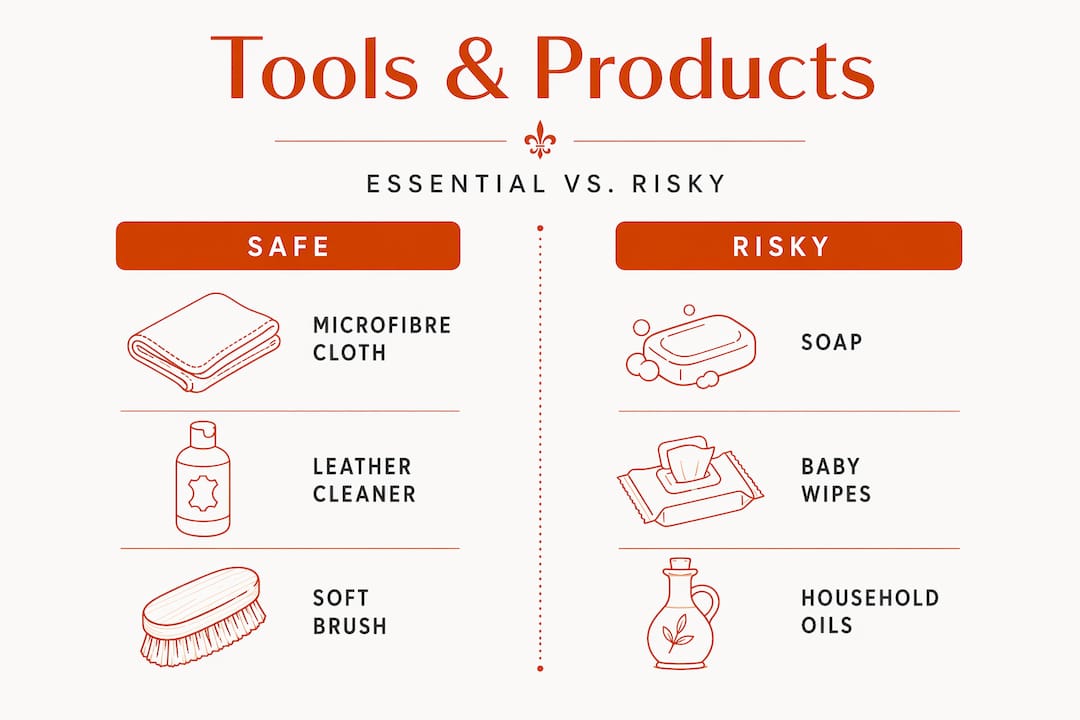
The essential toolkit
Here is precisely what you need before you begin:
- Soft-bristle brush (natural hair or very fine synthetic): For gently sweeping away dry dust, debris, and fine grit that accumulate in seams and gussets. Never use a stiff brush, which will scratch the surface.
- Dry microfibre cloth: Microfibre (a fabric woven from ultra-fine synthetic fibres) lifts dust and light surface particles without abrasion. Have two cloths ready, one dry and one slightly damp.
- Slightly damp microfibre cloth: Wrung out thoroughly so that no excess water can transfer to the leather. The cloth should feel barely cool to the touch, not wet.
- pH-balanced leather cleaner: The term “pH-balanced” means the product is formulated to match leather’s natural acidity level (roughly pH 4 to 5), preventing chemical damage to the surface. A product such as Lexol pH-Balanced Leather Cleaner is widely trusted by leather specialists for exactly this reason.
- High-quality leather conditioner: A specialist formula designed to penetrate the leather fibres and restore suppleness. Consult this expert cleaner guide for current product comparisons, and our guide to best leather conditioners for specific recommendations.
- Cotton swabs: For delicate work around hardware, zips, and stitched edges where a cloth cannot reach cleanly.
Suitable versus risky products: A quick comparison
| Product type | Safe to use? | Reason |
|---|---|---|
| pH-balanced leather cleaner | Yes | Matches leather’s natural acidity; will not strip oils |
| Specialist leather conditioner | Yes | Penetrates fibres without residue |
| Slightly damp microfibre cloth | Yes | Lifts surface dirt gently |
| Baby wipes | No | Contain alcohol, fragrance, and surfactants that strip finish |
| Household glass or surface cleaner | No | Highly alkaline; permanently damages leather |
| Washing-up liquid or soap | No | Removes protective oils and causes drying and cracking |
| Acetone or nail varnish remover | No | Dissolves leather finish immediately |
| Olive oil or coconut oil | No | Darkens leather, goes rancid, and attracts bacteria |
| Rubbing alcohol | No | Strips dye and surface coating |
As part of routine cleaning of fine Italian leather handbags, you should begin by removing loose surface dust carefully, avoiding over-wetting the leather at all times. Over-wetting causes permanent stiffness, texture changes, and watermarks that are notoriously difficult to remedy. Preparation is everything.
Pro Tip: Before using any new product on your bag, apply a small amount to an inconspicuous area such as the base corner or inside a strap loop. Wait 24 hours and check for any discolouration, darkening, or surface change before proceeding.
Step-by-step: Safe luxury handbag cleaning process
With your toolkit ready, let’s follow the precise actions that keep Italian leather flawless. Rushing this process or skipping steps is the single most common reason well-intentioned owners cause damage. Give each step the time it deserves.
The cleaning process
-
Empty and prepare your bag. Remove all contents, including organisers, pouches, and card holders. Open all compartments and zips. Set the bag on a clean, dry surface in a well-lit room so you can see the full surface clearly.
-
Brush away dry surface dust. Using your soft-bristle brush, work gently over the entire exterior in light, sweeping motions. Pay particular attention to seams, piping, corners, and around hardware fittings, where grit tends to collect and scratch over time.
-
Wipe with a dry microfibre cloth. After brushing, take your dry microfibre cloth and wipe the surface with light, circular motions. This lifts anything the brush loosened. Do not press hard.
-
Dampen your second microfibre cloth. Rinse it under cool water and wring it out firmly and completely. Test it on the back of your wrist: it should feel barely cool, not noticeably wet. If you can squeeze a drop of water from it, wring it further.
-
Wipe the leather in small sections. Work in sections no larger than roughly 15 centimetres square. Use gentle, straight motions following the grain of the leather. Do not scrub. Move methodically across the bag to ensure even coverage and avoid leaving damp patches.
-
Apply leather cleaner to the cloth (not the bag). If the bag requires a deeper clean beyond surface dust, dispense a small amount of your pH-balanced leather cleaner onto a fresh microfibre cloth and work it gently into the cloth first. Then apply to the leather surface using small, circular motions in sections. Never spray or pour product directly onto the bag.
-
Remove residue with a clean dry cloth. Before moving to the next section, lightly buff with a clean dry cloth to lift any remaining product and bring out a gentle surface lustre.
-
Allow the bag to air-dry naturally. Place the cleaned bag on a clean, dry cloth in a room-temperature environment with gentle air circulation. Away from windows, radiators, and any direct heat sources.
Cleaning steps at a glance
| Step | Goal | What to avoid | Time needed |
|---|---|---|---|
| Brush surface | Remove loose dust and debris | Stiff brushes, rough strokes | 2 to 3 minutes |
| Dry cloth wipe | Lift brushed particles | Pressing too hard | 2 minutes |
| Damp cloth wipe | Remove light surface soiling | Over-wetting, large sections | 5 to 8 minutes |
| Cleaner application | Deeper clean if needed | Direct application to leather | 5 to 10 minutes |
| Dry buff | Remove residue, lift lustre | Using a wet or dirty cloth | 2 to 3 minutes |
| Air drying | Restore natural moisture balance | Heat, sunlight, radiators | 20 to 30 minutes |
Important: Never use a hairdryer, place the bag near a radiator, or set it in direct sunlight to speed up drying. Rapid heat causes leather fibres to contract, resulting in cracking, fading, and irreversible stiffness. Patience during drying is as important as care during cleaning.
For more inspiration around natural cleaning methods that respect fine leather, our dedicated guide offers further detail on gentle approaches. And when you are working with a particularly valuable piece, the in-depth leather cleaning guide provides additional context on working with specific leather types.
For deeper cleaning requirements, a pH-balanced leather cleaner applied to the cloth first and followed immediately by conditioning keeps moisture strictly minimal while delivering real results.
Pro Tip: Always work on one face of the bag at a time and complete each face before moving on. Stopping mid-way and resuming later risks uneven cleaning lines that become faintly visible once the leather dries.
Conditioning: The secret to suppleness (and mistakes to avoid)
After a thorough clean, what keeps high-end leather luscious and crack-free? Conditioning is the step many owners either forget entirely or overdo with enthusiasm. Both errors are costly in the long run.
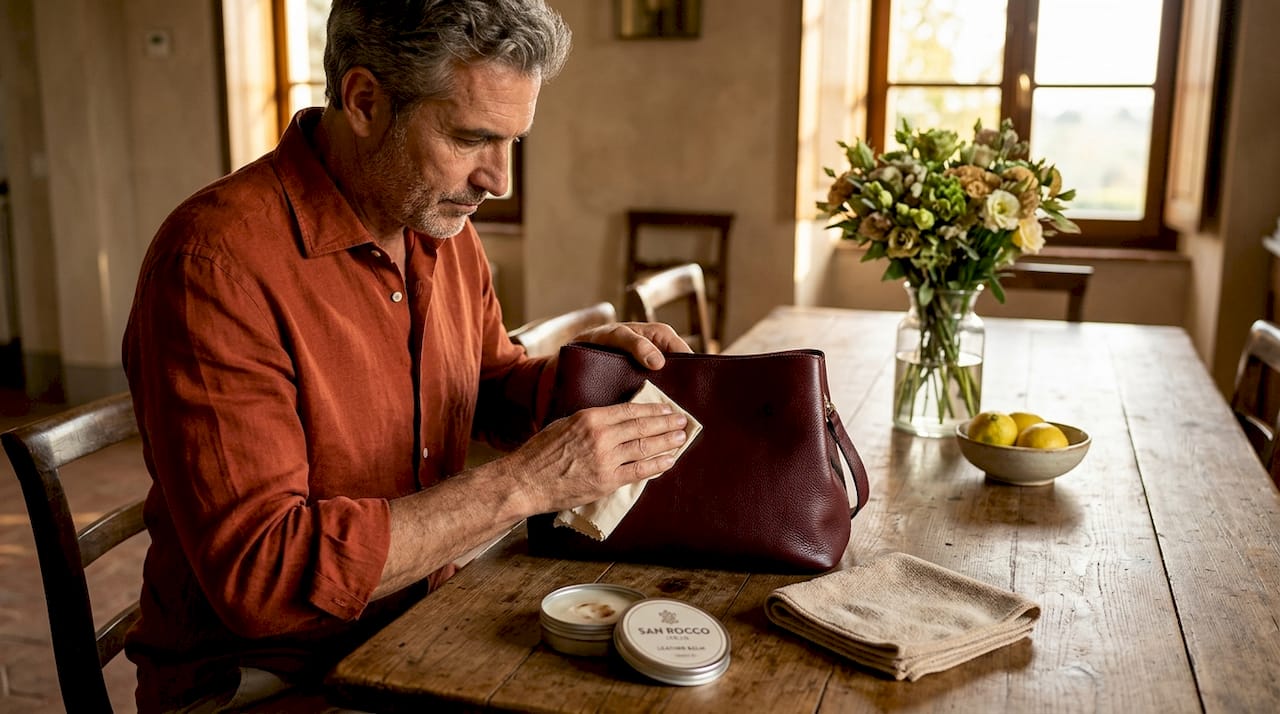
Luxury full-grain Italian leather contains natural oils and fats introduced during the tanning process. These oils keep the fibres pliable, give the leather its characteristic feel and sheen, and protect against cracking. Cleaning, time, heat, and even ordinary use gradually deplete these oils. Conditioning replenishes them. However, too much conditioning suffocates the leather, leaves a greasy residue, attracts dust, and can even alter the colour of lighter shades.
Conditioning should be done sparingly, approximately once or twice per year for most luxury leather handbags. A product designed to nourish and penetrate without leaving greasy residue is the only appropriate choice. Explore options in our guide to the best conditioner for bags and learn more about leather treatment details for structured Italian styles.
Signs you may be over-conditioning
- The leather surface feels tacky or greasy to the touch after application
- Dust and lint adhere to the surface more readily than before
- Lighter coloured leathers appear darker or unevenly toned
- The leather feels heavy or stiff rather than supple
- Stitching threads show discolouration from absorbed product
How to apply conditioner correctly
- Apply a pea-sized amount of conditioner to a clean, dry microfibre cloth.
- Work the product into the cloth first to distribute it evenly.
- Apply to the leather using small, circular motions, one section at a time.
- Use only as much as the leather visibly absorbs within 30 seconds. If product sits on the surface, you have applied too much.
- Buff gently with a clean, dry cloth after application.
- Allow the bag to rest and absorb the conditioner for at least one hour before using or storing it.
A useful reference point for leather care techniques confirms that restraint is the guiding principle: use the minimum effective amount, applied infrequently.
Pro Tip: Never use household oils such as olive oil, coconut oil, baby oil, or petroleum jelly on luxury Italian leather. These substances do not penetrate leather fibres correctly, they go rancid over time within the material, attract bacteria, and leave permanent dark staining. They are not a natural substitute for a specialist conditioner; they are a guaranteed way to ruin a fine bag.
Troubleshooting and common luxury handbag care mistakes
Even with care, accidents happen. Here is what you need to know for damage control, and how to minimise the consequences when something goes wrong.
The most common mistakes
Many visible problems with luxury leather bags are not caused by everyday use at all. They result from well-meaning but inappropriate cleaning attempts. The top mistakes include:
- Using too much water, resulting in watermarks, stiffness, and texture change
- Applying household cleaning sprays, surface wipes, or multi-purpose products
- Using heat to dry the leather after cleaning or an accidental spill
- Rubbing vigorously at a stain, which spreads the mark and damages the surface coating
- Applying conditioner too frequently, leading to residue build-up and discolouration
- Storing the bag in a plastic cover, which traps moisture and encourages mildew
Quick fixes for accidental situations
- Liquid spill (water, tea, coffee): Blot the surface immediately and gently with a clean, dry cloth. Do not rub. If water soaks in, blot immediately and air-dry slowly, well away from heat or direct sunlight. Once fully dry, apply a small amount of conditioner to the affected area to rebalance moisture.
- Over-conditioning: Buff the surface firmly with a clean, dry cloth to remove as much excess product as possible. Leave the bag uncovered in a well-ventilated room for 24 to 48 hours to allow absorption and evaporation of the excess.
- Sun exposure or colour fade: Prevention is the only true solution here. Faded colour requires professional attention. See below.
- Transfer stains from denim or dark fabric: Treat as soon as you notice them, using a small amount of pH-balanced leather cleaner on a cotton swab, applied with a very light touch. Do not rub aggressively.
A note on panic: Discovering a stain or spill on an expensive handbag is distressing, but hasty action almost always makes matters worse. Stop. Breathe. Blot gently, do not rub. Then allow the material to dry completely before making any further decisions. A dry stain is nearly always easier to address than a wet one that has been spread by hurried rubbing.
Knowing when not to intervene yourself is just as important as any technique. For deep stains, structural damage, or significant colour change, consult a professional leather restoration specialist. Attempting aggressive home repair on a fine Italian bag often escalates the damage considerably.
For guidance on protecting your bag between uses, our advice on storing handbags safely is essential reading. Our guide to purse care basics also covers the fundamentals of everyday handling and protection.
The truth most handbag owners overlook about leather care
Here is a perspective we hold firmly at San Rocco Italia, one that sometimes surprises our clients: the single greatest threat to a luxury Italian leather handbag is not everyday use. It is over-intervention.
We see it regularly. A woman notices the faintest trace of surface dust and immediately reaches for a cloth and a product she found in a well-meaning article. She cleans her bag with the same frequency she cleans her kitchen surfaces. Within two years, the leather shows premature dryness, fine surface cracking, and a dulled patina that should have deepened beautifully with age. She wonders what went wrong. The answer, almost always, is too much care rather than too little.
Italian full-grain leather is designed to develop character over time. The natural oils in the hide, combined with skilled tannery work, create a material that is genuinely resilient when left to behave as it should. Light, routine maintenance (a gentle weekly dust removal with a dry cloth) is largely all the leather requires. Deeper cleaning and conditioning should be event-driven, triggered by visible soiling or seasonal changes, not performed on a fixed frequent schedule regardless of actual need.
The contrarian truth is this: most of the visible deterioration people attribute to “wear” is actually the cumulative result of inappropriate cleaning attempts. The silver ring mark from a cleaning product applied directly. The pale streak from a wipe with a cloth that was slightly too wet. The texture change from a conditioner that was applied monthly rather than annually. These are human-made problems, and they are entirely avoidable.
Our advice is to treat your luxury leather handbag as you would a piece of designer silk or a delicate cashmere coat. You would not wash cashmere weekly on a whim. You would handle it with considered restraint, intervening only when genuinely necessary, and trusting the material’s inherent quality to do most of the work. The same philosophy applies here.
Knowing when to call in a professional is also a mark of wisdom rather than defeat. A qualified leather restoration specialist can address issues that no home remedy will solve: deep dye transfer, mould, structural softening, or hardware tarnish that has penetrated the surrounding leather. The cost of professional care is almost always significantly less than the cost of replacing a fine Italian piece. Learn how to clean bags safely and when to step back, as this is arguably the most valuable skill a luxury bag owner can develop.
Discover luxury care solutions for timeless handbags
Caring for a truly exceptional Italian leather handbag deserves the same level of attention and expertise that went into creating it. At San Rocco Italia, we believe that outstanding craftsmanship and informed care are two sides of the same coin.

Our curated collection of care guides, expert cleaning advice, and handpicked product recommendations is designed specifically for women who take their leather investment seriously. Whether you want to deepen your knowledge of maintenance techniques, explore the San Rocco Italia collection of artisan-crafted Italian leather handbags, or simply find a trusted next step after an accidental spill, our resources are here to guide you. When you are ready to invest in beauty that lasts a lifetime, we are ready to help you protect it.
Frequently asked questions
How often should I clean my luxury handbag at home?
A weekly dust removal with a soft microfibre cloth is sufficient for routine maintenance; a deeper clean should only be done when genuinely needed, as excessive cleaning accelerates leather ageing.
Is baby wipe or soap safe for Italian leather bags?
No. Only pH-balanced, leather-specific products are appropriate, as pH-balanced cleaners are formulated to match leather’s natural acidity level, whereas baby wipes and soap will strip the natural oils and surface finish over time.
How do I fix water stains or spills on a luxury bag?
Blot excess moisture immediately and gently with a clean dry cloth, then allow the bag to air-dry slowly at room temperature, well away from heat and sunlight, and never rub the affected area.
How often should luxury leather handbags be conditioned?
Condition sparingly, once or twice per year at most, using a specialist leather conditioner designed to penetrate without leaving a greasy residue.
What is the safest way to store my Italian leather handbag?
Store your bag in its original dust bag, lightly filled with tissue paper to maintain its shape, in a cool and dry location away from direct sunlight, humidity, and plastic covers that trap moisture.
