


Choose timeless navy blue leather handbags crafted in Italy
Finding a handbag that balances luxury, durability, and ethical production can feel overwhelming when so many brands prioritise fast fashion over lasting quality. Many women assume all leather handbags are created equal, yet the reality is far more nuanced. Navy blue leather bags offer both versatile style and enduring sophistication, especially when crafted using traditional Italian methods. Italian craftsmanship with vegetable-tanned full-grain leather delivers a superior, sustainable choice that develops character over decades, making each piece a genuine investment in timeless elegance.
Table of Contents
- Key takeaways
- Understanding Italian craftsmanship in navy blue leather handbags
- Selecting full-grain over top-grain leather for lifelong durability
- Sustainability in Italian leather handbags: responsible sourcing and eco-friendly tanning
- Choosing and caring for your navy blue leather handbag
- Discover Italian navy blue leather handbags at San Rocco Italia
- Frequently asked questions about navy blue leather handbags
Key Takeaways
| Point | Details |
|---|---|
| Vegetable tanning benefits | Vegetable tanning preserves the natural grain and uses botanical tannins, delivering a chemical free process with a reduced environmental footprint. |
| Full grain durability | Full grain leather retains the complete surface with natural markings, offering superior longevity and structural durability. |
| Patina development | Navy dye penetrates deeply, evolving colour over time as oils and wear create a unique character. |
| Brand exemplars | Brands such as VERA ITALY and San Rocco Italia illustrate the blend of quality, style and sustainability. |
| Care extends lifespan | Regular conditioning helps preserve appearance and extend the handbag’s lifespan. |
Understanding Italian craftsmanship in navy blue leather handbags
Italian leather production represents centuries of refined artisan skill, particularly in Tuscany where master craftspeople maintain traditional methods passed down through generations. The vegetable tanning process forms the foundation of this excellence, using natural tannins extracted from tree bark, leaves, and other botanical sources. This meticulous approach takes approximately 60 days to complete, far longer than industrial alternatives, yet the results justify every patient hour.
Vegetable tanning preserves the complete natural grain of the leather, allowing each hide to retain its unique characteristics and surface texture. Unlike chrome tanning, which strips away natural fibres and requires harsh chemicals, vegetable methods work with the leather’s inherent structure. The process involves slowly rotating hides in large drums filled with tannin-rich solutions, gradually building up layers of natural compounds that bind to the collagen fibres. This chemical-free approach reduces environmental impact dramatically, cutting water consumption by nearly half and eliminating toxic discharge entirely.
The navy blue dye used in premium Italian handbags penetrates deeply into these vegetable-tanned fibres, creating colour that evolves rather than fades. As you carry your bag through daily life, the surface develops a rich patina that tells your unique story. Natural oils from your hands, subtle exposure to sunlight, and the gentle friction of use all contribute to this transformation. The depth of colour achieved through proper dyeing techniques means your navy handbag will shift from a uniform shade to a nuanced spectrum of blues, with lighter tones emerging at stress points and darker hues settling into creases.
Traditional Tuscan workshops employ skilled artisans who inspect every centimetre of leather before cutting patterns. These craftspeople understand how different sections of a hide behave, selecting the firmest areas for structural components and more supple sections for decorative elements. They hand-stitch critical stress points, ensuring seams withstand years of weight and movement. This level of attention creates Italian leather bags that function as reliably as they impress aesthetically.
Pro Tip: When examining Italian navy leather, look for slight variations in colour and texture across the surface. Perfect uniformity often indicates synthetic treatment or lower-quality processing.
- Vegetable tanning preserves natural grain structure and eliminates harsh chemicals
- The 60-day process allows tannins to bind thoroughly with leather fibres
- Navy dye penetrates deeply, creating colour that evolves beautifully with age
- Tuscan artisans select optimal hide sections for each handbag component
Selecting full-grain over top-grain leather for lifelong durability
The distinction between full-grain and top-grain leather determines whether your handbag becomes a cherished heirloom or a temporary accessory. Full-grain leather retains the entire natural surface of the hide, including all the subtle markings, pores, and texture variations that prove authenticity. These natural characteristics might seem like imperfections at first glance, yet they represent the leather’s strongest fibres and most durable structure. Each hide carries unique patterns from the animal’s life, making your navy handbag genuinely one of a kind.
Top-grain leather undergoes sanding and buffing to remove these natural features, creating a uniform surface that initially appears flawless. Manufacturers then apply artificial grain patterns and pigmented finishes to simulate natural texture. Whilst this process produces consistent colour and appearance, it fundamentally weakens the leather’s structure. The sanding removes the tightest, most resilient fibres, leaving behind material that looks impressive in the shop but deteriorates faster with regular use.
Full-grain leather develops patina that enhances beauty over decades, whilst top-grain finishes crack and peel as protective coatings break down. For affluent women seeking investment-quality bags, this difference translates to decades of use versus a few years before replacement becomes necessary. The natural oils in full-grain leather allow it to flex and bend without cracking, whilst top-grain’s rigid finish eventually fails at stress points.

| Feature | Full-grain leather | Top-grain leather |
|---|---|---|
| Surface treatment | Completely natural, untouched | Sanded and buffed smooth |
| Durability | Exceptional, lasts decades | Good, typically 5-10 years |
| Patina development | Rich, unique character emerges | Limited, coating may crack |
| Natural markings | Visible and celebrated | Removed, artificial grain added |
| Care requirements | Simple conditioning | Frequent treatment needed |
| Investment value | Increases with age | Decreases over time |
The texture of full-grain navy leather feels substantial in your hands, with natural resistance that signals quality. When you press your thumb into the surface, it springs back without leaving permanent indentation. Top-grain leather feels softer initially but lacks this resilient response. Understanding these differences helps you identify authentic quality when shopping, ensuring your investment delivers the longevity you expect from Italian craftsmanship.
Pro Tip: Examine the leather’s edge when possible. Full-grain shows consistent fibre structure throughout the thickness, whilst top-grain often reveals a thin coloured layer over lighter material beneath.
- Full-grain retains complete natural surface for maximum strength
- Top-grain sanding weakens structural integrity for cosmetic uniformity
- Patina development distinguishes top grain leather bags from full-grain investment pieces
- Natural markings prove authenticity and predict exceptional durability
- Best leather for handbags prioritises full-grain for lifelong value
Sustainability in Italian leather handbags: responsible sourcing and eco-friendly tanning
Modern Italian leather production embraces sustainability as a core principle, not merely a marketing angle. Ethical sourcing begins with utilising byproducts from the meat industry, ensuring no animals are raised or killed solely for their hides. This approach transforms what would otherwise become waste into beautiful, functional accessories. Tanneries work directly with certified suppliers who provide traceability documentation for every hide, confirming humane treatment and proper processing standards.
Vegetable tanning processes eliminate chrome entirely, removing the primary source of toxic runoff in traditional leather production. Chrome tanning requires heavy metals that contaminate water supplies and soil when improperly managed. By contrast, vegetable tanning reduces water consumption by approximately 50% and produces biodegradable waste that can be composted or recycled. The natural tannins break down harmlessly, leaving no persistent pollutants in the environment.
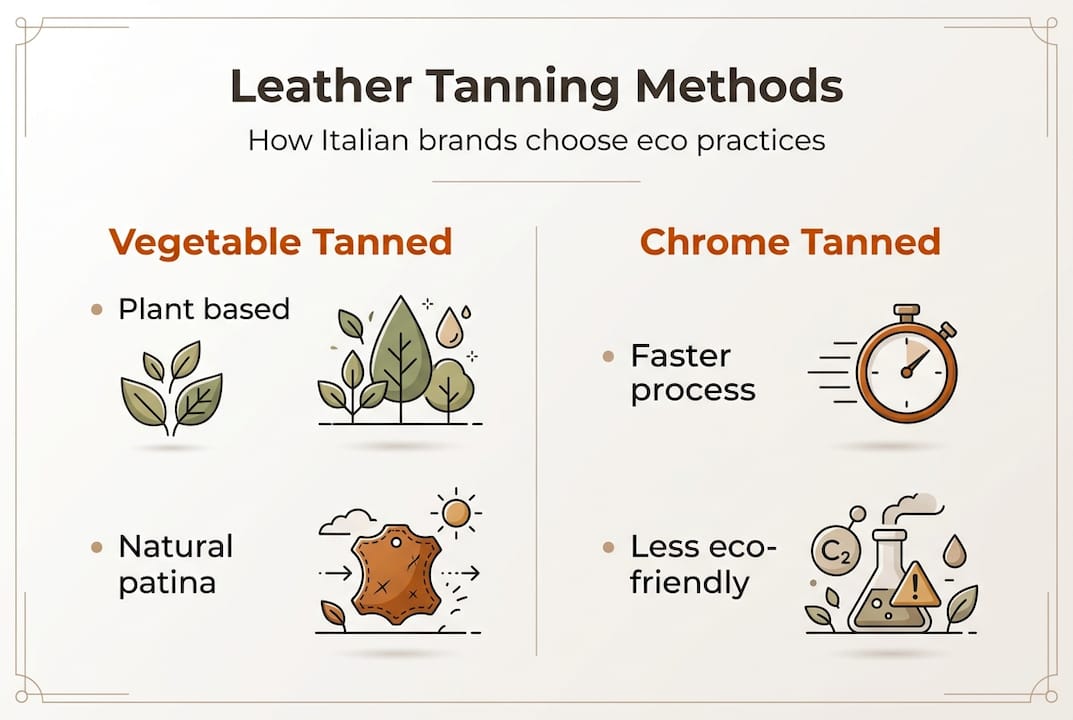
Innovative Italian workshops now upcycle leather scraps that previous generations would have discarded. Small pieces become decorative elements, interior pockets, or even compressed into new composite materials. This circular approach minimises waste whilst maintaining the artisan tradition of using every valuable resource. Some tanneries have achieved zero-waste certification by implementing comprehensive recycling programmes for water, chemicals, and organic matter.
Brands adopting green methods demonstrate stronger long-term business resilience, with studies showing sustainable practices double survival rates compared to conventional manufacturers. This business advantage stems from growing consumer demand for ethical luxury and regulatory pressures favouring environmentally responsible production. For professional women over 35 who value both style and substance, these practices align perfectly with quiet luxury aesthetics that prioritise quality over conspicuous consumption.
Sustainability extends beyond production methods to encompass the entire lifecycle of your handbag. A well-made navy leather piece from Italy will serve you for decades, eliminating the need for frequent replacements that burden landfills. The natural materials biodegrade eventually, unlike synthetic alternatives that persist for centuries. Choosing sustainable luxury handbags means investing in fashion that respects both your values and the planet’s future.
- Ethical sourcing uses meat industry byproducts, preventing waste
- Vegetable tanning eliminates chrome and reduces water use by 50%
- Upcycling programmes transform scraps into valuable components
- Green production methods double long-term business survival rates
- Decades-long durability reduces environmental impact per use
Choosing and caring for your navy blue leather handbag
Authenticating a genuine Italian navy blue leather handbag requires examining several key indicators that reveal true craftsmanship. Start by inspecting the stitching closely, looking for even, tight rows that follow precise lines without wavering. Hand-stitched seams often show slight variations in tension that prove human craftsmanship, whilst machine stitching appears perfectly uniform. The thread should match or complement the leather colour, and critical stress points like handle attachments should feature reinforced double or triple stitching.
Natural grain variations tell the most honest story about leather quality. Run your fingers across the surface, feeling for subtle texture changes and noting how light reflects differently across various areas. Genuine full-grain leather displays pores, slight wrinkles, and occasional natural markings that prove its organic origin. If the surface feels plasticky or shows perfectly uniform texture, you’re likely examining top-grain or synthetic material. Press firmly with your thumb and watch how quickly the leather springs back, a sign of proper tanning and quality fibres.
Conditioning extends handbag life significantly whilst encouraging beautiful patina development. Apply a high-quality leather conditioner formulated specifically for vegetable-tanned leather every three to six months, depending on use frequency and climate conditions. Work the conditioner into the leather using circular motions with a soft cloth, paying extra attention to areas that experience the most handling. Allow the conditioner to absorb for at least 30 minutes before buffing away any excess with a clean, dry cloth.
- Examine stitching for evenness and reinforcement at stress points
- Feel for natural grain variations and texture inconsistencies
- Test leather resilience by pressing firmly and observing spring-back
- Apply vegetable-tanned leather conditioner every three to six months
- Avoid overpacking to maintain shape and prevent strain on seams
- Store in breathable dust bags away from direct sunlight and heat
- Clean gently with barely damp cloth, never soaking the leather
- Address spills immediately by blotting, not rubbing the surface
Avoiding overpacking preserves your handbag’s elegant silhouette and prevents unnecessary stress on the natural leather fibres. Full-grain leather maintains its shape beautifully when used as designed, but excessive weight can cause permanent stretching or sagging. Distribute weight evenly within the bag rather than concentrating heavy items in one area. Consider rotating between multiple handbags if you regularly carry substantial loads, allowing each piece adequate rest time to recover its natural form.
Gentle cleaning routines protect the leather’s surface whilst removing accumulated dirt and oils. Use a barely damp cloth to wipe the exterior, working in the direction of the grain rather than against it. Never soak vegetable-tanned leather or use harsh detergents that strip away natural oils. For stubborn marks, specialised leather cleaners designed for vegetable-tanned materials offer effective solutions without damaging the patina you’ve carefully developed.
Pro Tip: Minor scratches and scuffs actually enhance vegetable-tanned leather’s character. Apply conditioner to blend these marks into the developing patina rather than attempting to remove them completely. This approach celebrates your handbag’s unique journey whilst maintaining its structural integrity.
Discover Italian navy blue leather handbags at San Rocco Italia
Now that you understand what distinguishes exceptional Italian leather craftsmanship, exploring curated collections becomes an exciting journey rather than an overwhelming task. San Rocco Italia offers vegetable-tanned, full-grain navy blue leather handbags that embody every principle discussed throughout this article. Each piece originates from prestigious Tuscan workshops where artisans apply centuries of inherited knowledge to contemporary designs.
The collection features designs that transition seamlessly from professional settings to evening occasions, proving that sustainable luxury never compromises on versatility. You’ll discover structured totes with reinforced bases for daily essentials, elegant crossbody styles for hands-free convenience, and sophisticated shoulder bags that complement both tailored suits and casual weekend attire. Every handbag supports ethical fashion principles whilst delivering the longevity that makes Italian leather legendary.
San Rocco Italia prioritises transparency about sourcing and production methods, providing detailed information about each piece’s origin and the artisans who created it. Shopping confidently means knowing your investment supports fair labour practices, environmental responsibility, and the preservation of traditional craftsmanship. Explore the best leather handbags for 2026 and discover how sustainable luxury enhances both your wardrobe and your values.
Frequently asked questions about navy blue leather handbags
What makes vegetable-tanned leather better than chrome-tanned?
Vegetable tanning uses natural botanical compounds over 60 days, preserving the leather’s complete grain structure and eliminating toxic chemicals entirely. Chrome tanning requires heavy metals that weaken fibres and create environmental hazards, whilst vegetable methods produce biodegradable waste and leather that develops beautiful patina over decades.
How can I tell if a navy blue handbag is full-grain leather?
Examine the surface for natural markings, pores, and slight texture variations that prove the hide’s complete outer layer remains intact. Full-grain leather shows consistent fibre structure when you view the edge, whilst top-grain reveals a thin coloured coating over lighter material beneath. Press firmly to test resilience; genuine full-grain springs back immediately without permanent indentation.
What are the best care products for vegetable-tanned leather handbags?
Choose conditioners specifically formulated for vegetable-tanned leather, avoiding products containing silicone or petroleum derivatives that can interfere with natural patina development. Apply every three to six months using a soft cloth, working the conditioner into the leather with circular motions. Quality brands often provide pH-balanced cleaners that remove dirt without stripping beneficial oils.
Why is navy blue a good colour choice for professional handbags?
Navy blue offers versatile sophistication that complements virtually every colour palette in professional wardrobes, from neutral greys and blacks to bold jewel tones. The depth of navy appears more interesting than basic black whilst maintaining the same level of formality and elegance. As vegetable-tanned navy leather develops patina, it gains character without looking worn or dated.
Are sustainable Italian leather handbags more expensive?
Initial investment typically exceeds fast fashion alternatives, yet the decades-long lifespan and timeless design deliver superior value per use. Sustainable production methods and artisan craftsmanship justify premium pricing, whilst the handbag’s durability eliminates frequent replacement costs. Quality Italian leather appreciates aesthetically with age, making it a genuine investment rather than a disposable purchase.
Recommended
- Best Leather for Handbags: Italian Quality and Timeless Style – San Rocco Italia
- Choose timeless leather tote bags with Italian craft – San Rocco Italia
- Best Leather Handbags 2026: 40% More Durable & Timeless – San Rocco Italia
- Navy Handbag Leather – Italian Craftsmanship Unveiled – San Rocco Italia
