


Artisanal vs designer handbags: what to choose
TL;DR:
- Artisanal handbags are defined by handmade craftsmanship, full-grain leather, and timeless design, ensuring longevity.
- Designer bags focus on brand recognition, seasonal trends, and vary widely in material quality and construction.
When you’re weighing up artisanal vs designer handbags, the decision quickly becomes more complex than it first appears. Brand names carry cultural weight, but craftsmanship tells a different story entirely. Knowing how to read both is what separates a purchase you’ll cherish for decades from one that loses its shine within a couple of seasons. This article breaks down the defining criteria, walks through real examples from both worlds, and gives you a clear framework to match your priorities to the right bag.
Table of Contents
- Key takeaways
- 1. The core differences in artisanal vs designer handbags
- 2. Material quality: what the leather actually tells you
- 3. Construction techniques: saddle stitching vs machine stitching
- 4. Design philosophy: timeless craft versus brand aesthetics
- 5. Notable features of artisanal handbags
- 6. Designer handbags under £450: what the market actually offers
- 7. Side-by-side comparison: how the two categories stack up
- 8. Situational recommendations: matching the bag to the buyer
- My honest take on this choice, after years of looking closely at bags
- Experience Italian artisan craftsmanship at Sanroccoitalia
- FAQ
Key takeaways
| Point | Details |
|---|---|
| Craftsmanship drives longevity | Artisanal bags built with saddle stitching and burnished edges outlast machine-made bags by years, sometimes decades. |
| Designer pricing varies widely | Accessible designer options exist between roughly £120 and £380, making luxury branding more attainable than many assume. |
| Material quality differs by origin | Full-grain and vegetable-tanned leathers signal artisanal quality; designer bags vary considerably by price tier. |
| Each suits different priorities | Artisanal bags reward buyers who value uniqueness and durability; designer bags offer brand recognition and trend relevance. |
| Care habits affect both equally | Conditioning leather and handling natural fibres correctly extends the life of any bag, regardless of its origin. |
1. The core differences in artisanal vs designer handbags
The confusion between artisanal and designer bags comes down to a fundamental misunderstanding of what each category actually sells. Designer bags sell identity. Artisanal bags sell process. Neither is wrong, but conflating them leads to disappointing purchases.
A designer bag is defined by its brand house. Louis Vuitton, Mulberry, Burberry. These names carry heritage and aesthetic codes that signal membership in a particular cultural conversation. The production behind the bag varies enormously depending on the price tier and the house’s manufacturing commitments.
An artisan handbag, by contrast, is defined by how it was made. The artisan handbags definition centres on visible, human-led creation: hand stitching, manual edge finishing, and small-batch production where a single craftsperson may complete most or all of a bag. The maker’s skill is the product, not the logo.
Understanding this distinction is your starting point for every other comparison that follows.
2. Material quality: what the leather actually tells you
Not all leather is equal, and the gap between grades matters enormously over the lifespan of a bag. Full-grain leather, which retains the natural surface of the hide with minimal processing, is the strongest and most durable option available. It develops a patina over time rather than degrading, which is why an artisanal bag made from it can look more distinguished at ten years than it did on day one.
Vegetable-tanned leather is another mark of quality associated with traditional artisan production. It uses plant-based tannins rather than chemical processes, producing a leather that is firmer, more responsive to conditioning, and longer-lasting. Many Italian workshops, including those supplying Sanroccoitalia, use this method specifically because the results compound in quality over time.
Designer bags across all price points use varying grades of leather. A heritage house offering a bag at £1,200 may well use full-grain leather. A designer-branded bag at £180 is more likely to use corrected-grain or bonded leather, which has a uniform surface because the natural grain has been sanded down and re-embossed. It looks polished in the shop. It peels within a few years.
Pro Tip: Turn a bag over and look at the cut edges. Hand-burnished edges sealed with wax signal artisanal finishing; raw or plastic-coated edges that look too uniform almost always indicate machine production and are prone to cracking sooner.
3. Construction techniques: saddle stitching vs machine stitching
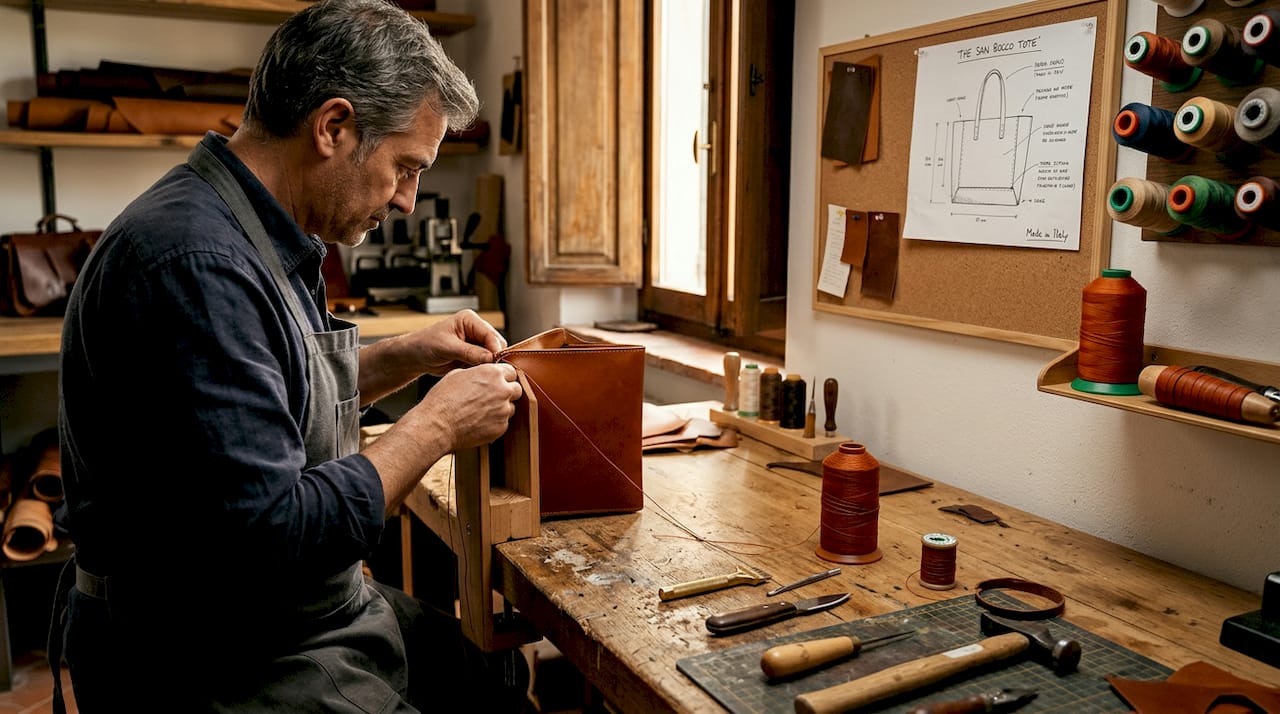
This is where the engineering argument for artisanal bags becomes impossible to ignore. Saddle stitching uses two needles passing through the same hole from opposite sides, locking each stitch independently. If one stitch breaks, the surrounding stitches hold. The seam stays intact.
Machine chain stitching, by contrast, uses a looping thread pattern. If one loop fails, the entire seam can progressively unravel. This is not a minor distinction. It is the difference between a bag that you repair a single thread on versus one that splits along a seam and requires a complete rebuild.
Artisanal bags with saddle stitching and hand-burnished edges can last two to three times longer than factory-made equivalents. The production time reflects this: handmade bags take 12 to 20 hours to create, compared to under an hour for factory production. You are not paying for a name. You are paying for time and precision.
Designer bags at the entry and mid-price tiers almost universally use machine stitching. Top-tier heritage houses sometimes employ hand-finishing on key areas, but full saddle stitching throughout a bag is almost exclusively an artisanal or bespoke feature.
4. Design philosophy: timeless craft versus brand aesthetics
The way each category approaches design reveals a great deal about its priorities. Artisan bags tend toward timeless forms: structured totes, simple crossbody shapes, and clean silhouettes that do not rely on logos or seasonal colour palettes. The identity is in the leather’s texture, the stitching rhythm, and the proportions. These are design decisions made to age well.
Designer bags operate on a fashion calendar. Seasonal collections, trend-led colours, and logo cycles mean that a bag purchased for its relevance in 2024 may read as dated by 2027. That said, the best designer houses understand the value of heritage design. The contrast between vintage heritage and contemporary minimalism is a deliberate aesthetic choice, not an accident, and buyers who understand this can find genuine longevity within the designer market.
The practical implication is straightforward. If you want a bag that works across contexts for a decade without requiring updates, the design philosophy of artisanal production aligns more naturally with that goal.
5. Notable features of artisanal handbags
Understanding what to look for makes the handbag style comparison much easier in practice. Artisanal bags typically share a set of defining characteristics that set them apart from factory output:
- Hand stitching with visible variation. No two saddle-stitched seams look identical under close inspection. That subtle human variation is a quality signal, not a flaw.
- Full-grain or vegetable-tanned leather. The surface feels different: more supple in some grades, firmer in others, but always with natural texture rather than an embossed uniformity.
- Small-batch or made-to-order production. Many artisan brands offer repair or lifetime service options, reinforcing that the bag is intended as a long-term companion rather than a seasonal purchase.
- Burnished, wax-sealed edges. Run your finger along the edge of the strap. A smooth, sealed finish that feels almost waxy signals proper finishing. A rough or painted edge does not.
- Cultural and regional provenance. Italian leather goods, for example, carry centuries of workshop tradition behind them. That heritage shapes technique, material sourcing, and finishing standards in ways that are genuinely detectable in the finished object.
Pro Tip: Ask any artisan brand directly where the leather is tanned and who stitches the bag. A confident, specific answer is a strong indicator of genuine craftsmanship. A vague response about “quality suppliers” is not.
The emotional dimension matters here too. An artisan bag carries what might be called a creation story: the visible evidence of a person’s skill and judgement at every stage. For many buyers, that is a meaningful part of what they are investing in.
6. Designer handbags under £450: what the market actually offers
The accessible end of the designer market is worth examining carefully because the range is wider than most people expect. Fashion editorial sources for 2026 place well-regarded designer bags between approximately £120 and £380, with recognised names offering structured leather totes, crossbody bags, and minimalist shoulder styles at these price points.
| Designer bag feature | What to expect in this price tier |
|---|---|
| Material | Corrected-grain leather, coated canvas, or occasional genuine leather |
| Stitching | Machine stitching throughout; minimal hand finishing |
| Design | Brand logo details, seasonal colourways, trend-aligned silhouettes |
| Durability | 3 to 7 years with proper care; edges and lining may show wear sooner |
| Repairability | Limited; brand repair services vary widely and can be costly |
The designer bag features that genuinely justify their pricing in this tier are brand recognition, considered design, and in some cases, genuinely well-chosen hardware. Brands that prioritise versatility and minimalism over heavy logo placement tend to offer better long-term value within this category because the bags remain stylish across more contexts and years. For guidance on which designer styles last, understanding the heritage of a brand’s core silhouettes is more reliable than following a season’s editorial picks.
Care also matters significantly at this level. Natural fibres require gentle handling, and full-grain leather benefits from regular conditioning regardless of the brand on the label. A mid-range designer bag that is conditioned monthly and stored properly will outlast an equivalent bag that is treated casually by several years.
7. Side-by-side comparison: how the two categories stack up
The question of whether artisanal is better than designer handbags does not have a single answer. It depends on what you are actually optimising for. This comparison lays out the key trade-offs clearly.
| Criterion | Artisanal handbags | Designer handbags |
|---|---|---|
| Construction | Saddle stitching, hand-finished | Machine stitching, some hand-finishing at top tiers |
| Leather quality | Full-grain, vegetable-tanned | Varies widely by price and brand |
| Design intent | Timeless craft, maker’s identity | Brand aesthetics, seasonal relevance |
| Price range | £150 to £800+ depending on maker | £120 to £2,000+ depending on brand tier |
| Longevity | 15 to 30+ years with care | 3 to 15 years depending on materials |
| Repairability | Often excellent; many makers offer services | Limited at most price tiers |
| Brand recognition | Niche; story-driven | Immediate; widely recognised |
| Emotional value | Maker’s story, provenance, individuality | Status signalling, community belonging |
The durability gap is the most objective difference. Saddle stitching’s engineering ensures that if one stitch fails, the surrounding stitches remain intact, and this structural advantage compounds over years of use. No machine-stitched bag can replicate that property regardless of its price point.
Pro Tip: If you are spending more than £300 on any handbag, ask whether it can be repaired. An artisan who will resole a strap or re-burnish an edge in five years is offering you a fundamentally different ownership experience to a brand whose repair service costs nearly as much as a replacement.
8. Situational recommendations: matching the bag to the buyer
The most useful question is not which category is objectively superior. It is which category fits your actual life and priorities. Here is a straightforward guide:
Choose an artisanal bag when:
- You want a bag that improves with age and develops a personal patina
- Uniqueness matters to you and you want something that does not appear in every office or restaurant you walk into
- You are buying with a 10-plus-year horizon and want repairability to be part of the deal
- You appreciate knowing the provenance of what you own, from the tannery to the workshop
- You are interested in Italian craft tradition or other regional artisan heritage
Choose a designer bag when:
- Brand recognition is part of what you are buying, whether for professional contexts or personal satisfaction
- You want to engage with fashion trends and update your bag wardrobe every few years
- You have a specific budget closer to £150 to £250 and want a well-designed option with recognisable heritage
- The occasion calls for a specific aesthetic that a particular designer house handles exceptionally well
A genuinely useful strategy for many buyers is to do both. Invest in one artisanal bag that serves as your everyday workhorse for years. Then supplement with a more trend-led designer piece for occasions where brand context matters. This is how experienced buyers in fashion circles tend to organise their wardrobes, and it makes financial and practical sense for most lifestyles.
When verifying authenticity in either category, look for documentation of where the leather was sourced, photographs or descriptions of the production process, and a direct point of contact at the brand or workshop.
My honest take on this choice, after years of looking closely at bags
I’ve spent years looking at handbags across every price tier, and the single biggest misconception I encounter is the assumption that a higher price on a designer bag means better construction. It almost never does below £600. What you are paying for is the name, the packaging, and the cultural currency of being seen with that particular logo. That is a legitimate thing to buy. But call it what it is.
What genuinely impresses me every time I handle a well-made artisanal piece is how immediately the quality communicates itself. The weight of the leather, the rhythm of the stitching, the way the edge of a strap feels under your thumb. These are not subtle differences. Once you know what to look for, a machine-finished bag feels noticeably provisional by comparison.
I’ve also noticed that buyers who choose artisanal bags tend to have a different relationship with their bags over time. They condition them, repair them, and keep them for decades. Buyers of trend-led designer bags tend to rotate them more frequently. Neither approach is wrong, but they represent genuinely different philosophies about objects and ownership.
My personal view is that the artisanal market is significantly underappreciated because it lacks the marketing budget of the major houses. The bags themselves are often extraordinary. The difficulty is finding makers whose quality is consistent and whose provenance is transparent. When you find that combination, the value is remarkable relative to what a comparable designer name would cost. For practical guidance on choosing durable pieces, the principles are consistent regardless of which direction you lean.
— Mara
Experience Italian artisan craftsmanship at Sanroccoitalia
If this comparison has made you curious about what genuinely artisanal production looks like in practice, Sanroccoitalia is a good place to start. The collection features handbags and leather goods made in Italy by skilled artisans using premium full-grain leather and traditional techniques, including the same hand-finishing and construction standards described throughout this article. Every piece is chosen for quality and longevity, not seasonal relevance.
You can explore the full range of Italian leather handbags directly on the site, or read further on how to approach styling luxury handbags for everyday and occasion wear. Sanroccoitalia is a woman-owned boutique, and the curation reflects a genuine commitment to pieces that earn their place in your wardrobe for years.
FAQ
What is the definition of an artisan handbag?
An artisan handbag is one made primarily by hand using traditional techniques such as saddle stitching and hand-burnished edge finishing, typically in small batches or made to order by a skilled craftsperson rather than in factory production.
Are artisanal handbags more durable than designer bags?
Artisanal bags built with saddle stitching and full-grain leather can last two to three times longer than factory-made equivalents, largely because saddle stitching locks each stitch independently and prevents seam unravelling.
Why choose artisanal handbags over designer options?
Artisanal handbags offer superior construction, repairability, and a maker’s provenance that mass production cannot replicate. They suit buyers prioritising longevity, individuality, and a deeper connection to what they own.
What features should I look for in a designer bag?
At accessible price points, prioritise hardware quality, edge finishing, and the brand’s core heritage silhouettes over seasonal colourways. Bags built around timeless shapes rather than logo-heavy styling tend to hold their appeal across more years and contexts.
Can I combine artisanal and designer bags in one wardrobe?
Absolutely. Many experienced buyers invest in an artisanal everyday bag for long-term use and supplement with a designer piece for occasions where brand context matters, balancing durability with trend relevance across their collection.
