


Leather bag maintenance guide: keep your luxury bags flawless
TL;DR:
- Regular cleaning and conditioning significantly extend the lifespan of luxury leather bags.
- Use appropriate, pH-neutral products and avoid damaging household or chemical cleaners.
- Proper storage and awareness of leather type are essential for maintaining bag beauty over time.
A beautiful leather bag can lose its lustre faster than you might expect. Daily use, humidity shifts, and the wrong products all quietly age the leather from the inside out. Regular cleaning routines can increase bag longevity five to ten times compared to neglect, which means the difference between a bag that lasts a season and one that becomes a family heirloom. If you own a luxury leather piece, whether it’s a structured Italian tote or a buttery Nappa clutch, it deserves more than an occasional wipe-down. This guide gives you a clear, expert-backed maintenance plan tailored to women who treat their bags as the investments they truly are.
Table of Contents
- What you need: tools and materials for luxury leather bag care
- Step-by-step daily and deep-cleaning routines
- Conditioning and restoring leather: the expert’s approach
- Protection, troubleshooting and avoiding common mistakes
- Material-specific care for different luxury leathers
- What the experts won’t tell you about luxury bag longevity
- Upgrade your care routine with expert solutions
- Frequently asked questions
Key Takeaways
| Point | Details |
|---|---|
| Routine is essential | Consistent cleaning and conditioning can multiply a leather bag’s lifespan several times over. |
| Use the right products | Always choose pH-neutral cleaners and branded conditioners tailored to your bag’s material. |
| Act quickly on spills | Immediate blotting and gentle care prevent stains and long-term damage. |
| Adapt care to material | Each luxury leather type needs a distinct maintenance routine for best results. |
| Expert touch matters | Professional cleaning or restoration services offer extra insurance for prized designer handbags. |
What you need: tools and materials for luxury leather bag care
To prepare for effective maintenance, it’s best to have the right kit at hand. Here’s everything you’ll need before starting your routine.
Having the correct tools is not about spending more money. It’s about avoiding the kind of irreversible damage that comes from using the wrong cloth or a product with the wrong pH. Luxury leather is a natural material, and it responds badly to shortcuts.
Your essential kit
Start with these non-negotiables:
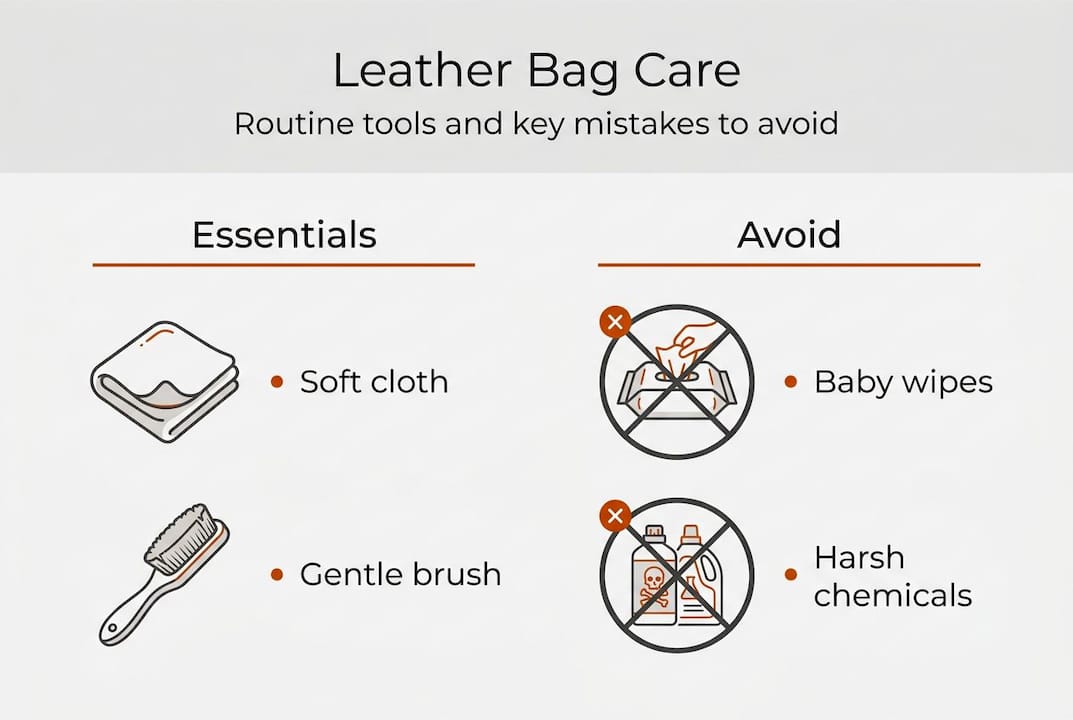
- Microfibre cloths (at least two, one for cleaning and one for buffing)
- Soft horsehair brush for removing surface dust without scratching
- pH-neutral leather cleaner such as Leather Honey, Saphir Renovateur, or a brand-specific option like the Coach Moisturizer
- Leather conditioner to restore suppleness after cleaning
- Waterproofing spray for smooth leathers (never use on suede or metallic finishes)
- Dust bag for storage between uses
Always use a pH-neutral cleaner and a soft microfibre cloth to avoid stripping the leather’s natural oils or scratching its surface.
Optional but worthwhile extras
- Silicone-free hardware polish for gold or silver fittings
- Nappa cream for delicate, soft leathers
- A suede brush and suede eraser for napped finishes
- Silica gel packets placed inside the bag during storage to control humidity
For a curated list of the best cleaning supplies for luxury leather, it helps to start with what professionals actually recommend rather than what’s marketed most heavily.
What to avoid entirely
Some products are actively harmful to luxury leather. Baby wipes contain alcohol, fragrance, and surfactants that strip the leather’s protective coating over time. Household cleaning sprays, nail varnish remover, and anything containing bleach or ammonia will cause permanent discolouration or cracking. Even some “leather” products sold in supermarkets contain silicone, which creates a temporary shine but blocks the leather’s pores and accelerates long-term deterioration.
Pro Tip: Before using any new product on your bag, always patch-test it on a hidden area, such as the base or inside a pocket seam. Wait 24 hours before proceeding. This one habit protects against irreversible mistakes.
Here’s a quick comparison of popular conditioners to help you choose:
| Product | Best for | Darkening effect | Residue |
|---|---|---|---|
| Leather Honey | Dry or cracked leather | Moderate | Low |
| Bick 4 | Light-coloured leathers | Minimal | Very low |
| Saphir Renovateur | High-end smooth leathers | Low | Low |
| Nappa cream | Soft, delicate leathers | Low | Minimal |
For a deeper look at leather conditioner options, comparing ingredients and results side by side can save you from a costly mistake.
Step-by-step daily and deep-cleaning routines
With your cleaning supplies prepared, you’re ready to start your routine. Let’s break down the optimal cleaning process step by step.
Daily upkeep (5 minutes)
- Empty the bag completely and shake out any debris
- Use a soft horsehair brush to sweep away surface dust
- Wipe the exterior with a dry microfibre cloth using light, even strokes
- Inspect the handles, corners, and base for early signs of wear or staining
- Return the bag to its dust bag if not in use
This five-minute habit prevents the build-up of grime that makes deep-cleaning harder and riskier.
Quarterly deep-clean
A thorough clean every three months keeps the leather in excellent condition without over-processing it. Wiping the exterior with a dry microfibre cloth, emptying the bag, and using a pH-neutral cleaner every three months is the professional standard for maintaining a luxury finish.
- Dust and empty the bag as above
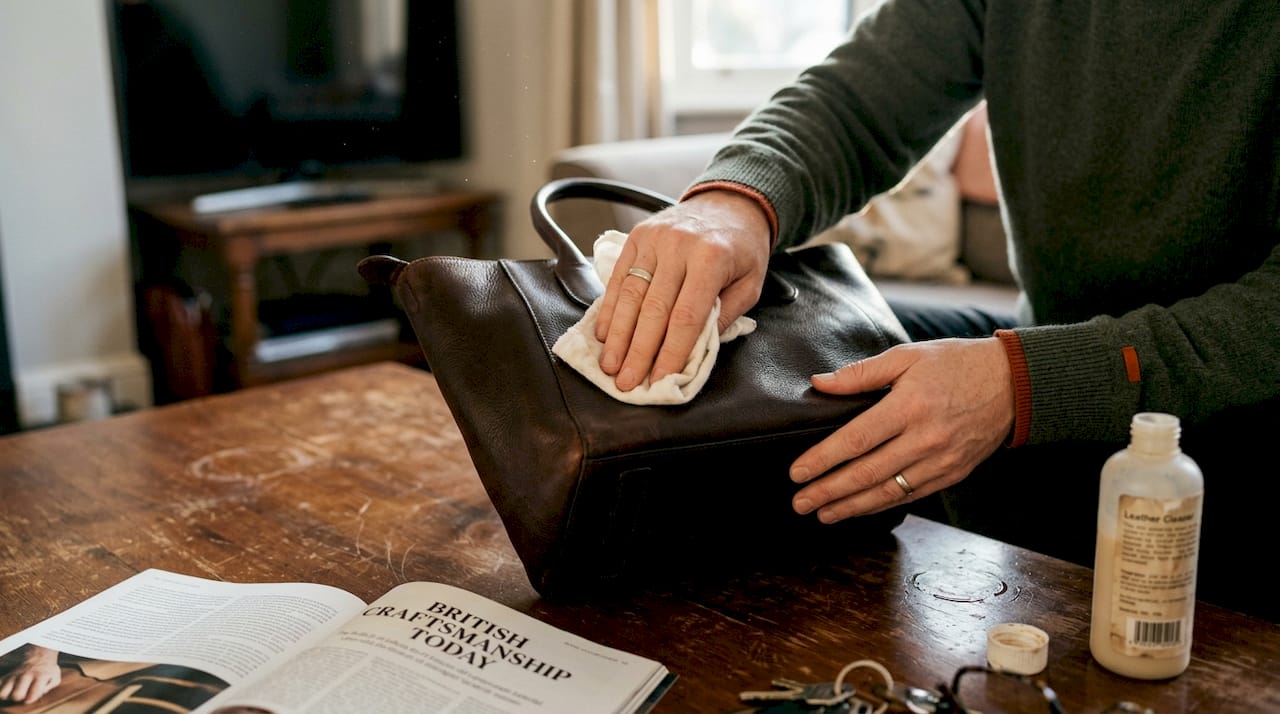
- Apply a small amount of pH-neutral cleaner to a damp (not wet) microfibre cloth
- Work in gentle circular motions across one section at a time
- Use a clean, dry cloth to remove any excess cleaner immediately
- Allow the bag to air dry for at least 30 minutes before conditioning
Using a leather-specific cleaner in circular motions and allowing 30 minutes of drying time prevents moisture from seeping into the leather’s core, which is where cracking begins.
Removing small marks and light stains
For minor scuffs, a barely damp cloth with a tiny drop of cleaner is usually enough. Work from the outside of the stain inward to avoid spreading it. Never scrub. For ink or grease, stop immediately and consult a professional rather than experimenting with home remedies.
Never use a hairdryer, radiator, or direct sunlight to speed up drying. Heat causes leather to contract and crack. Always air dry at room temperature.
Pro Tip: If you use your bag daily, consider a light wipe-down every evening. It takes 60 seconds and prevents the kind of embedded grime that requires aggressive cleaning later.
Here’s a quick reference for cleaning frequency:
| Usage level | Wipe-down | Deep-clean |
|---|---|---|
| Daily use | Every evening | Every 3 months |
| Occasional use | After each use | Every 6 months |
| Stored/seasonal | Before storing | Once per season |
For more safe cleaning tips and lasting luxury care methods, understanding frequency is just as important as technique.
Conditioning and restoring leather: the expert’s approach
After cleaning, conditioning maintains that supple, luxurious look and prevents ageing. Here’s the expert-approved approach.
Leather is skin. Like your own skin, it loses moisture over time, especially in dry or air-conditioned environments. When the oils deplete, the fibres become brittle and the surface begins to crack. Conditioning replenishes those oils and keeps the leather flexible, which is what gives a well-maintained bag its unmistakable feel.
How often should you condition?
Apply conditioner every three to six months to restore oils and prevent cracking, always testing on a hidden area first. But don’t rely solely on the calendar. Run your fingertips across the leather’s surface. If it feels slightly rough, stiff, or papery rather than smooth and slightly yielding, it needs conditioning regardless of when you last treated it.
In dry climates or centrally heated homes during winter, you may need to condition every two months. In humid coastal environments, every six months may be sufficient.
Step-by-step conditioning
- Ensure the bag is clean and fully dry before applying any conditioner
- Apply a small, pea-sized amount of conditioner to a clean microfibre cloth
- Work it into the leather using gentle circular motions, covering one section at a time
- Pay extra attention to handles, corners, and the base, as these areas dry out fastest
- Allow the conditioner to absorb for 10 to 15 minutes
- Buff gently with a soft horsehair brush to restore a natural, even sheen
Pro Tip: Less is more with conditioner. Applying too much can darken the leather or leave a greasy residue. Start with a tiny amount and build up only if needed.
Choosing the right conditioner
Leather Honey penetrates deeper into the leather’s fibres, making it ideal for very dry or neglected pieces, while Bick 4 leaves significantly less residue and is the safer choice for light-coloured leathers. For high-end smooth leathers, Saphir Renovateur is widely regarded as the professional’s choice.
| Conditioner | Penetration | Colour impact | Best use case |
|---|---|---|---|
| Leather Honey | Deep | Moderate darkening | Dry or neglected leather |
| Bick 4 | Medium | Minimal | Light-coloured or delicate pieces |
| Saphir Renovateur | Medium-deep | Very low | Premium smooth leathers |
For detailed guidance on choosing a leather conditioner that suits your specific bag, matching the product to the leather type makes a significant difference in results.
Protection, troubleshooting and avoiding common mistakes
With your bag clean and conditioned, daily habits, not just deep care, will keep it lasting for decades. Here’s how to avoid pitfalls and react in emergencies.
Emergency spill response
Speed matters. Blot spills immediately, do not apply heat, and avoid harsh chemicals and direct sunlight. Use a clean, dry cloth and press firmly without rubbing. Rubbing spreads the liquid and pushes it deeper into the leather fibres.
For rain exposure, blot the surface, stuff the bag loosely with tissue paper to help it retain its shape, and leave it to air dry at room temperature. Never place it near a radiator.
Common mistakes to avoid
- Using baby wipes or household cleaners on leather surfaces
- Overstuffing the bag, which distorts the shape and stresses the stitching
- Storing the bag in direct sunlight or near a heat source
- Skipping the dust bag during storage
- Ignoring early signs of wear at the corners or handles
- Applying waterproofing spray to suede or metallic leathers
If you notice deep scratches, significant colour loss, or mould, stop home treatments immediately. These situations require professional restoration, not DIY fixes.
Special leather considerations
Vachetta leather develops a natural patina over time, which is considered desirable by many collectors. Avoid conditioning it too frequently, as this can darken it unevenly. Suede and metallic leathers react very differently to moisture: suede absorbs water and stains easily, while metallic finishes can peel if over-conditioned.
For preserving Italian luxury leathers specifically, the principle is always gentle intervention. Less product, more consistency.
Pro Tip: Prevent colour transfer by avoiding contact between dark denim and light-coloured leather bags. The dye from fabric can penetrate the leather permanently within minutes.
For more on designer purse care, understanding the specific vulnerabilities of your bag’s leather type is the foundation of good protection.
Material-specific care for different luxury leathers
A one-size-fits-all approach doesn’t work for every luxury leather. Next, discover exactly how to tailor your care by leather type.
Full-grain and vegetable-tanned leathers thrive with minimal intervention, while suede and metallic leathers need consistent protection from water and moisture. Knowing which category your bag falls into changes everything about how you care for it.
Care by leather type
- Full-grain leather: The most durable option. Clean with a pH-neutral product and condition every three to six months. Develops a rich patina over time.
- Vegetable-tanned leather: Responds beautifully to natural conditioners. Avoid synthetic products. Patina is part of its character.
- Vachetta leather: Untreated and highly absorbent. Avoid water and most conditioners. Use a specialised Vachetta protector if needed.
- Nappa leather: Soft and smooth. Use Nappa cream for conditioning. Handle gently as it scratches easily.
- Calfskin: Fine-grained and elegant. Clean sparingly and condition with a light formula like Bick 4.
- Lambskin: The most delicate of all. Requires the gentlest touch. Avoid overfilling the bag as it dents easily.
- Coated canvas: Not true leather but often paired with leather trim. Wipe with a damp cloth. The canvas itself rarely needs conditioning.
- Suede: Use a suede brush for dust and a suede eraser for marks. Never use liquid cleaners or standard conditioners.
- Metallic leather: Wipe gently with a dry cloth only. Avoid conditioners, which can break down the metallic coating.
Here’s a reference table for quick decisions:
| Leather type | Clean with | Condition with | Avoid |
|---|---|---|---|
| Full-grain | pH-neutral cleaner | Leather Honey or Saphir | Harsh chemicals |
| Vachetta | Dry cloth only | Specialised protector | Water, most conditioners |
| Nappa | Gentle cleaner | Nappa cream | Alcohol-based products |
| Lambskin | Barely damp cloth | Light conditioner | Overfilling, rough handling |
| Suede | Suede brush/eraser | None (use protector spray) | Water, standard cleaners |
| Metallic | Dry cloth only | None | Conditioners, moisture |
For guidance on storage for longevity and a broader complete care guide covering all leather types, pairing the right storage method with the right care routine doubles the benefit of everything you do.
What the experts won’t tell you about luxury bag longevity
Most care guides focus on products and techniques, which matters, but the real difference between a bag that ages beautifully and one that deteriorates quietly comes down to environment and mindset.
Artisanal leathers, particularly full-grain and vegetable-tanned pieces, are designed to improve with use. The patina that develops over years of careful handling is not a flaw. It is evidence of a life well-lived with a beautiful object. Chasing perfection can actually work against you, because over-cleaning and over-conditioning strips the leather of the very character it’s developing.
What genuinely ages leather faster than daily use is environmental stress: fluctuating temperatures, high humidity, and rough storage. A bag left on a shelf in a warm bedroom without its dust bag will deteriorate faster than one carried regularly and stored correctly. In humid environments, use silica gel packets inside the bag and consider professional servicing twice a year for the best results.
Professional cleaning and conditioning every six to twelve months is not an indulgence. It is a practical investment, particularly after a stain, heavy seasonal use, or before long-term storage. A professional can also spot early structural issues, such as weakening stitching or lining separation, before they become expensive repairs.
Finally, learn to read your bag. The texture of the leather, the flexibility of the handles, and the condition of the edges all tell you what it needs. No product schedule replaces that kind of attentive care for your bag.
Upgrade your care routine with expert solutions
Your luxury leather deserves the very best. For hand-picked products and more expert advice, turn to the specialists.
At San Rocco Italia, we understand that a luxury bag is more than an accessory. It is a considered investment and, often, a deeply personal one. Our curated selection of care products and expert resources is designed specifically for women who take pride in maintaining their leather collections to the highest standard.
From pH-neutral cleaners and premium conditioners to detailed care guides for every leather type, we bring together everything you need in one trusted place. Our team sources only from makers who share our commitment to quality, authenticity, and longevity. Whether you’re caring for a structured Italian tote or a delicate lambskin clutch, we have the guidance and the products to help it last beautifully for years to come. Explore our full range of care resources and find your next favourite piece at San Rocco Italia.
Frequently asked questions
How often should I clean my luxury leather bag?
Wipe the exterior daily with a dry cloth and deep-clean with a leather-specific cleaner every three months to maintain a luxury finish.
Which conditioner is best for delicate or light-coloured leather?
Bick 4 is recommended for light-coloured leathers as it conditions without darkening, while Leather Honey suits drier leathers that need deeper penetration.
What should I do if my luxury bag gets caught in the rain?
Blot moisture immediately with a dry cloth, air dry naturally at room temperature, and never apply heat. A waterproofing spray applied in advance offers the best protection.
Do all luxury leathers require the same maintenance routine?
No. Suede, metallic, and full-grain leathers each have distinct needs, and using the wrong product on the wrong leather type can cause permanent damage.
How can I prevent cracking or fading over time?
Condition every three to six months, keep the bag away from direct sunlight, and never use harsh chemicals to keep the leather supple and vibrant.
Recommended
- Leather Handbag Cleaner: Expert Guide to Pristine Luxury Bags – San Rocco Italia
- How to Store Leather Handbags for Longevity and Care – San Rocco Italia
- How to Clean Leather Handbag for Long-Lasting Luxury Care – San Rocco Italia
- How to Care for Leather Bags: A Complete Guide for Longevity – San Rocco Italia
- How to organize your jewelry beautifully in 2026 – Diamonds


