


Ethical luxury explained: A guide to conscious Italian style
TL;DR:
- Many luxury brands claim “ethical luxury,” but genuine standards require transparency, traceability, and independent verification.
- Consumers can verify ethical practices by seeking certified supply chains, documented audits, and direct artisan relationships, rather than trusting marketing claims or prices.
There is a quiet assumption that runs through the world of luxury fashion: that the higher the price and the more prestigious the label, the more ethical the product. Many women who have invested in high-end Italian handbags have done so partly for this reason. Yet “Made in Italy” can sometimes mask unethical sourcing even for the most respected luxury houses. Understanding what ethical luxury genuinely means is not just an intellectual exercise. It is the difference between investing in something you can be proud of and simply paying a premium for a compelling story.
Table of Contents
- What ethical luxury really means
- Italian craftsmanship and its ethical promise
- How to identify ethical luxury: What to look for
- Common misconceptions and ethical pitfalls
- How to demand real change in ethical luxury
- Bring ethical Italian luxury into your life
- Frequently asked questions
Key Takeaways
| Point | Details |
|---|---|
| Ethics go beyond labels | Luxury brands must prove ethical claims with traceability, not just ‘Made in Italy’ tags. |
| Look for real certification | LWG-certified leathers and third-party audits provide transparency and confidence. |
| Be an informed shopper | Scrutinise marketing and demand evidence for ethical practices before you buy. |
| Italian craftsmanship requires vigilance | Even top brands can face supply chain scandals, so knowing what to ask is crucial. |
What ethical luxury really means
The phrase “ethical luxury” is used so freely now that it has begun to lose its edges. Brands attach it to campaigns, stamp it on packaging, and weave it into brand narratives without always providing the substance to support it. For the discerning shopper who expects more, cutting through this noise is essential.
True ethical luxury is not simply about quality materials or a prestigious postcode of origin. It rests on three interlocking pillars: transparency, traceability, and independent verification. Transparency means a brand openly shares where its materials come from and how its products are made. Traceability means you can follow the journey of a handbag’s leather from the tannery to the finished product, with documentation to support every step. Independent verification means that a credible third party, rather than the brand itself, has confirmed those claims are accurate.
“Ethical luxury has to move beyond aspirational language. Consumers today want auditable facts, not curated narratives.” The distinction matters enormously, particularly as traceability and third-party audits become the accepted standard for avoiding greenwashing.
Sophisticated shoppers are increasingly demanding this kind of data. In the world of ethical jewellery trends, for example, the most respected brands now publish full supply chain documentation as a baseline expectation, not a bonus feature. The luxury fashion world is following suit, however slowly.
What actually certifies a luxury item as truly ethical? Consider the following key markers:
- Documented supply chain: A brand that can name its tanneries, artisan workshops, and material suppliers is operating at a meaningfully higher standard than one that simply says “handcrafted in Italy.”
- Third-party certification: Look for recognition from bodies such as the Leather Working Group, B Corp, or equivalent independent organisations.
- Published sustainability reports: Annual reports with measurable targets and honest assessments of shortfalls signal genuine commitment rather than performance.
- Worker welfare policies: Ethical luxury extends to the people who make the goods. Fair wages, safe working conditions, and no subcontracting to unmonitored suppliers are all part of this picture.
- Material provenance: Premium full-grain leather sourced from responsible tanneries carries a very different ethical weight to leather whose origins are vague or undisclosed.
Pro Tip: When researching a brand, go directly to their website and look for a dedicated ethics or sustainability section. If you find only vague language and no certifiable data, treat this as a red flag, regardless of how beautiful the handbag is.
The authenticity in Italian luxury that genuinely discerning women seek goes well beyond aesthetics. It is about knowing that the object you carry reflects your values as clearly as it reflects your taste.
Italian craftsmanship and its ethical promise
Italy’s reputation for luxury craftsmanship is not an accident of marketing. It is the product of centuries of accumulated skill, regional traditions, and a culture that treats the making of beautiful objects as a serious vocation. The leather districts of Tuscany, particularly around Santa Croce sull’Arno, have been perfecting vegetable-tanning techniques since the thirteenth century. This is genuine heritage, and it matters deeply for those who want to buy with both conscience and connoisseurship.
Yet even within this celebrated tradition, the ethical picture is not always as clean as the reputation suggests. Understanding what makes Italian leather unique begins with recognising that “Made in Italy” as a label does not operate in isolation from broader global supply chains.
| Factor | What it tells you | What it does not tell you |
|---|---|---|
| “Made in Italy” label | Final production or assembly occurred in Italy | Where raw materials originated |
| Artisan workshop provenance | Skilled handcraft involvement | Whether subcontractors were used |
| Premium price point | High perceived market value | Ethical production standards |
| Heritage brand name | Long-standing reputation | Current supply chain practices |
| Full-grain leather description | Higher quality raw material used | Tannery certification or ethics |
As this comparison makes clear, each marker carries genuine meaning but also significant gaps. Italian leather versus other leathers is a useful comparison for understanding quality distinctions, but quality and ethics, while often aligned, are not the same conversation.
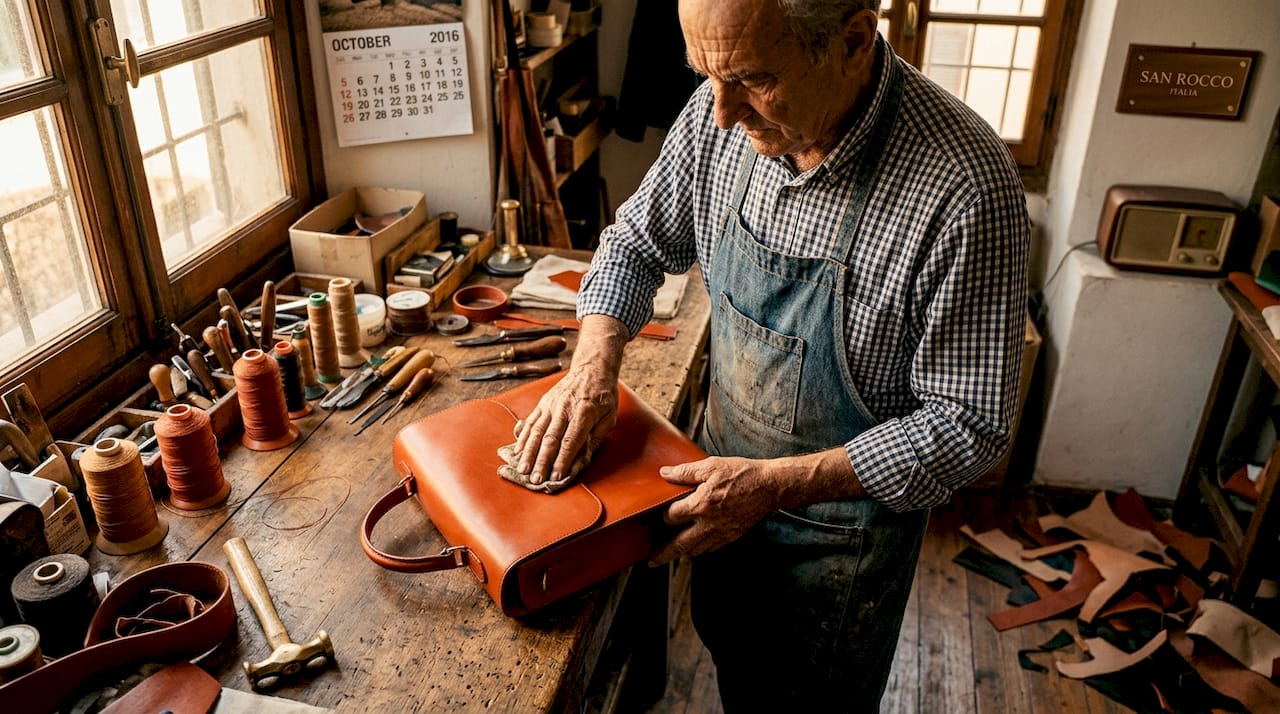
The subcontracting issue is a real one. Some major luxury houses have faced scrutiny for outsourcing production to workshops operating outside regulated conditions, while still attaching “Made in Italy” labels to finished goods. Under Italian law, a product can carry this designation if the last substantial transformation of the product occurred in Italy. This means leather tanned abroad, cut abroad, and even partially assembled abroad can, in certain interpretations, still qualify. The gap between legal compliance and genuine ethical provenance can be considerable.
Key checks for identifying authentic, ethical Italian luxury:
- Ask directly: can the brand name the tannery and the workshop where your bag was made?
- Look for local sourcing transparency, where the closer the materials stay to the artisan and the customer, the shorter and more auditable the supply chain.
- Verify whether the brand uses certified Italian tanneries, particularly those accredited by the Leather Working Group.
- Check whether the brand works directly with named artisan workshops or relies on undisclosed intermediaries.
- Research the brand’s ownership and structure. A woman-owned boutique with direct artisan relationships operates very differently from a conglomerate brand managing hundreds of supplier relationships.
The distinction matters not just philosophically. It matters practically, because it determines whether the piece you purchase was made by someone working in safe, fairly compensated conditions, or whether the beauty of the final product conceals conditions you would not choose to support.
How to identify ethical luxury: What to look for
Understanding craftsmanship is key, but the real skill lies in separating genuine ethical practice from clever branding. This is a learnable skill, and once you have it, shopping for luxury becomes a considerably more satisfying and confident experience.
The most common trap is confusing the story with the substance. Luxury brands are extraordinarily skilled at storytelling. A campaign featuring silver-haired artisans in sun-drenched Florentine workshops is compelling. It is also, in some cases, a carefully composed fiction. The LWG certification for Italian leathers provides one of the clearest third-party benchmarks available.
LWG stands for the Leather Working Group, an international body that audits tanneries against strict criteria covering environmental management, water use, chemical handling, and traceability. When a brand uses LWG-certified leather, you have independent confirmation that the tanning process met verified standards. This is not a guarantee of perfection across the entire supply chain, but it is a meaningful and creditable starting point. Seeking LWG-certified Italian leathers combined with robust third-party audits represents the clearest alignment of values with style.
| Practice | Strong ethical signal | Weak ethical signal |
|---|---|---|
| Supply chain disclosure | Names tanneries and workshops | Uses generic “Italian artisans” language |
| Certification | LWG, B Corp, or equivalent | Self-described “ethical” or “sustainable” |
| Sustainability reports | Published annually with data | Not published or vague |
| Worker welfare | Documented fair labour policy | No mention |
| Material sourcing | Traceable to named origin | “Premium leather” with no source |
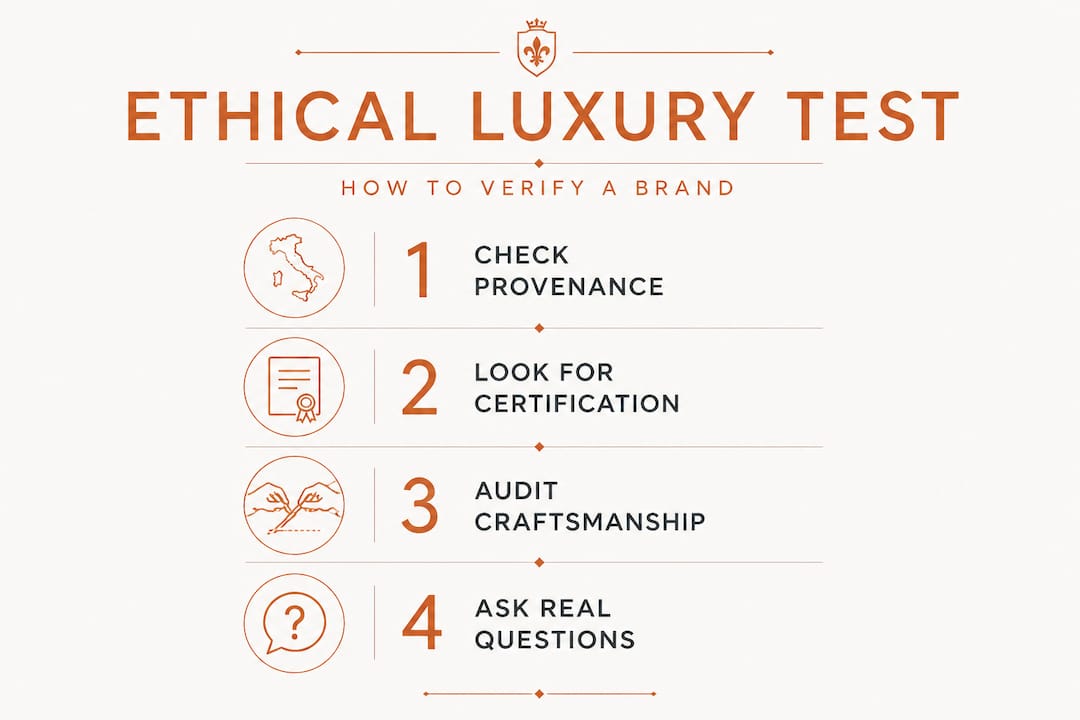
Here is a practical numbered process for verifying ethical luxury claims before you buy:
- Visit the brand’s website and search for a transparency or sustainability page. If one does not exist, this is itself informative.
- Look for named certifications such as LWG, B Corp, or GOTS, and cross-reference these with the certifying body’s own database to confirm they are current.
- Read the brand’s origin story critically. Does it describe the specific region, tannery, or workshop? Or does it use appealing but vague language about tradition and heritage?
- Email or message the brand directly and ask where the leather for a specific product was tanned and assembled. The response, or lack of one, tells you a great deal.
- Search for independent press coverage of the brand’s practices. Journalists and sustainability researchers are increasingly scrutinising luxury supply chains, and their findings are often more candid than brand communications.
- Look at the brand’s founding story and ownership. Direct relationships between an owner and their artisan suppliers create accountability that large corporate structures often cannot replicate.
Pro Tip: The most ethical luxury brands will answer your questions about provenance without hesitation. Any brand that responds to a simple supply chain question with evasion or marketing language is likely not operating at the standard its price point implies.
Identifying authentic Italian leather is a skill that combines sensory knowledge with supply chain literacy. Both matter equally when you are investing in a piece intended to last decades.
Common misconceptions and ethical pitfalls
Equipped with criteria for ethical shopping, it is equally important to dispel some persistent myths. These misconceptions are not just harmless misunderstandings. They are actively exploited by brands looking to charge ethical premiums without delivering ethical substance.
Myth 1: A high price guarantees ethical production. This is perhaps the most tenacious misconception in luxury fashion. Price reflects perceived desirability, brand equity, and distribution costs as much as it reflects material quality or ethical sourcing. Some of the world’s most expensive handbags have been produced under conditions that would alarm their buyers. The price point is a marketing signal, not an ethics certificate.
Myth 2: Prestigious Italian brands are inherently more ethical. The global standing of Italian craftsmanship is genuinely deserved in many respects, but as the essential context around leather from Italy makes clear, prestige and ethics are separate conversations. Evidence must be shown, not simply trusted, even when a brand has a distinguished name.
Myth 3: Handmade means ethical. The word “handmade” describes a production method, not a set of labour standards. A handmade product can be produced in conditions that are neither safe nor fairly compensated.
“The most damaging luxury myths are the ones that allow buyers to feel virtuous without doing the work. Real ethical luxury requires active engagement, not passive trust.” This is why subcontracting scandals involving major Italian houses, including Loro Piana, have been so instructive for the industry.
The Loro Piana case is a useful lesson. The brand, known for extraordinarily fine cashmere and wool, faced serious scrutiny regarding conditions experienced by Andean herders supplying their raw materials. This was not a second-tier brand. It was one of the most expensive and respected names in Italian luxury. The gap between the brand’s positioning and the reality of its supply chain is a reminder that scrutiny should intensify, not relax, at the top of the market.
Warning signs that a product may not be as ethical as claimed include:
- No certifications listed beyond vague references to Italian origin or “sustainable practices.”
- Lack of response to specific supply chain questions from the brand’s customer service.
- Opaque ownership structures that separate the consumer-facing brand from its production reality.
- Dramatic price reductions in sales that suggest cost-cutting in production rather than genuine value.
- No named artisan relationships. A brand that genuinely works with skilled craftspeople tends to celebrate those relationships openly.
- Heavy reliance on influencer marketing without corresponding investment in verified sustainability credentials. A beautiful campaign is not a supply chain audit.
Understanding fine jewellery ethics offers parallel lessons for the leather goods world. Across both categories, the pattern is consistent: third-party evaluations, named suppliers, and documented practices matter far more than brand promises, heritage narratives, or price.
How to demand real change in ethical luxury
Here is where we go beyond product selection. You, as a discerning and affluent buyer, have more influence over the direction of the luxury industry than you may realise. This is not a modest observation. It is grounded in how luxury markets actually work.
Luxury brands are acutely sensitive to the preferences and perceptions of their highest-value customers. When that customer base begins consistently demanding supply chain transparency, the industry adjusts. We have seen this happen in fine jewellery, where consumer engagement and visible auditing have been identified as critical drivers of meaningful industry progress. The same dynamic applies to leather goods and handbags.
The conventional wisdom in ethical fashion suggests that individual consumer choices are the primary lever for change. We think this underestimates the picture. Your choices matter, but your voice matters as much as your wallet. When you ask a brand a direct, informed question about their tannery certifications or artisan welfare policies and share the response publicly, that action has a reach that a single purchase never will.
There are specific, high-impact ways to use your influence:
Ask better questions. Not “is this bag sustainable?” but “which tannery produced this leather and are they LWG certified?” Specificity forces brands to engage seriously or expose their evasiveness.
Attend or follow Italian leather events and trade shows. These events are where the industry shapes its standards. As a well-informed consumer, your presence and questions in these spaces carry weight.
Choose brands with direct artisan relationships. When you buy from a boutique that has a genuine, named relationship with its Florentine or Tuscan workshop, your purchase is a vote for that model of accountability over anonymous subcontracting.
Share your knowledge generously. The women in your network who also invest in luxury goods are your most valuable allies in driving change. A conversation at dinner that reframes the ethics of a handbag purchase reaches further than any petition.
Hold repeat offenders accountable. If a brand has faced supply chain scandals and has responded with only PR rather than structural change, do not return to them simply because their new collection is appealing. Pattern matters more than any single collection.
The uncomfortable truth is that the luxury industry will not transform because of its own virtue. It will transform because its most demanding customers refuse to accept anything less than genuine accountability. You are in a better position to drive that change than almost any other consumer group.
Bring ethical Italian luxury into your life
At San Rocco Italia, we believe that knowing exactly where your bag was made, by whom, and from what materials is not an added extra. It is the foundation of genuine luxury.
Every handbag and leather good in our collection is made in Italy by skilled artisans using premium full-grain leather, and we are proud to share the details of that provenance openly. For the woman who refuses to compromise between beauty and integrity, our collection offers a starting point that feels as good to stand behind as it does to carry. We are a woman-owned boutique, and our direct relationships with Italian craftspeople mean the accountability you deserve is built into every purchase. Explore our collection and discover what conscious Italian luxury truly looks and feels like.
Frequently asked questions
Does ‘Made in Italy’ guarantee an ethical product?
No, “Made in Italy” may indicate local finishing but does not always mean materials or methods are fully ethical. As research shows, “Made in Italy” labels can mask imported materials that were only finished locally, leaving significant gaps in supply chain accountability.
What is LWG certification and why does it matter?
LWG certification confirms that leather is sourced from tanneries meeting strict environmental and ethical standards, covering areas such as water use, chemical management, and traceability. Seeking LWG-certified Italian leather provides independent confirmation that cannot be replicated by a brand’s self-description.
How can shoppers verify ethical claims made by luxury brands?
Seek third-party certifications, traceability reports, and documented audits instead of taking brand marketing at face value. Third-party audits and traceability are the accepted standard for genuine ethical luxury, and any credible brand should be able to provide this evidence on request.
Are all premium-priced handbags produced responsibly?
A high price does not guarantee ethical production. Investigate the brand’s supply chain transparency and certifications to be sure, because evidence must be shown, not simply assumed from a brand’s heritage or price point.
Recommended
- Why choose ethical accessories: timeless, responsible luxury – San Rocco Italia
- Why authenticity sets Italian luxury fashion apart – San Rocco Italia
- Understated elegance: Mastering timeless Italian style – San Rocco Italia
- Travel leather guide 2026: luxury, craft & sustainability – San Rocco Italia



