


Premium leather sourcing: ethical, timeless fashion guide
TL;DR:
- Genuine premium leather is defined by full-grain quality, origin, and traditional tanning methods.
- Italian craftsmanship, especially in Tuscany, is rooted in centuries-old, regionally integrated production processes.
- True ethical sourcing relies on transparent certifications like LWG and specific tannery partnerships, not vague claims.
Most of us assume that a high price tag guarantees ethical quality. Walk into any luxury boutique, pick up a handbag labelled “genuine Italian leather,” and you might feel confident you’re holding something exceptional. But the reality is more nuanced, and frankly, more interesting. The leather industry is layered with terminology, regional traditions, and certification systems that most shoppers never encounter. This guide cuts through the noise. You will learn what truly separates premium leather from the rest, why Italian craftsmanship holds a unique global standing, and how to shop with genuine confidence rather than relying on marketing language alone.
Table of Contents
- What defines premium leather?
- Italian craftsmanship and the Tuscan advantage
- Ethical sourcing: certifications and real standards
- How to spot genuine premium leather goods
- Why true luxury is more than a label: our perspective
- Experience true Italian premium leather with us
- Frequently asked questions
Key Takeaways
| Point | Details |
|---|---|
| Recognise true premium leather | Quality depends on heritage, region, and ethical supply chains, not just labels or price. |
| Trust Italian tradition | Tuscan craftsmanship and generational tanneries ensure consistency, beauty, and sustainability. |
| Verify ethical standards | Look for LWG certification and direct retailer transparency to ensure genuine eco-friendly sourcing. |
| Invest in timeless pieces | Choosing well-made, classic leather goods supports both slow fashion values and lasting elegance. |
What defines premium leather?
Leather quality is not a single measurement. It is the result of the animal’s breed, the tannery’s methods, the skill of the artisan, and the integrity of the supply chain. Understanding these layers changes how you see every bag, belt, and wallet you will ever consider buying.
The most important distinction begins with the hide itself. Full-grain leather is the top layer of the hide, left entirely intact, natural markings and all. It is the densest, most durable part of the skin. Over time, it develops a patina, a subtle sheen that deepens with use and care. This is not a flaw; it is the leather telling its story. Top-grain leather, by contrast, has been sanded or buffed to remove surface imperfections. It looks more uniform but loses some of the structural integrity and character that makes full-grain so prized.
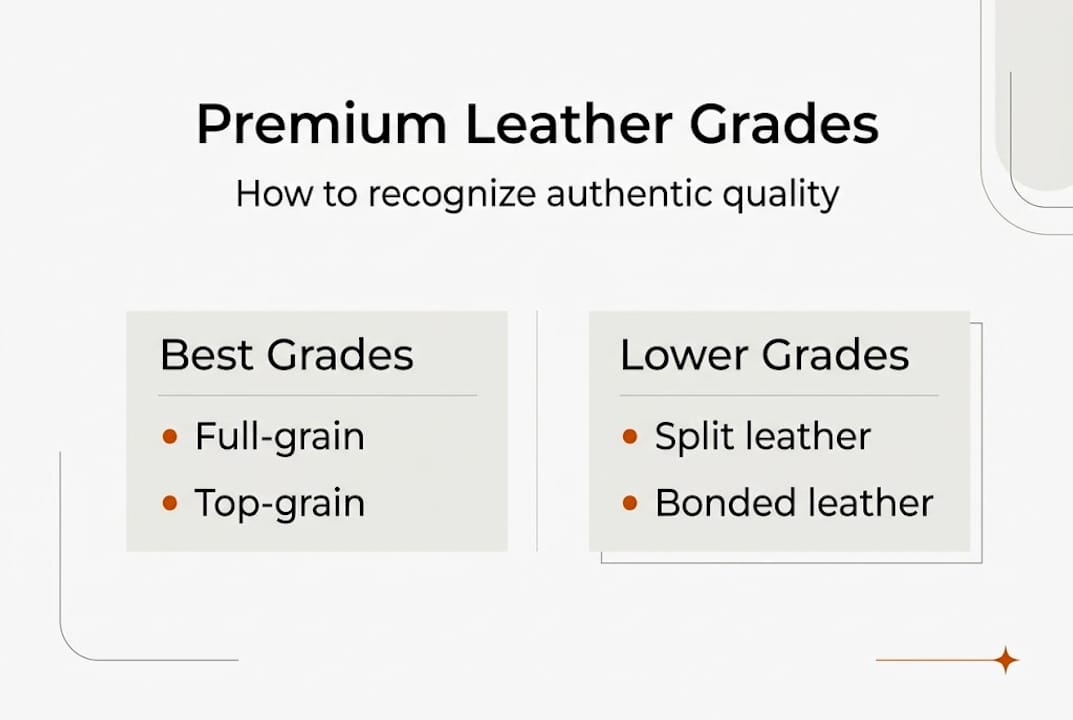
Below these two grades, you find split leather, bonded leather, and various coated materials that are often marketed with vague terms like “genuine leather.” Technically, bonded leather is leather. But it is closer to particleboard than solid oak. Knowing the difference protects you from paying premium prices for inferior goods.
Region matters enormously. Italian districts like Tuscany dominate premium leather output with centuries-old traditions that simply cannot be replicated overnight. The soil composition, the water quality used in tanning, and the accumulated knowledge of generations of artisans all contribute to a final product that is measurably different. You can explore a deeper breakdown of how Italian leather compares to other leathers to understand why origin is such a reliable quality signal.
Then there is the question of tanning. Vegetable tanning is the oldest method, using natural plant-based tannins from bark, leaves, and roots. It is slow, taking weeks or even months, and it produces leather with exceptional depth and character. Chrome tanning, the modern industrial alternative, takes hours and produces a more uniform, softer result. It dominates mass production precisely because it is faster and cheaper. Vegetable-tanned leather, by contrast, is a marker of heritage and ethical intent.
Here is a quick comparison to anchor these distinctions:
| Leather type | Surface | Durability | Patina | Typical use |
|---|---|---|---|---|
| Full-grain | Natural, intact | Highest | Yes, rich | Fine handbags, belts |
| Top-grain | Sanded, buffed | High | Minimal | Mid-range goods |
| Split leather | Suede or coated | Moderate | No | Budget accessories |
| Bonded leather | Glued fibres | Low | No | Fast fashion items |
When evaluating any leather good, look for these markers of genuine premium quality:
- Natural surface variation and markings (not a flaw, a feature)
- A subtle, earthy smell rather than a sharp chemical odour
- Edges that are burnished or painted, not raw or fraying
- Weight and structure that feel substantial in the hand
- Clear information about tannery origin and tanning method
For a focused look at which leathers perform best in handbag construction, the guide on best leather for handbags is worth reading before your next purchase.
Italian craftsmanship and the Tuscan advantage
Italy’s reputation in leather is not accidental. It is the product of centuries of accumulated skill, regional specialisation, and a cultural commitment to making things properly. Understanding this context helps you recognise why a bag made in a Florentine workshop is genuinely different from one assembled elsewhere, even if both carry a “made in Italy” label.
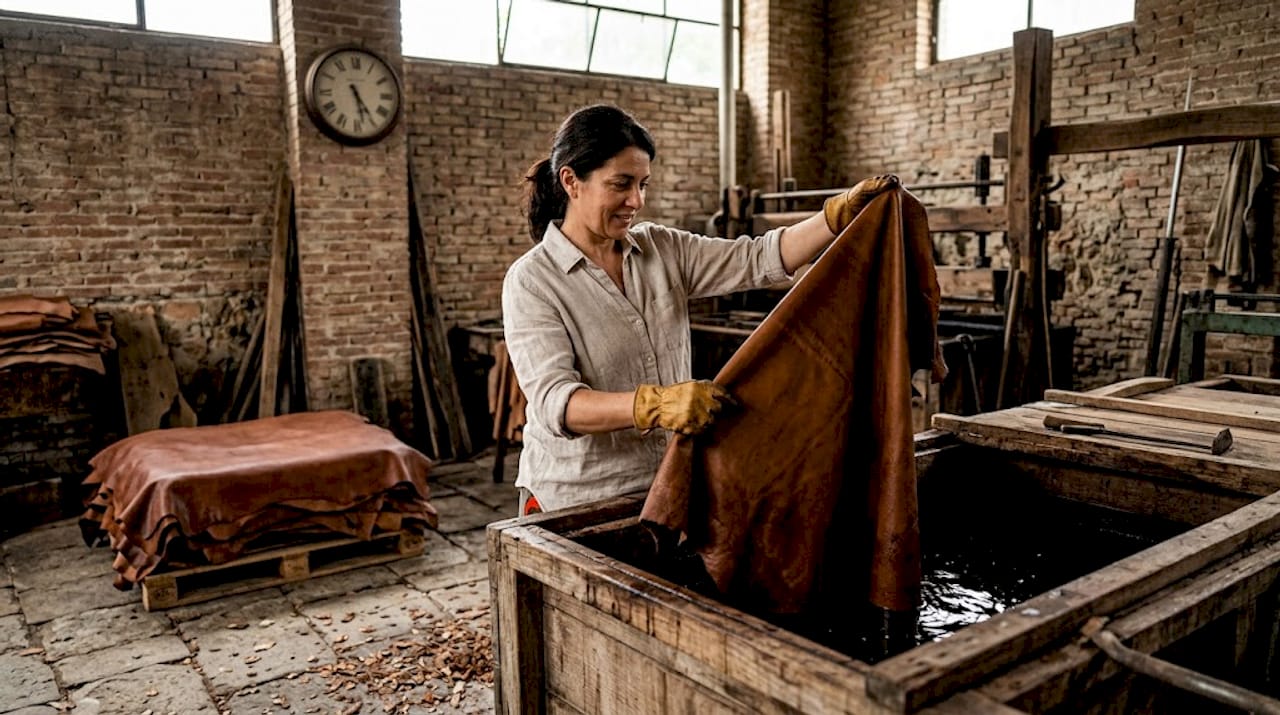
The city of Florence has been a centre of leather craft since the Middle Ages. The Scuola del Cuoio, or School of Leather, has operated within the walls of a Franciscan church since 1950, teaching traditional techniques to each new generation. Santa Croce sull’Arno, a small town in the Pisa province, became the heartland of sole leather production. The Arno River provided the soft water essential for vegetable tanning, and the surrounding farmland supplied the oak and chestnut bark needed for the process.
Tuscany produces 35% of Italy’s leather output and an extraordinary 98% of its sole leather. These are not just impressive statistics. They reflect a regional ecosystem where tanneries, artisan workshops, hardware suppliers, and thread makers all operate within a few kilometres of each other. This proximity creates accountability. Craftspeople know their suppliers personally. Relationships span generations.
“The beauty of Tuscan leather lies not just in its texture or durability, but in the living knowledge passed from one generation of tanner to the next. A hide processed in Santa Croce carries with it centuries of refinement that no industrial shortcut can replicate.”
Premium quality stems from relationships with generational tanneries, not simply from geography. A brand that has worked with the same family-run tannery for decades benefits from consistency, trust, and a shared commitment to standards. This is fundamentally different from a brand that sources from the cheapest available supplier in a given country.
Here is how Tuscan leather production compares to standard industrial output:
| Factor | Tuscan vegetable tanning | Industrial chrome tanning |
|---|---|---|
| Process duration | 30 to 60 days | 1 to 2 days |
| Chemicals used | Natural plant tannins | Chromium salts |
| Environmental impact | Low, biodegradable | Higher, requires treatment |
| Patina development | Rich and deepening | Minimal |
| Traceability | High, regional ecosystem | Variable |
Pro Tip: When a brand mentions “Italian leather,” ask specifically whether the tannery is LWG certified and located in a recognised Italian district such as Tuscany or Veneto. A confident, detailed answer is a very good sign. Vagueness is not.
For a thorough overview of what makes Italian sourcing distinctive across different product categories, the Italian leather luxury guide offers a useful reference. If you are comparing specific products, the top Italian leather bags comparison is equally helpful.
Ethical sourcing: certifications and real standards
The word “ethical” is used freely in luxury marketing. It costs nothing to print on a website. What actually separates a brand with genuine ethical sourcing from one trading on vague goodwill is a combination of third-party certification, supply chain transparency, and a willingness to be specific.
The most credible standard in the leather industry is the Leather Working Group (LWG) certification. LWG certification audits 17 areas; Gold status requires scoring 85% or above in all critical sections. These sections include water usage, chemical management, waste handling, energy consumption, and traceability of raw materials. A Gold-rated tannery has been independently verified to meet rigorous environmental and operational standards.
The three tiers of LWG certification work as follows:
- Bronze: Meets basic environmental benchmarks; early stage compliance
- Silver: Demonstrates consistent improvement across key audit areas
- Gold: Achieves 85% or above in all critical sections; highest level of independent verification
Beyond the certificate itself, genuine ethical sourcing requires transparency at every stage. Where did the hide originate? Which tannery processed it? What chemicals were used? Can the brand name the specific artisan workshop? Brands that can answer these questions clearly are operating with integrity. Those that deflect with broad claims about “sustainable practices” or “responsibly sourced materials” without specifics are worth scrutinising.
Ethical sourcing also has a direct environmental impact. Vegetable tanning, when practised properly, produces biodegradable leather with minimal toxic runoff. Chrome tanning, if poorly managed, releases hexavalent chromium, a known carcinogen, into water systems. Choosing certified leather goods is not just a personal preference. It is a measurable contribution to reducing industrial pollution.
This connects directly to slow fashion values. A single well-made leather bag, sourced ethically and cared for properly, can last twenty or thirty years. The environmental cost per use is a fraction of what fast fashion generates. The ethical leather bags comparison offers a practical look at how different brands measure up against these standards.
Pro Tip: Watch for “greenwashing” signals in luxury marketing. Phrases like “eco-conscious,” “sustainably inspired,” or “responsible materials” without a named certification or tannery are red flags. Genuine ethical brands name their partners and welcome scrutiny. If a brand’s sustainability page contains no verifiable information, treat it with scepticism.
For those interested in how these standards apply in specific retail contexts, the guide on ethical craftsmanship in luxury retail provides a grounded perspective.
How to spot genuine premium leather goods
Knowing the theory is one thing. Standing in a boutique or browsing online, you need practical tools to evaluate what you are actually looking at. These are the signals that experienced buyers use, and they are available to anyone willing to pay attention.
Start with your senses. Genuine full-grain leather has a distinctive smell: earthy, slightly sweet, and natural. If a bag smells sharply chemical or plasticky, it is likely chrome-tanned at best, or synthetic at worst. Run your fingers across the surface. Premium leather has a slight warmth and give. It responds to touch. Bonded or coated materials feel cooler, more uniform, and slightly hollow.
Premium quality depends on ongoing relationships with reputable tanneries, not just country of origin. This means the questions you ask a retailer matter as much as the label inside the bag. Here is what to ask:
- Which tannery supplied the leather, and where is it located?
- Does the tannery hold LWG certification, and at what level?
- Are the artisans who made this piece employed directly or through a certified workshop?
- Can you provide documentation of the supply chain for this product?
A retailer who sells genuinely premium goods will welcome these questions. They will have answers. A retailer who responds with vague reassurances or redirects to marketing language is telling you something important.
Look closely at the construction. On a quality leather bag, the stitching is even, tight, and uses waxed thread or saddle stitching. The edges are finished, not raw. Hardware is weighty and operates smoothly. Lining materials are cut cleanly and attached with care. These details are not incidental. They reflect the overall standard of the workshop.
Here are the key markers to check before any leather purchase:
- Natural surface variation: slight grain differences, small marks, and subtle colour shifts are signs of real hide
- Edge finishing: burnished, painted, or folded edges rather than raw cuts
- Stitching: consistent spacing, no loose threads, waxed or linen thread preferred
- Hardware: solid weight, smooth action, no visible plating flaws
- Interior: clean lining, well-attached pockets, no chemical smell
Pro Tip: Choosing a classic, timeless design is itself an act of sustainable fashion. A structured tote or a simple crossbody in a neutral colour will serve you for decades. Trend-driven designs, however beautifully made, are more likely to feel dated and be replaced. The best leather bag brands guide focuses specifically on makers whose designs stand the test of time. For gift-giving occasions, the Italian leather gift ideas comparison is a thoughtful starting point.
Why true luxury is more than a label: our perspective
We have spent years working with Italian artisans and sourcing from tanneries where the head tanner’s grandfather helped build the vats still in use today. That experience has given us a clear view of something the broader luxury market rarely admits: the gap between what is marketed as premium and what actually is premium is significant, and it is growing.
Many brands attach “Italian leather” to goods where only the final stitching happened on Italian soil. The hide itself may have been processed in a country with no environmental oversight. The artisan may have been paid a fraction of a living wage. The certification, if it exists at all, may cover only one stage of a much longer chain.
True premium sourcing is about relationships. It means knowing the name of the tannery, understanding their process, and returning to them year after year because the quality justifies it. It means accepting that this costs more and takes longer, and believing that both are worth it.
The slow fashion argument is not sentimental. It is practical. A bag made with certified leather by a skilled artisan in a Florentine workshop, as explored in our piece on Italian leather bags from function to icon, will outlast ten fast fashion alternatives. The cost per year of ownership is lower. The environmental cost per use is dramatically lower. And the experience of carrying something made with genuine care is simply different.
Invest in fewer things. Choose better things. That is not a luxury mindset. It is a sensible one.
Experience true Italian premium leather with us
At San Rocco Italia, everything we have discussed here is not an aspiration. It is how we operate. Every handbag and leather good in our collection is made in Italy by skilled artisans using premium full-grain leather and traditional techniques. We work with tanneries whose standards we know personally, not just from a certificate.
For those ready to explore what genuine Italian craftsmanship looks and feels like, the San Rocco Italia collection is a good place to begin. You will find pieces designed for longevity, sourced with transparency, and made by people who take pride in every stitch. If you want to go deeper into the world of Italian leather before committing to a purchase, our guide to Italian leather fashion events offers a way to experience the craft firsthand. We believe that understanding what you are buying makes the purchase more meaningful, and the piece more treasured.
Frequently asked questions
What makes Tuscan leather different from regular leather?
Tuscan districts dominate Italy’s premium leather production with centuries-old vegetable tanning traditions and a tightly connected regional ecosystem that ensures consistency, traceability, and ethical quality at every stage.
How can I trust the ethical claims of a luxury leather brand?
Look for named LWG certifications and specific tannery partnerships rather than vague marketing phrases. LWG certification audits tanneries on detailed environmental and operational standards, so a Gold rating carries genuine weight.
Does premium Italian leather always come from Italy?
Not always. Premium quality stems from generational tanneries in certified Italian districts, not simply a country-of-origin label. Ask for specific tannery information before assuming a product meets true Italian standards.
Why does vegetable tanning matter for ethical fashion?
Centuries-old vegetable tanning traditions use natural plant-based tannins instead of toxic chemicals, producing biodegradable leather with a far lower environmental footprint than industrial chrome tanning methods.
