


How to clean and care for luxury leather accessories
TL;DR:
- Properly cleaning and conditioning luxury leather accessories involves using specific tools and techniques to preserve their natural beauty and durability. Avoid household cleaners and harmful remedies, and instead follow a careful, step-by-step routine of dusting, spot testing, gentle cleaning, drying, conditioning, and protecting to maintain the leather’s condition over time. Consistent, thoughtful care enhances the leather’s aging process and helps develop a unique patina that reflects proper maintenance.
You reach for your favourite Italian leather handbag, and there it is — a scuff along the side panel, or worse, a mysterious dark stain near the clasp. Your heart sinks. You want to fix it immediately, but the fear of making things worse keeps you frozen. This is the moment most women either grab the nearest wipe and hope for the best, or do nothing at all. Both choices carry real risk. The good news is that with the right tools, the correct technique, and a reliable routine, you can keep your luxury leather accessories looking as beautiful as the day they arrived — without ever risking the finish.
Table of Contents
- Essential tools and products for cleaning luxury leather
- Step-by-step guide: how to clean your leather accessories safely
- The importance of conditioning and protecting your leather
- Common mistakes to avoid when cleaning leather accessories
- Why most advice on cleaning leather misses the luxury mark
- Explore timeless care with San Rocco Italia
- Frequently asked questions
Key Takeaways
| Point | Details |
|---|---|
| Choose specialist products | Always use purpose-made cleansers and conditioners for luxury leather, avoiding household alternatives. |
| Follow the three-step workflow | Clean, condition, and protect for best long-term results. |
| Spot test and use minimal moisture | Test any cleaner in an inconspicuous area and never soak leather to avoid permanent marks. |
| Condition regularly | Conditioning every 2-3 months prevents drying, cracking, and maintains a supple feel. |
Essential tools and products for cleaning luxury leather
With the problem in mind, the right approach starts with having the proper tools to hand. Before you touch your bag with anything, you need to be confident that what you’re using is appropriate for premium leather. This is not the place for improvisation.
The core kit for luxury leather care is straightforward but specific. You’ll need:
- Soft microfibre cloths (lint-free and gentle enough not to scratch the surface)
- A pH-balanced leather cleanser formulated specifically for finished leather
- A quality leather conditioner to restore moisture after cleaning
- A leather protectant or finishing spray to seal and shield the surface
- A soft-bristled brush for any textured areas or stitching
Why does this matter so much? Because luxury leather, particularly the full-grain leather used in Italian-crafted pieces, has a living surface. It breathes, absorbs, and reacts to what you put on it. A recommended leather care products selection will be pH-balanced to work with the leather’s natural oils rather than stripping them away.
Home remedies are tempting because they’re convenient. Many articles suggest vinegar solutions, coconut oil, or even toothpaste for scuffs. For everyday items, some of these might cause no visible harm. But on luxury leather, particularly vegetable-tanned or aniline-finished pieces, even a mild acid like diluted vinegar can shift the colour, dull the sheen, or cause irreversible patchiness. Coconut oil, meanwhile, can darken leather permanently and attract dust. The risk simply isn’t worth it.
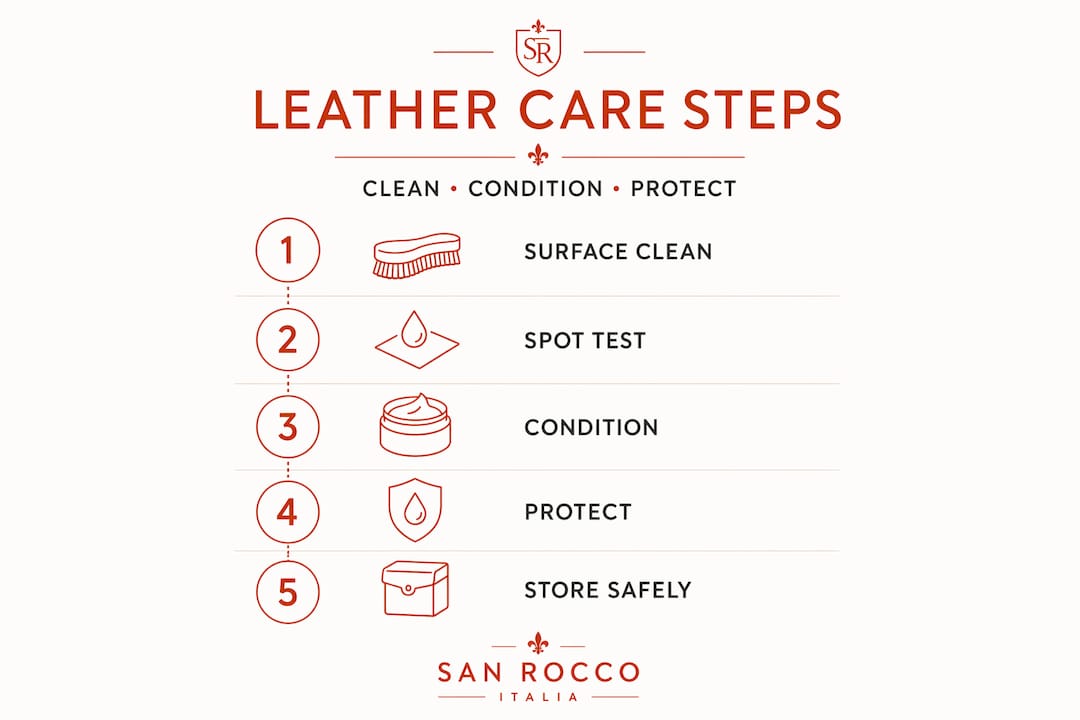
A practical luxury clean-condition-protect workflow is widely recommended by leather care experts such as David Mesquita of Leather Spa as the most reliable method for keeping accessories looking their best over time. This three-step sequence is not just logical; it reflects how leather actually responds to care. Cleaning without conditioning leaves the leather temporarily depleted. Conditioning without protecting means the surface remains vulnerable to water and UV damage.
Before applying any product to the full surface, always spot test on an inconspicuous area, such as the base of the bag or the underside of a strap. Leave it for a few minutes and check for any darkening, bubbling, or colour change. This is a non-negotiable step, even when using products labelled as safe for luxury leather.
| Product type | Purpose | What to avoid |
|---|---|---|
| Leather cleanser | Removes surface dirt and grime | Alcohol-based formulas, baby wipes |
| Leather conditioner | Restores moisture and suppleness | Petroleum-based products, coconut oil |
| Leather protectant | Shields from water and UV | Heavy waxes not suited to finished leather |
| Microfibre cloth | Applies and buffs products safely | Rough cloths, paper towels, abrasive sponges |
For a thorough introduction to the full process, our guide to cleaning a leather handbag walks through natural approaches in detail. You can also explore our expert leather cleaner guide for product-specific recommendations.
Step-by-step guide: how to clean your leather accessories safely
Once you’ve assembled the right products, the correct technique is just as crucial for keeping your accessories pristine. Even the best cleanser can cause harm if applied incorrectly. Here is the method we recommend, broken down into clear, manageable steps.
-
Dust and dry-wipe first. Use a clean, dry microfibre cloth to gently wipe the entire surface of the bag. This removes loose dust, crumbs, and surface debris that could act as abrasives during the cleaning stage. Pay attention to seams, corners, and hardware surrounds.
-
Spot test your cleanser. Apply a small amount of your chosen leather cleanser to a hidden area. Wait two to three minutes, then blot gently. If there is no adverse reaction, proceed.
-
Apply cleanser in small sections. Dampen a fresh microfibre cloth lightly with the cleanser. Never apply the product directly to the leather. Work in small circular motions across one section at a time, using minimal pressure. The key is controlled, targeted application.
-
Address specific stains with care. Water marks respond well to a very slightly damp cloth applied evenly across the whole panel, allowing it to dry uniformly. Oil stains benefit from a small amount of cornstarch left overnight to absorb the grease before brushing away. Makeup transfers, particularly foundation, respond to a gentle cleanser applied with a cotton pad.
-
Remove residue gently. Once you’ve cleaned each section, use a dry cloth to lift any remaining product. Do not rub; blot.
-
Allow to air dry completely. This is critical. Before conditioning, the leather must be fully dry. Leave the bag in a well-ventilated space, away from sunlight and heat, for at least 30 minutes.
Experts advise that careful, minimal moisture is essential when cleaning delicate leather types such as vachetta. Applying cleaner to the cloth rather than directly to the leather, and keeping dampness to an absolute minimum, prevents the water marks and uneven dark spots that so often result from hasty cleaning.
“Over-wetting is one of the most common causes of permanent damage to luxury leather. Water can penetrate the surface unevenly, leaving tide marks that are difficult or impossible to reverse. Always air dry naturally, and never attempt to speed up the process with a hairdryer or by placing the bag near a radiator.”
Pro Tip: For bags with lighter coloured leather or vachetta trim, use a cotton pad rather than a cloth for even more precise product application. This gives you finer control and reduces the risk of spreading moisture unevenly.
| Method | Approach | Suitable for luxury leather? |
|---|---|---|
| Rapid scrub with damp cloth | Fast but aggressive | No, risks surface damage |
| Baby wipe across full surface | Convenient but harsh | No, strips natural oils |
| Gentle cleanser on cloth, small sections | Slow but controlled | Yes, ideal method |
| Dry microfibre buff only | Quick maintenance | Yes, for light surface dust |
For further guidance, our article on cleaning your leather bag safely covers additional scenarios. If you own a lighter piece, our advice on cleaning a white leather purse addresses specific challenges with pale finishes.
The importance of conditioning and protecting your leather
After the cleaning stage, there is one step many overlook that is the true secret to lasting luxury. Conditioning is not an optional extra. It is the step that determines whether your leather remains supple, glossy, and rich in tone for years, or begins to dry and crack within a matter of months.
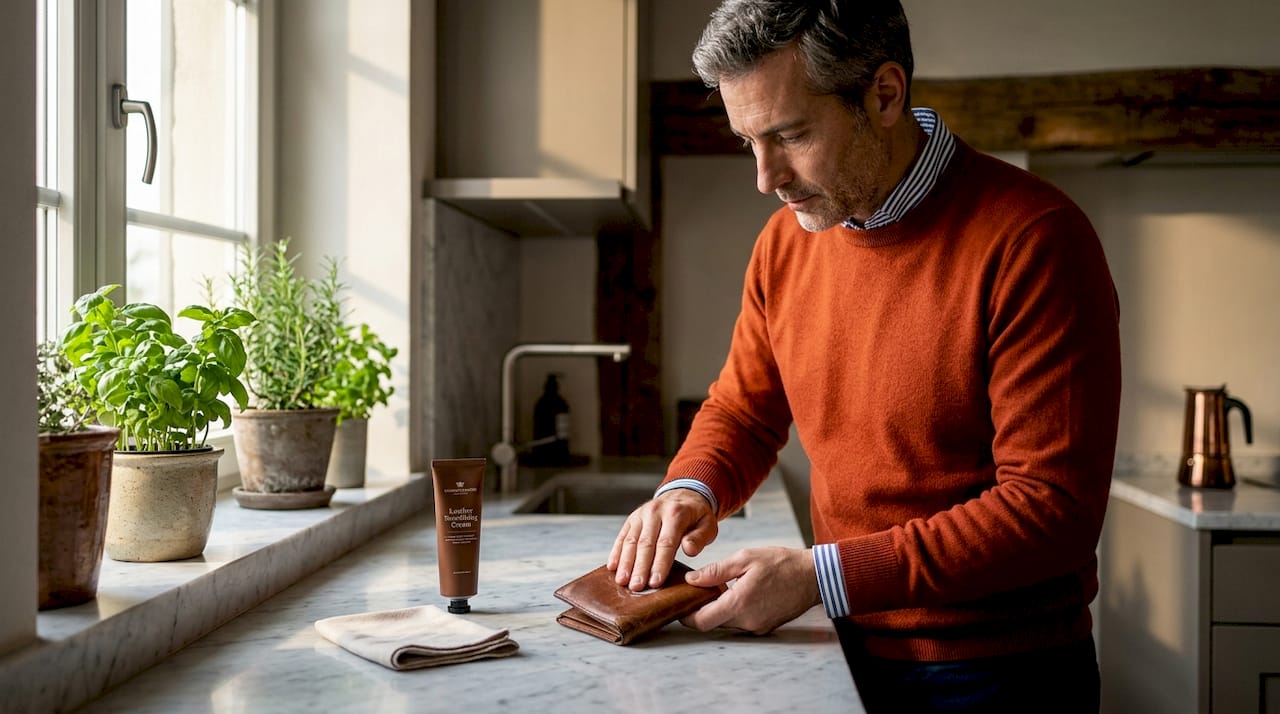
Leather is skin. Without moisture, it tightens, stiffens, and eventually cracks. Even after a careful, gentle clean, the leather surface has been mildly depleted of its natural oils. Conditioning restores that balance. Regular conditioning for full-grain leather is strongly recommended by experts at The RealReal to prevent drying and cracking, and should always follow the cleaning step as part of a consistent care routine.
Most experts recommend conditioning full-grain leather every two to three months under normal use. If you live in a dry climate, use your bag frequently, or store it in centrally heated environments, conditioning every six to eight weeks is more appropriate. Under-conditioning is far more common than over-conditioning, and it shows over time as bags begin to lose their depth of colour and develop fine surface cracks.
Here is how to apply conditioner correctly:
- Apply a small amount of conditioner to a clean, dry microfibre cloth
- Work it into the leather using gentle, circular motions across the full surface
- Pay extra attention to areas that flex repeatedly, such as handles, corners, and the base
- Allow the conditioner to absorb for at least 10 to 15 minutes before buffing gently with a fresh cloth
- Do not over-apply; a thin, even coat is more effective than a heavy layer
Once conditioned, the leather should receive a protective layer. A quality leather protectant, applied in the same manner as the conditioner, creates an invisible barrier against water ingress, surface staining, and UV fading. This step is particularly important during the wetter months, when bags are more frequently exposed to rain and damp conditions.
Pro Tip: Many high-quality conditioners now contain UV-blocking ingredients. If you regularly carry your bag in sunny conditions, look for a conditioner that combines moisture restoration with UV protection. This reduces the colour fading that can affect even the richest, darkest leathers over time.
For a broader overview of long-term caring for leather bags, including seasonal considerations, our dedicated guide covers what your bag needs throughout the year. We also cover correct storing leather handbags practices, which are equally critical between uses.
The clean-condition-protect workflow endorsed by leather care professionals including expert David Mesquita of Leather Spa is not just a recommendation for damaged bags. It is a preventative routine that keeps leather in its best condition from the very start, reducing the likelihood of ever needing restorative treatment.
Common mistakes to avoid when cleaning leather accessories
Knowing what to do is half the solution, but being aware of pitfalls is just as essential for long-lasting results. Some of the most well-intentioned cleaning attempts cause the most lasting damage.
Using harsh household cleaners. Alcohol-based products, vinegar solutions, and even some multi-surface sprays are widely suggested online. In practice, they strip the protective finish from luxury leather, alter pH balance, and can cause permanent discolouration. Baby wipes are particularly problematic because they contain alcohol, fragrance, and surfactants that may seem harmless but damage delicate leather surfaces over repeated use, leaving the surface dull and vulnerable.
Scrubbing rather than wiping. Vigorous scrubbing might feel satisfying when tackling a stubborn stain, but it micro-abrades the leather surface, weakening the top layer and causing the colour to appear uneven or faded. Always use light, controlled circular motions rather than back-and-forth pressure.
Soaking the leather. Applying excessive moisture, whether from a wrung-out cloth or a spray applied directly to the bag, causes the leather fibres to swell unevenly. When they dry, they contract in different directions, creating puckering, stiffness, and those tell-tale tide marks that are so difficult to remove.
Skipping the conditioning step. Many people clean their bags and consider the job done. Without conditioning after cleaning, the leather is left temporarily depleted. Over time, this cumulative depletion leads to surface cracking that begins subtly but becomes increasingly visible with each cleaning session.
Leaving the bag unprotected after care. Cleaning and conditioning without applying a protectant means the surface is temporarily more receptive to moisture and staining. Always finish with a protectant spray or cream to seal the work you’ve done.
Pro Tip: Never place a freshly cleaned bag near a radiator, in direct sunlight, or in front of a fan heater to speed up drying. Heat causes leather to dry too rapidly and unevenly, which can lead to shrinkage, cracking, and distortion of the bag’s shape. Always air dry naturally at room temperature.
The following common mistakes also apply to leather purses and smaller accessories:
- Using nail varnish remover on sticky residue (strips the finish entirely)
- Applying saddle soap designed for equestrian leather to fine fashion leather
- Storing a bag in a plastic cover that traps moisture and encourages mildew
- Ignoring small scuffs until they deepen and become much harder to address
Our guides on cleaning a leather purse naturally and cleaning a thrifted leather purse offer specific advice for different scenarios, including pieces that may require a little more attention to begin with.
Why most advice on cleaning leather misses the luxury mark
Most cleaning advice you’ll find online is written for convenience. It assumes you want a quick fix, a shortcut, a product that does everything in one pass. And for a high-street leather item, that approach might be acceptable. But for a piece of full-grain Italian leather, crafted by hand by an artisan who has spent decades perfecting his technique, convenience is the enemy.
Here is what we’ve observed time and again: the bags that age most beautifully are not the ones that have been cleaned most often. They’re the ones that have been cleaned correctly, and less than most people think is necessary. Luxury leather does not need frequent, intensive cleaning. It needs infrequent, careful attention combined with consistent conditioning.
The high cost of casualness is something that rarely gets discussed honestly. A hasty scrub with the wrong cloth can permanently dull a hand-burnished finish that took a craftsperson hours to achieve. Once that surface lustre is gone, it cannot be brought back without professional intervention, and even then, it may never look exactly as it did. This is not a scare tactic. It is simply the reality of working with a natural material that responds irreversibly to mistreatment.
There is also a cultural dimension worth noting. The Italian leather tradition from which San Rocco Italia draws its heritage is built on the philosophy that quality materials, properly maintained, improve with age. The beautiful patina that develops on a well-tended bag is a sign of life and care, not wear and neglect. That patina can only develop when the leather is nourished, not stripped. It requires restraint rather than aggression.
Our perspective is this: invest in two or three exceptional products, learn the clean-condition-protect sequence, and apply it every few months with patience and attention. Read our expert leather cleaner guide before purchasing anything new. Then leave your bag alone between sessions. Let it breathe. Let it develop the character that comes only with proper care and gentle handling over time.
Doing less, but doing it correctly, is the real luxury approach.
Explore timeless care with San Rocco Italia
Applying the best techniques starts with the best tools, and knowing where to turn for trustworthy guidance makes all the difference.
At San Rocco Italia, our commitment to full-grain Italian leather goes far beyond the initial purchase. We believe that a beautifully made bag deserves a lifetime of thoughtful care, and we’ve built our knowledge base to support exactly that. Whether you’re caring for a structured tote, a slim leather purse, or a treasured belt, our care guides and product resources are designed to help you protect your investment with confidence. Explore our collection and discover accessories crafted to last, alongside the knowledge to keep them looking exceptional for years to come.
Frequently asked questions
How often should I clean and condition my leather accessories?
Clean gently every few weeks using a dry microfibre cloth for surface dust, and perform a full conditioning routine every two to three months to keep full-grain leather supple and prevent dryness or cracking.
Can I use household cleaners or baby wipes on luxury leather?
No. Household cleaners and baby wipes can strip the finish or dry out premium leather. The risks of harsh cleansers include permanent discolouration and surface damage; always use dedicated leather products and spot test first.
What is the safest way to dry leather after cleaning?
Let leather air dry naturally at room temperature and never use a radiator, hairdryer, or direct sunlight, as rapid heat causes cracking, shrinkage, and uneven drying.
Is it safe to use leather conditioner on all types of leather?
Most genuine and full-grain leathers respond well to conditioning, but always check the product label and test on a discreet area first, as conditioning restores moisture differently depending on the finish and tanning method used.



