


Choosing durable handbags: the affluent woman's guide
TL;DR:
- Durable handbags depend on the quality of materials, construction, and functional design to withstand daily use. Full-grain leather offers the best aging, while thoughtful features like reinforced straps, secure closures, and proper storage prolong longevity. Choosing a timeless, well-crafted bag that suits your lifestyle ensures lasting value and emotional resonance beyond transient trends.
There is a particular frustration in spending seriously on a handbag only to watch it pill at the corners, lose its shape, or date itself within two seasons. Choosing durable handbags is not simply about buying expensive or buying Italian, though craftsmanship absolutely matters. It requires understanding which materials age beautifully under real use, which construction details signal genuine quality, and which design choices guarantee a bag remains relevant long after the receipt has faded. This guide gives you the framework to make that call with confidence every time.
Table of Contents
- Understanding what makes a handbag durable
- Choosing the right materials for lasting quality and elegance
- Evaluating design features for everyday usability and endurance
- Preserving your handbag’s durability through care and storage
- Verifying durability and timelessness before purchase
- Rethinking durability: more than just materials and style
- Discover timeless durability with Italian craftsmanship at San Rocco Italia
- Frequently asked questions
Key Takeaways
| Point | Details |
|---|---|
| Durability includes usability | A durable handbag performs well daily, offering comfort, security, and organisation beyond strong materials. |
| Full-grain leather excels | Choose full-grain leather for superior strength, elegant ageing, and long-lasting quality. |
| Design matters | Closures, strap comfort, and pocketing influence how long a handbag stays practical and loved. |
| Care prolongs life | Proper cleaning, conditioning, and storage protect materials and maintain a bag’s shape over time. |
| Invest wisely | Consider cost per wear and timeless style to ensure your handbag remains an enduring luxury investment. |
Understanding what makes a handbag durable
Durability is not a single quality. It is the sum of decisions made at every stage of a bag’s construction, from the hide selected at the tannery to the thread used on the final seam. A bag can be made from excellent leather and still fail in two years if the lining is cheap or the stitching is inconsistent. Equally, a bag with flawless seams becomes unwearable if the closure breaks mid-commute or the single strap digs painfully into your shoulder.
Think of durability as three interlocking elements: material integrity, construction quality, and functional design. Material integrity covers the strength and character of what the bag is made from. Construction quality covers how those materials are assembled, including stitching density, edge finishing, and hardware attachment. Functional design is where most buyers underestimate, and where our handbag materials guide offers useful depth. As Forbes Vetted notes, durability includes day-to-day usability factors such as closure type, pocketing, and strap adjustability.
Key functional features worth assessing before purchase:
- Closure type: Twist locks and turnlock mechanisms add elegance and tend to outlast standard zip pulls, which fray at the pull tab and snag lining fabric over time.
- Strap construction: Double-stitched, reinforced straps with metal D-rings at the attachment points handle daily load far better than glued or single-stitched alternatives.
- Internal pocketing: Structured internal pockets protect your phone, keys, and cards from scratching each other and from burrowing to the bottom of the bag where pressure causes interior wear.
- Base support: Feet on the base of the bag keep the leather off surfaces and prevent premature wear along the bottom panel.
- Lining material: Suede and full textile linings breathe and handle friction better than flimsy synthetic linings, which crack and peel after months of use.
Pro Tip: When assessing a bag in a boutique, load it with your usual daily essentials and walk around. The weight distribution, strap comfort, and ease of accessing the main compartment under load will tell you more than any product description.
Choosing the right materials for lasting quality and elegance
Not all leathers are created equal, and the differences matter enormously over a ten-year ownership period. Full-grain leather is the strongest and most durable, developing a patina that enhances its character over time rather than deteriorating. This is the material you want for an investment piece. It retains the hide’s original surface, meaning all the natural grain, tight fibre structure, and oils that give leather its tensile strength remain intact.
Top-grain leather, which has been sanded to remove imperfections, is the second tier. It is still good quality but slightly more vulnerable to cracking over time because the surface has been corrected and then coated. Genuine leather, despite the reassuring name, is often little more than bonded scraps pressed together. It looks fine on a shelf and fails within a year under regular use.
| Material | Durability | Ageing character | Best use case |
|---|---|---|---|
| Full-grain leather | Excellent | Develops rich patina | Investment handbags, daily carry |
| Top-grain leather | Good | Maintains appearance | Smart casual, mid-range bags |
| Saffiano leather | Very good | Resists scratches, stays structured | Work bags, travel |
| Pebbled leather | Good | Hides minor marks well | Everyday casual use |
| Bonded leather | Poor | Cracks and peels | Not recommended for investment |
| High-quality synthetics | Variable | Depends on specification | Niche use, requires scrutiny |
Saffiano leather deserves specific mention. It is cross-hatched under pressure, giving it a distinctive texture that resists scratches and water far better than smooth leathers. It is not the most tactile material, but for a work bag that travels between meetings and airports, it performs exceptionally well.
On sustainable alternatives: the market has grown considerably, but scrutiny is essential. Vegan options often wear quicker than high-quality leather and do not biodegrade, making them neither a longevity nor an environmental solution in most cases. If sustainability is a priority, the better choice is investing in a full-grain leather bag that lasts twenty years, buying far less frequently. Our guide to choosing well-made leather handbags explains how to read quality signals at a glance.
Pro Tip: Ask where the leather was tanned. Italian vegetable-tanned leathers from regions such as Tuscany use oak-bark processes that produce hides with exceptional strength and an unmatched ageing trajectory. This provenance detail is one of the clearest indicators of a serious investment piece.
Evaluating design features for everyday usability and endurance
The most overlooked aspect of how to pick sturdy bags is this: design decisions that reduce daily friction also reduce wear. A bag you reach into dozens of times each day is putting stress on its closure, its strap attachment, and its lining every single time. Good design absorbs that stress gracefully. Poor design amplifies it.
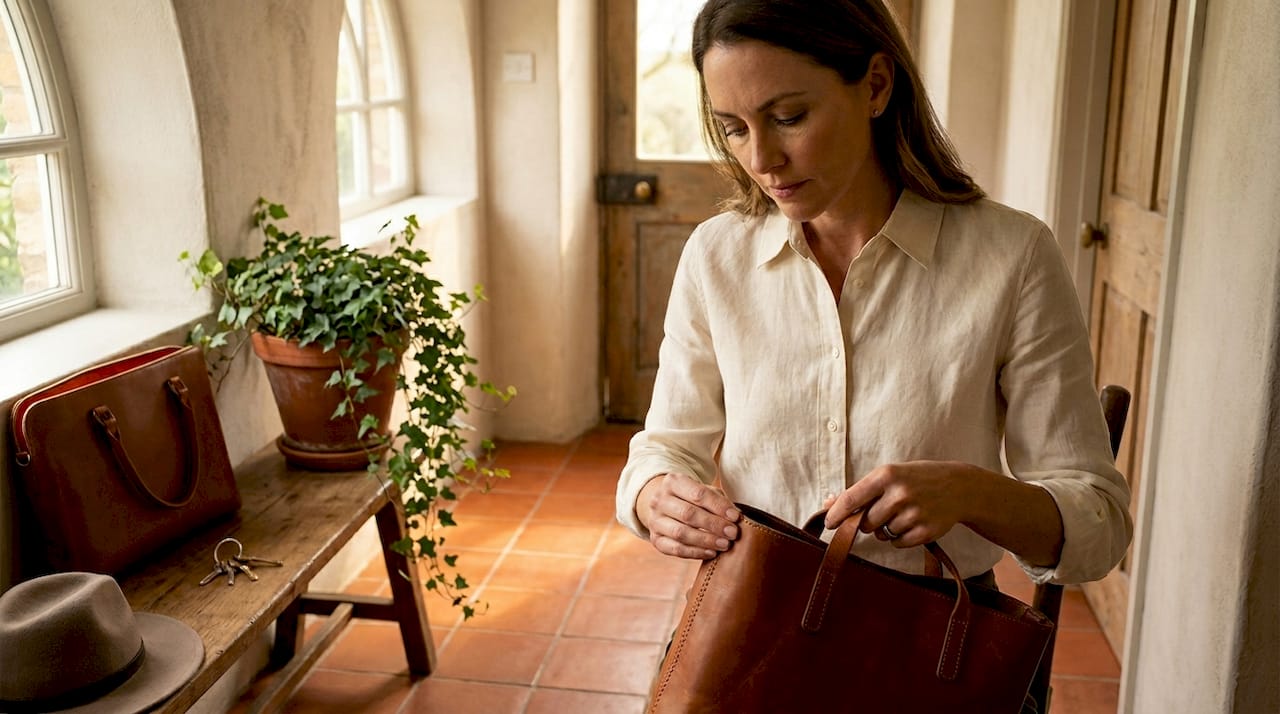
Closure type affects both security and bag character; twist and turnlock closures offer vintage appeal and are generally more costly than zippers, but they distribute opening and closing force differently, reducing focal stress on a single point. A zipper, by contrast, concentrates mechanical wear along a narrow track. This matters after three years of daily use.
For leather handbags that are elegant and durable, the design features that matter most day to day include:
- Adjustable, padded shoulder straps: These allow weight distribution across different carry positions and reduce shoulder fatigue on longer days.
- Structured base panels: Reinforced bottoms prevent the bag from collapsing inward under weight, which stresses seams along the lower sides.
- Reinforced stress points: Look for bar tacking (dense horizontal stitching) at strap attachment points and the top handles, the areas most likely to fail under repeated load.
- Well-placed external pockets: Reducing how often you open and close the main compartment extends the life of the primary closure significantly.
A numbered approach to evaluating design before purchase:
- Open and close every closure ten times. It should feel smooth and secure, not stiff or loose.
- Put the bag on your shoulder and adjust the strap. It should sit naturally without pulling the bag inward or outward.
- Look at the stitching at stress points under decent light. Uneven spacing or loose threads are warning signs.
- Check the lining by pressing it gently against the interior walls. It should feel attached and firm, not loose or bubbled.
- Lift the bag at the handles. The handles should bear the load without twisting or the attachment hardware creaking.
Comfort and wear under load are critical durability parameters, assessed meaningfully only over long commutes and travel. A bag that feels fine in a boutique but creates shoulder pain after two hours is a bag you will stop using, regardless of its material quality.
Pro Tip: Pay attention to the weight of an empty bag. A heavy bag before anything goes in it will become genuinely fatiguing by midday. The tips for choosing well-made leather handbags on our blog address this balance in detail.
Preserving your handbag’s durability through care and storage
Buying the right bag is half the work. The other half is keeping it in condition. Even full-grain Italian leather will dry, crack, and lose its structure if neglected, and even a beautifully crafted bag will distort if stored carelessly. The good news is that proper care takes very little time and costs almost nothing relative to the investment you are protecting.
A practical care routine:
- Weekly wipe-down: Use a clean, barely damp cloth to remove surface dust and light marks. Avoid soaking the leather or using household cleaning products, which strip natural oils.
- Monthly conditioning: Apply a leather conditioner appropriate to your bag’s finish. Most bags benefit from conditioning and upright storage to avoid deformations. Conditioning restores oils that daily handling and environmental exposure gradually deplete.
- Immediate spot treatment: Address spills within minutes. Blot, never rub. Rubbing works moisture and contaminants deeper into the grain, creating stains that are nearly impossible to reverse.
- Post-season deep clean: Before storing a bag for more than a month, clean it thoroughly, condition the leather, and treat any hardware with a soft cloth to prevent tarnishing.
- Structured storage: Store your bag upright and filled lightly with tissue paper or a bag insert to preserve its shape. Avoid overstuffing, which stretches seams and distorts the base.
- Environmental protection: Keep bags away from direct sunlight, which fades and dries leather faster than almost anything else, and away from humid spaces like bathrooms, which encourage mould growth and weaken stitching.
Our guides on how to store leather handbags naturally and storing handbags properly cover this in practical detail, including which inserts work best for different bag shapes.
Pro Tip: Rotate your bags. A single bag used every day without rest will wear at pressure points far faster than two bags used on alternate weeks. Rotation doubles the effective lifespan of your entire collection for no additional cost.
Verifying durability and timelessness before purchase
Before committing to any significant handbag purchase, run it through a structured evaluation. This is where high-quality handbag selections separate themselves from the merely attractive ones. Value should be judged by cost per wear, prioritising high-quality craftsmanship and materials that last for years. A £1,200 bag used daily for eight years costs less per use than a £300 bag replaced every eighteen months.
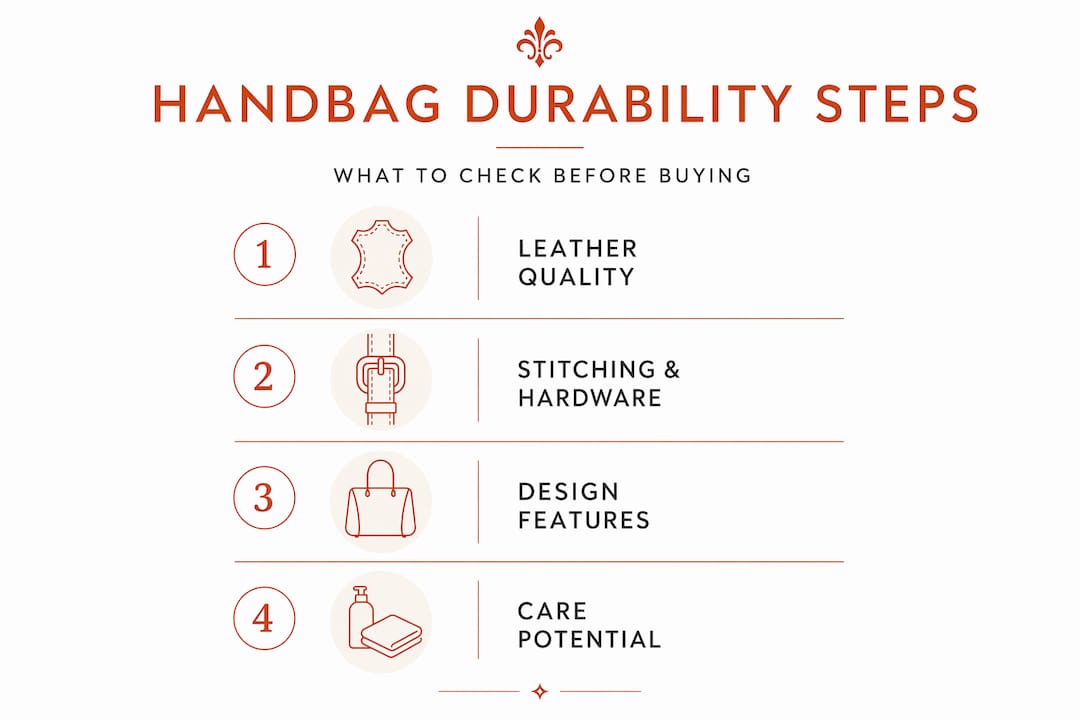
Equally, timeless style is key to ensuring a bag remains desirable beyond fleeting trends, which directly influences how long you will actually use it. A trend-driven bag with excellent materials is still a bag you will retire in two seasons.
Pre-purchase checklist for top durable handbag styles:
- Material authenticity: Confirm full-grain or top-grain leather. Ask the retailer directly. Evasive answers are informative.
- Stitching density and consistency: More stitches per centimetre means stronger seams. Look for evenness. Loose or skipped stitches indicate rushed production.
- Hardware quality: Press and rotate all hardware. It should feel solid, not hollow or gritty. Solid brass hardware outlasts zinc alloy by years.
- Lining integrity: A quality lining feels secured and purposeful. Check corners and base seams where lining detachment typically begins.
- Design neutrality: Avoid bags dominated by large logos or trend-specific silhouettes. A clean, structured shape works across contexts and across decades.
| Evaluation criterion | What to look for | Red flags |
|---|---|---|
| Leather quality | Full-grain, natural grain texture, slight variation | Uniform, plasticky surface; no smell |
| Stitching | Even, dense, consistent colour | Loose threads, uneven spacing |
| Hardware | Solid, smooth movement, weighty | Hollow sound, stiff or wobbly |
| Closure | Secure with natural resistance | Loose, difficult, or noisy |
| Lining | Firmly attached, quality fabric | Bubbling, peeling, loose corners |
| Silhouette | Clean, structured, proportional | Logo-heavy, trend-specific detailing |
Our roundup of best durable timeless leather handbags applies exactly these criteria to current collections, and our essential tips for choosing leather handbags gives you the vocabulary to assess quality independently.
Pro Tip: When comparing two shortlisted bags, photograph them side by side and assess the stitching and hardware under the camera’s flash. The flash eliminates flattering boutique lighting and reveals surface inconsistencies that are invisible under warm display light.
Rethinking durability: more than just materials and style
Here is something the standard buying guide will not tell you: the most durable handbag is not necessarily the one made from the thickest leather or fitted with the heaviest hardware. It is the bag you reach for every morning without hesitation. That sounds simple, but it is not. A bag that is technically excellent but feels awkward to carry, or lacks the right internal organisation for your specific life, will sit on a shelf. A bag you never use does not last. It simply does not age.
True durability has an emotional dimension. It is about the bag that holds its own at a board meeting and at a weekend lunch, that feels right whether you are in Milan or a northern city at 7am. It is the bag that your daughter might eventually want to borrow. That kind of longevity cannot be manufactured through material specifications alone. It comes from a design that was conceived with real women’s lives in mind and crafted by artisans who understand that quality and usability are the same thing.
Provenance matters here in a way that marketing rarely captures honestly. When a handbag is made by a skilled artisan in a family-run workshop in Tuscany or the Veneto, using techniques refined over generations, that is not a story for a label. That is a structural advantage. Hand-finishing closes edges more completely. Artisan inspection catches inconsistencies that automated production misses. The essential tips on well-made handbags we have gathered speak directly to how craft and usability intersect at the highest level.
Invest in a bag whose design allows you to move fluidly between work, travel, and leisure. That versatility is part of its durability. Every time a bag crosses one of those contexts successfully, you are getting a return on your investment that no cost-per-wear calculation fully captures.
Discover timeless durability with Italian craftsmanship at San Rocco Italia
At San Rocco Italia, every handbag in our collection is crafted in Italy using premium full-grain leather and traditional artisan techniques. We built this brand around a single belief: a well-made bag should work as beautifully on day one thousand as it does on day one.
Our designs are created for women who expect their accessories to keep pace with a full, varied life, without sacrificing elegance to practicality. Each piece balances structured beauty with thoughtful internal organisation, quality hardware, and leathers that age into something genuinely personal. Our blog offers expert guidance, from choosing well-made leather handbags to care and storage advice, so that every purchase you make is an informed one. When you invest with us, you invest in craft, provenance, and lasting value.
Frequently asked questions
What is the most durable handbag material?
Full-grain leather is the strongest and most durable handbag material, owing to its intact natural fibre structure and its ability to develop a rich patina that improves its character with age rather than diminishing it.
How important is the handbag closure type for durability?
Closure type affects both security and character; twist and turnlock closures distribute mechanical stress more evenly than zippers and typically outlast them significantly under daily use, while also adding a timeless, considered aesthetic.
Can vegan handbags be as durable as leather?
Most vegan handbags made from PU or PVC are less durable than full-grain leather. Vegan options wear quicker and generally do not provide equivalent longevity, making full-grain leather the stronger long-term investment for discerning buyers.
How should I store my handbag to maintain its quality?
Leather benefits from upright storage and avoiding overstuffing; keep your bag in a dust bag, lightly filled with tissue to hold its shape, away from direct sunlight and humid conditions for lasting structural integrity.
