


Red leather journals: Italian artistry for timeless elegance
Not all leather journals are created equal. Slip your hand across a genuine Italian red leather journal and you will feel the difference immediately — the supple give of vegetable-tanned calfskin, the faint earthy scent of the hide, the satisfying weight of archival paper within. These are objects made to be passed down, not discarded. Milanese stationer F. Pettinaroli, a family-run atelier with 144 years of history, has long set the global standard for what fine Italian stationery can be. In this guide, we will walk you through the craft standards, the defining features, how Italian journals compare to other luxury options, and exactly what to look for when buying or gifting one.
Table of Contents
- Why Italian red leather journals are coveted
- Signature features of a true Italian red leather journal
- How Italian red leather journals compare to other luxury brands
- What to consider when buying or gifting a red leather journal
- Discover exceptional Italian leather journals
- Frequently asked questions
Key Takeaways
| Point | Details |
|---|---|
| True luxury defined | Italian red leather journals blend history, quality, and artistry for the most discerning buyers. |
| Craftsmanship matters | Details like vegetable tanning, sewn binding, and hand-marbled paper are clear signs of heirloom value. |
| Refillable and practical | Opt for refillable options and customisation for both longevity and personal expression. |
| Perfect gifts | With careful selection, a red leather journal becomes an unforgettable, timeless gift. |
Why Italian red leather journals are coveted
Italy’s leather tradition is not a marketing story. It is a centuries-old practice rooted in specific regions, specific families, and specific techniques passed from one generation to the next. The Florentine and Milanese ateliers that produce the finest journals today are often the same workshops that supplied Renaissance merchants with their ledgers. That continuity matters enormously when you are choosing something meant to last.
The leather itself tells the story. Vegetable-tanned Tuscan leather is processed using natural tannins from tree bark rather than harsh industrial chemicals. This slower, more labour-intensive method produces a hide that develops a rich patina over time, deepening in colour and character with every use. A red leather journal treated this way does not fade into a dull, uniform surface. It evolves into something uniquely yours.
The lasting Italian craftsmanship behind these journals extends well beyond the cover. Smythe sewing, a bookbinding method where signatures of paper are individually stitched together before being bound, ensures the pages lie flat and the spine never cracks. Acid-free paper protects your writing from yellowing for decades. These are not incidental details. They are the difference between a journal that survives a lifetime and one that falls apart within a year.
“Italian red leather journals from brands like F. Pettinaroli (Milan 1881) exemplify timeless craftsmanship with vegetable tanning and hand-antiqued calfskin — objects that carry both personal and cultural significance.”
Here is what sets Italian red leather journals apart at a glance:
- Vegetable-tanned or aniline-finish leather that develops a personal patina over time
- Hand-antiqued calfskin with natural grain variations, never uniform or plasticky
- Smythe-sewn binding for a spine that opens flat and holds firm across hundreds of pages
- Acid-free, fountain-pen friendly paper that resists bleed-through and feathering
- Stone-marbled edges and endpapers that reflect centuries of Florentine bookbinding tradition
- Artisanal finishing including hand-stitched borders, burnished edges, and clasp closures
Owning one of these journals is a statement about what you value. It signals an appreciation for process, for patience, and for the kind of beauty that only improves with age.
Signature features of a true Italian red leather journal
Knowing that Italian craftsmanship is exceptional is one thing. Knowing precisely what to look for when you are standing in front of a purchase decision is another. Let us break down the specific features that distinguish a genuine Italian red leather journal from an imitation.
The Roma Lussa Leather Journal in red, handcrafted in Florence for Cavallini & Co., is a useful benchmark. It features genuine top-grain leather, 400 pages of acid-free Italian wove paper, and marbled edges that reference the historic carta marmorizzata tradition of Florentine bookbinders. This is not decoration for decoration’s sake. It is a living connection to a craft that predates the printing press.
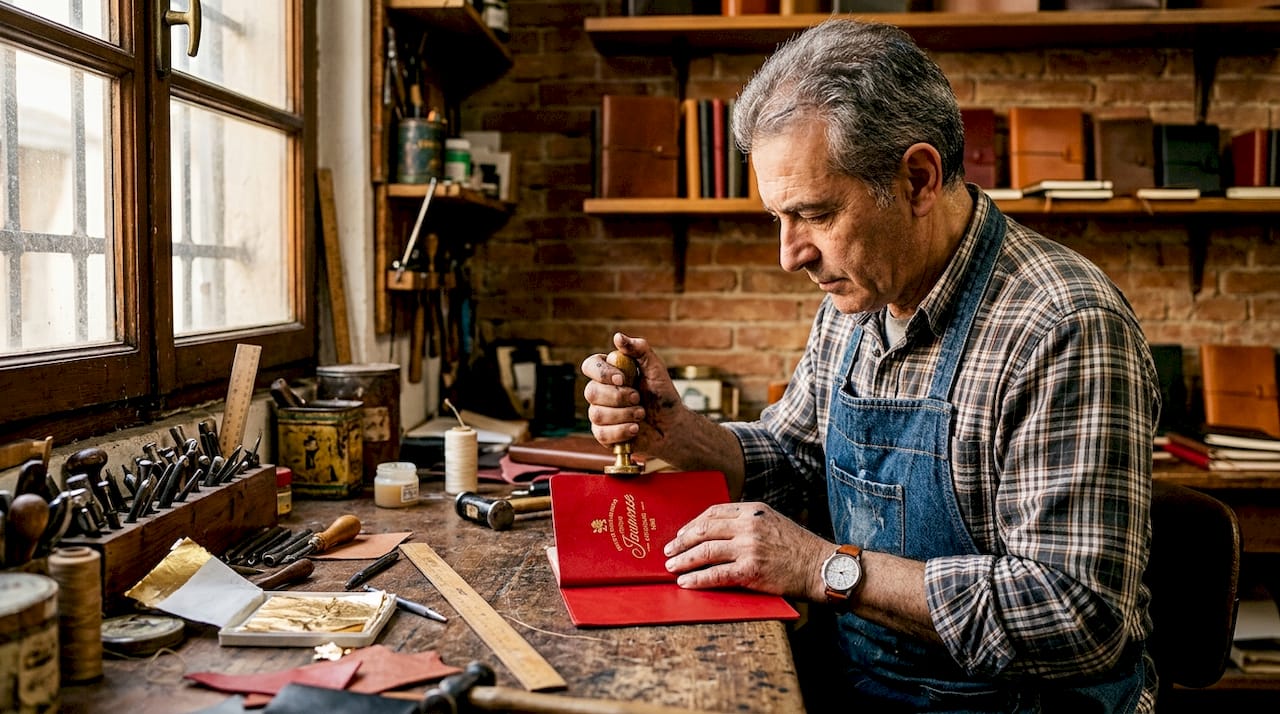
For those who prefer flexibility, refillable Italian journals offer a compelling alternative. A personalised Italian leather journal cover in red crafted from soft aniline cowhide in Tuscany can be fitted with new inserts as each one is filled, meaning the leather cover you invest in today can serve you for decades. These covers are available from pocket size through to extra-large, accommodating everything from a daily planner to a travel diary.
Here is a comparison of the key features to evaluate:
| Feature | What to look for | Why it matters |
|---|---|---|
| Leather type | Top-grain or aniline-finish Italian cowhide | Durability, patina development, authentic feel |
| Tanning method | Vegetable-tanned or hand-antiqued | Natural ageing, no synthetic coating |
| Binding | Smythe sewn or coptic stitch | Pages lie flat, spine stays intact |
| Paper quality | Acid-free, 90gsm or above, fountain-pen friendly | Longevity, no bleed-through |
| Refillability | Replaceable inserts with standard sizing | Sustainable luxury, long-term value |
| Personalisation | Monogramming, debossing, bespoke packaging | Gift distinction, sentimental value |
| Edge finishing | Marbled, gilded, or hand-painted edges | Florentine tradition, visual richness |
The numbered steps below will help you assess any journal before purchasing:
- Run your fingers across the cover. Genuine top-grain leather has a subtle, natural texture. If it feels perfectly uniform or slightly sticky, it is likely bonded or coated leather.
- Open the journal flat. A Smythe-sewn binding will open to a fully flat spread without resistance. A glued binding will resist and eventually crack.
- Check the paper weight. Hold a page to the light. Quality acid-free paper has a slight opacity and a smooth, consistent surface.
- Look for the origin. Authentic Italian journals will name the city of production, the atelier, or the specific leather source.
- Assess the finishing details. Hand-stitched borders, burnished edges, and ribbon markers are signs of genuine artisanal attention.
Pro Tip: If you write with a fountain pen, always request a paper sample or check the gsm rating before committing. Italian wove paper at 90gsm or above is your benchmark for a clean, feather-free writing experience.
Pairing your journal with matching Italian accessories such as a leather pen case or document folio elevates the entire experience and makes for a truly considered gift.
How Italian red leather journals compare to other luxury brands
The luxury stationery market is crowded, and not every prestigious name delivers the same standard of leather or paper craft. Understanding where Italian journals sit within that landscape helps you make a genuinely informed choice.
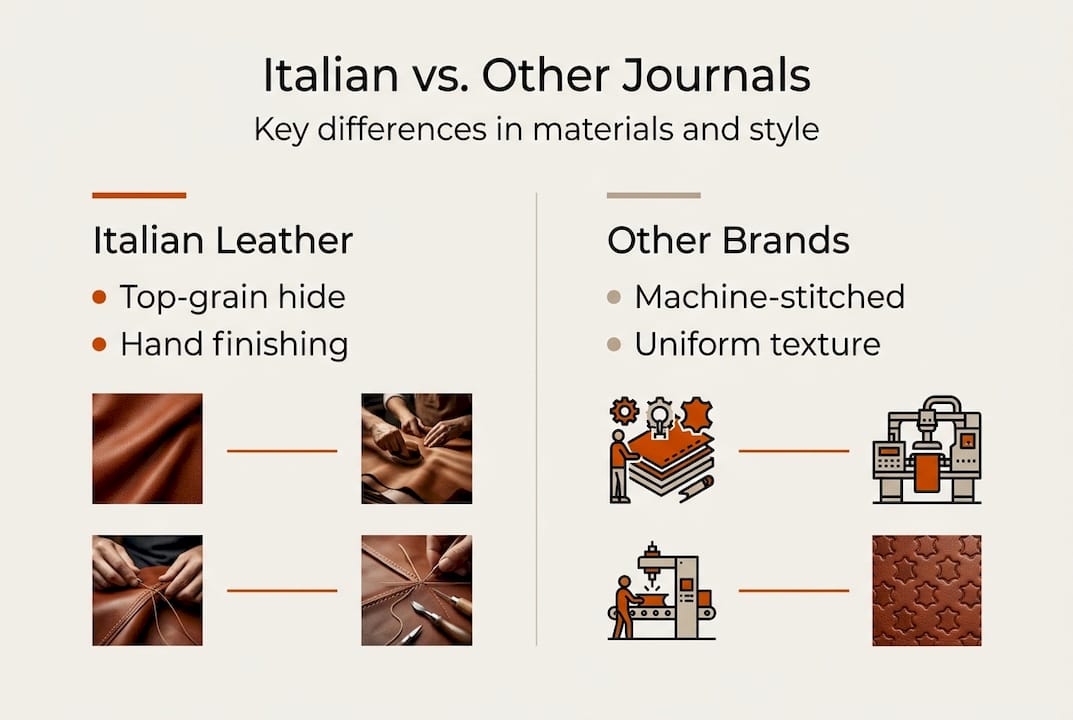
British brands such as Smythson of Bond Street are rightly celebrated for their elegant design and fine paper. However, Smythson typically uses crossgrain leather, a process that prioritises flexibility and a consistent surface finish over the natural variations and ageing character of vegetable-tanned hide. German brands such as Leuchtturm1917 excel in functional design and paper quality but position themselves as modern stationery rather than heirloom objects. Neither approach is wrong. They simply serve different purposes.
Italian journals, by contrast, favour artisanal top-grain leather with natural variations and an ageing patina that no machine-made product can replicate. Reviews consistently highlight their fountain-pen friendliness and longevity as key differentiators. The Italian leather gift comparison between these categories reveals a clear pattern: Italian options reward long-term ownership in a way that modern alternatives simply do not.
| Brand origin | Leather type | Binding | Paper quality | Ageing character | Refillable |
|---|---|---|---|---|---|
| Italian (Florence/Milan) | Vegetable-tanned top-grain | Smythe sewn | Acid-free, fountain-pen grade | Rich patina, deepens over time | Often yes |
| British (London) | Crossgrain cowhide | Machine sewn | Fine, consistent | Minimal ageing variation | Rarely |
| German | Synthetic or coated | Glued or sewn | Excellent functional quality | Little to none | Some models |
| French | Calf or goat leather | Variable | Good quality | Moderate | Rarely |
The key differentiators worth weighing up are:
- Leather tanning method: Vegetable tanning produces a living surface. Chrome or synthetic tanning produces a static one.
- Paper type: Acid-free Italian wove paper outperforms standard paper for both longevity and writing experience.
- Binding method: Smythe sewing is the gold standard for journals intended to last decades.
- Refillability: A practical consideration for those who want to invest once in a beautiful cover and replenish the pages sustainably.
- Provenance: Named ateliers with verifiable histories carry a cultural weight that generic luxury branding cannot replicate.
For a discerning buyer or gifter, these distinctions are not trivial. They are the entire point.
What to consider when buying or gifting a red leather journal
Choosing the right Italian red leather journal requires a little thought beyond aesthetics. The occasion, the recipient, and the intended use all shape what the ideal choice looks like.
For professional gifting, a larger format journal in deep red with monogrammed initials signals serious intent. It is the kind of gift that sits on a desk and draws admiring questions. For a creative writer or artist, a medium-format journal with unlined or dotted pages and a wraparound leather tie offers both freedom and elegance. For travel, a compact pocket journal in durable aniline leather fits neatly into a handbag and survives the rigours of daily use without losing its beauty.
Personalisation options from Florence and Tuscany ateliers include monogramming, debossed initials, bespoke page layouts, and curated gift packaging. These details transform a beautiful object into a deeply personal one. For milestone occasions such as a significant birthday, a promotion, or a retirement, a personalised Italian journal carries a weight of meaning that a generic gift simply cannot match.
Here are the key considerations to guide your decision:
- Occasion: Match the formality and scale of the journal to the occasion. A retirement gift warrants a larger, more elaborate piece than a travel companion.
- Customisation: Monogramming and debossing add sentimental value without compromising the integrity of the leather.
- Care: Store your journal away from direct sunlight and heat. Apply a small amount of suitable leather balm every few months to maintain suppleness.
- Longevity: Choose a refillable format if sustainability and long-term value are priorities. The cover will outlast many inserts.
- Presentation: A beautifully packaged journal, perhaps paired with a matching pen or leather bookmark, elevates the gifting experience considerably.
Pro Tip: For Italian gifting inspiration that goes beyond the journal itself, consider building a curated leather gift set. A red journal paired with a matching card holder or pen case creates a cohesive, memorable presentation. Guidance on personalising leather gifts can help you tailor the details to the recipient.
The care you put into selecting a gift like this is visible. It tells the recipient that you chose something made with intention, for someone worth the effort.
Discover exceptional Italian leather journals
If this guide has clarified what to look for in a genuine Italian red leather journal, the next step is finding one that meets every standard we have discussed. At San Rocco Italia, we have spent years curating a collection of Italian leather goods that reflect exactly the values explored here: authentic materials, skilled artisanship, and designs that endure.
Our curated Italian leather collection includes journals, accessories, and complementary pieces sourced directly from trusted Italian ateliers. As a woman-owned boutique with a genuine passion for Italian craft, we offer personalisation options and dedicated service for buyers who want something truly considered. Whether you are treating yourself or searching for a gift that will be remembered for years, we are here to help you find exactly the right piece.
Frequently asked questions
How can you tell if a red leather journal is genuinely Italian made?
Look for the name of the atelier, the city of production, vegetable-tanned markings, and evidence of hand-finishing such as burnished edges or hand-stitched borders. Brands like F. Pettinaroli (Milan) and Cavallini (Florence) emphasise family legacy and direct sourcing as part of their identity.
Are refillable red leather journals as durable as traditional sewn journals?
Yes. Quality refillable Italian covers use robust aniline cowhide crafted for long-term use, and the cover itself will outlast many sets of inserts, combining heritage with genuine practicality.
What size options are available for Italian red leather journals?
Common sizes range from pocket (approximately 3.5 x 5.5 inches) through medium and large to extra-large formats. Roma Lussa and Tuscany journals offer a full range with up to 400-page capacities to suit different writing habits.
Why choose a red leather journal as a gift?
Red carries associations with passion, confidence, and success, making it a particularly resonant choice for milestone occasions. The combination of Italian craft and personalisation creates an heirloom quality that elevates it well beyond a conventional gift.
How do you care for a luxury Italian leather journal?
Store it away from direct sunlight and heat, wipe gently with a soft dry cloth, and apply a small amount of leather conditioner every few months to keep the hide supple and prevent cracking over time.
Recommended
- Italian ladies leather briefcases: timeless craft for 2026 – San Rocco Italia
- Italian business messenger bags: timeless style for 2026 – San Rocco Italia
- Best Leather for Handbags: Italian Quality and Timeless Style – San Rocco Italia
- Brown Leather Notebook: Italian Craftsmanship’s Lasting Impact – San Rocco Italia



