


How to choose authentic Italian leather handbags
TL;DR:
- Authentic Italian leather handbags can be identified by their suppleness, natural scent, and subtle grain variations. Proper inspection of stitching, edging, hardware, and labels ensures genuine quality, as fake materials often fail these tests. Investing in well-crafted, classic designs offers long-term durability and timeless elegance, making authenticity worth the price.
There is a particular frustration in spending generously on a handbag, only to realise months later that the leather is peeling, the stitching is unravelling, and the bag has aged badly rather than gracefully. The market for Italian leather handbags is flooded with convincing imitations, and even well-intentioned purchases can go wrong without the right knowledge. This guide walks you through expert-validated criteria, signature styles, and practical comparisons so that every choice you make is grounded in genuine understanding, not guesswork or marketing language.
Table of Contents
- Key criteria for authentic Italian leather handbags
- Examining craftsmanship: Stitching, edging, and hardware
- Signature styles: Classic Italian leather bags to know
- Side-by-side comparison: Italian leather vs. common alternatives
- Making the right choice: Practical decision steps
- Beyond the label: Why real Italian leather is worth the investment
- Discover authentic Italian craftsmanship with San Rocco Italia
- Frequently asked questions
Key Takeaways
| Point | Details |
|---|---|
| Authenticity first | True Italian leather shows natural grain, subtle irregularities, and distinct suppleness. |
| Craftsmanship matters | Expert finishing, quality hardware, and ‘Made in Italy’ labels signal long-lasting value. |
| Iconic styles endure | Classic Italian designs like top-handles and totes remain stylish and functional across generations. |
| Compare before you invest | Put genuine Italian leather head-to-head with alternatives using texture and construction as key tests. |
| Choose with confidence | A simple inspection checklist lets you invest in a timeless piece with peace of mind. |
Key criteria for authentic Italian leather handbags
Now that we understand the enduring appeal of Italian leather, let’s break down the most reliable ways to authenticate a handbag before making a decision.
Real Italian leather has a character that no synthetic material can fully replicate. The first thing to assess is suppleness. Genuine full-grain leather yields softly under your fingers without feeling stiff or plasticky. When you gently press a fold into the surface, you will see tiny, natural wrinkles form and then relax. This is the leather breathing. Faux materials tend to crease sharply and hold the fold, or spring back with an artificial rigidity.
Scent is equally telling. Authentic leather carries a warm, slightly earthy smell that is immediately recognisable. As Vanity Fair Italia notes, “the best way to check if a ‘borsa in pelle’ is real is to examine the suppleness, scent, and the natural irregularities of the leather.” If a bag smells strongly of chemicals or plastic, that is a clear warning sign regardless of the price tag attached.
Surface texture matters too. Authentic leather shows subtle, non-uniform grain. No two hides are identical, which means a genuine bag will have slight variations in pattern across its surface. Uniform, perfectly repeated grain is almost always a sign of embossed faux material.
Key things to examine before buying:
- Suppleness: Does the leather yield naturally without stiffness?
- Scent: Is there a warm, earthy smell rather than a chemical one?
- Grain: Are there subtle, natural variations rather than a perfect repeated pattern?
- Bend test: Do tiny wrinkles form and relax when you fold the leather gently?
- Edge feel: Are the cut edges smooth and slightly absorbent rather than sealed with a shiny plastic coating?
“Price and logo alone are never a guarantee of authenticity. A bag can carry a prestigious name and still be made from bonded leather or synthetic materials. Your own hands and nose are your most reliable tools.”
Pro Tip: On bags with exotic textures such as crocodile or ostrich embossing, look for minor irregularities in the scale pattern. Authentic exotic leather will never be perfectly uniform. If every scale is identical, you are almost certainly looking at embossed faux leather.
For further guidance on evaluating materials before you buy, our article on choosing well-made leather handbags covers the most important practical steps, and our expert insights for leather bags goes deeper into quality indicators.
Examining craftsmanship: Stitching, edging, and hardware
Once you can spot real Italian leather, it is time to evaluate the bag’s construction for indications of enduring craftsmanship.
The stitching on a genuine Italian leather bag is one of its most revealing features. Look for tight, even stitches that are consistent in length and spacing throughout the entire bag, including interior seams. Loose threads, uneven spacing, or stitching that pulls the leather unevenly are all signs of rushed production. As ABC Italy confirms, “signs of true ‘Made in Italy’ include flawless stitching, smoothly coated edges, and robust, fluid hardware.”
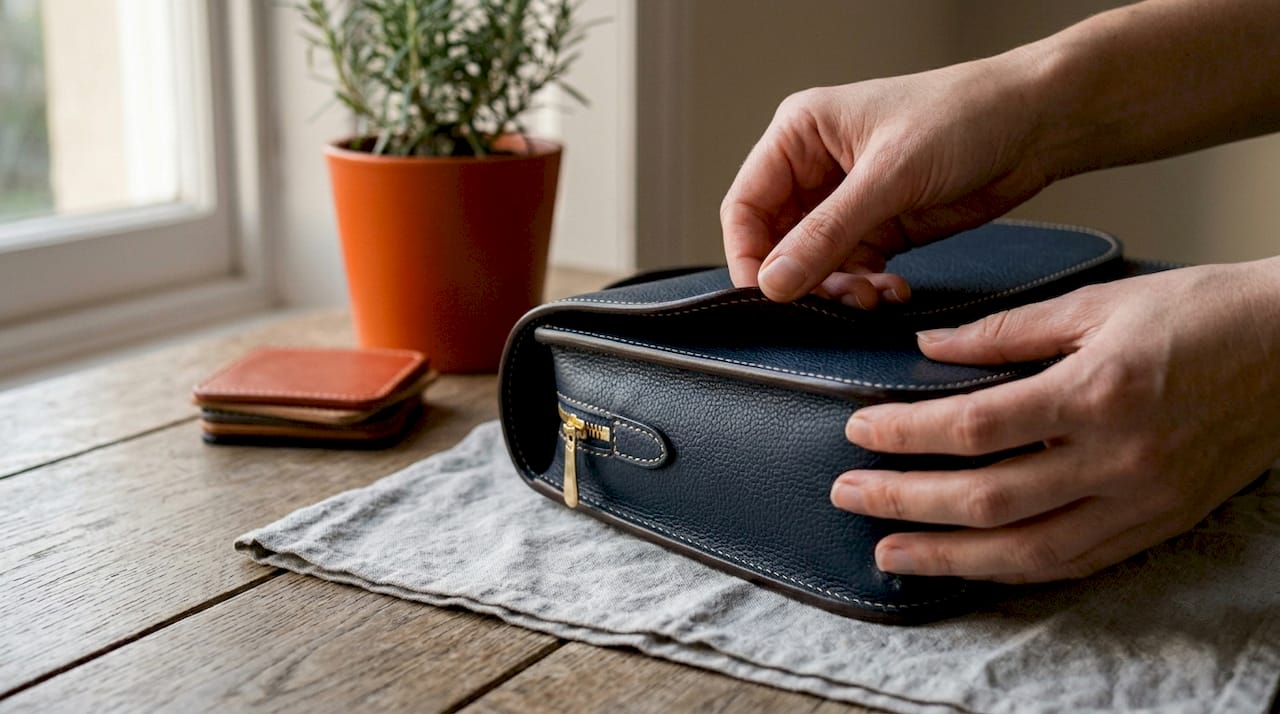
Edging is where many bags reveal their true quality. Wherever leather is cut, the raw edge should be smoothly burnished or painted with an even, consistent coat. Rough, fraying edges or a thick, lumpy edge coat suggest shortcuts in production. Run your finger along every edge you can reach. It should feel smooth and slightly rounded, not sharp or uneven.
Hardware is the third pillar of construction quality. Clasps, rings, zips, and studs should feel weighty and move smoothly. Cheap hardware feels hollow, rattles slightly, and often has an inconsistent finish where plating is uneven or already showing wear before the bag has been used. The label inside should clearly read Made in Italy, not merely “designed in Italy” or “inspired by Italian craftsmanship,” which are phrases that carry no legal guarantee of manufacture.
| Feature | Authentic Italian leather bag | Lower quality alternative |
|---|---|---|
| Stitching | Tight, even, consistent throughout | Loose, uneven, or missing in places |
| Edging | Smooth, burnished or evenly painted | Rough, fraying, or thickly coated |
| Hardware | Weighty, smooth movement, consistent finish | Hollow feel, rattles, uneven plating |
| Label | “Made in Italy” | “Designed in Italy” or no origin stated |
| Interior | Clean seams, quality lining | Exposed raw edges, thin lining |
Pro Tip: Pay particular attention to the handles and corners. These are the stress points that endure the most daily wear. If the stitching at the handle attachment looks strained or the corners are already showing wear on a shop floor sample, the bag will not age well.
Our guide on what to look for when buying Italian leather bags covers construction in greater detail, and our piece on the best leather for handbags explains how different hide types affect durability and appearance over time.
Signature styles: Classic Italian leather bags to know
A beautifully made bag is only enhanced by a design that endures. Here are classic Italian shapes and why they matter.
Italian leather craftsmanship has given the world some of its most enduring handbag silhouettes. Understanding these shapes helps you invest in something that will remain relevant and elegant for decades, not just seasons.
The structured tote is perhaps the most versatile piece in any wardrobe. It offers generous interior space, clean lines, and a silhouette that moves from professional settings to weekend use without effort. A well-made Italian leather tote in a neutral tone such as tan, cognac, or deep burgundy will only improve in character as the leather develops a natural patina.
The top-handle bag is the definitive Italian classic. Carried by hand or tucked into the crook of the arm, it projects a quiet, confident elegance. The structured body holds its shape beautifully, and the hardware at the handle attachment is usually a showcase of the maker’s skill. As ABC Italy notes, “selection of a timeless investment bag should factor in the longevity of stitching and finishing, as well as how well the hardware ages with use.”
The clutch occupies a different role. It is the piece you reach for when the occasion calls for something refined and minimal. A full-grain leather clutch with clean edging and a simple clasp will outlast trend-driven alternatives by years. For a contemporary take on this silhouette, the sculptural handbag with knotted handle demonstrates how artisan detailing can elevate a classic form.
| Style | Size | Versatility | Collectability | Best occasion |
|---|---|---|---|---|
| Structured tote | Large | Very high | Moderate | Work, travel, everyday |
| Top-handle bag | Medium | High | Very high | Professional, social |
| Clutch | Small | Moderate | High | Evening, formal events |
| Shoulder bag | Medium | High | Moderate | Everyday, casual to smart |
For a curated overview of the finest options available, our article on Italian leather handbags made in Italy highlights the styles most worth seeking out.
Side-by-side comparison: Italian leather vs. common alternatives
With these timeless shapes in mind, it is important to confidently separate true luxury from affordable imitations.
The differences between genuine Italian leather and faux or bonded alternatives are not always obvious at first glance, but they become very clear with use. Vanity Fair Italia observes that “faux materials may be treated with artificial scent and engineered for near-perfect pattern uniformity, but real leather shows subtle imperfections and a unique feel.” This is precisely why hands-on inspection matters so much.
Here is how to test a bag systematically before committing:
- The bend test: Gently fold a small section of the leather. Authentic leather produces fine, natural wrinkles that relax when released. Faux leather either holds a sharp crease or springs back artificially.
- The scent test: Hold the bag close and breathe in. Real leather has a warm, organic scent. A chemical or plastic smell indicates synthetic material, regardless of how convincing the surface looks.
- The pattern test: Examine the grain closely across different areas of the bag. Natural leather has subtle variation. Perfectly uniform, repeated grain is almost always embossed faux.
- The edge test: Look at every cut edge. Genuine leather edges are slightly absorbent and respond well to burnishing. Plastic-coated faux edges often peel or chip at the corners with use.
- The weight test: Authentic full-grain leather has a satisfying, natural weight. Very light bags with leather-look surfaces are often synthetic.
| Test category | Authentic Italian leather | Faux leather | Bonded leather |
|---|---|---|---|
| Scent | Warm, earthy, organic | Chemical or plastic | Faint, sometimes chemical |
| Grain | Natural, subtly varied | Uniform, repeated | Uniform, may flake |
| Bend response | Fine wrinkles, relaxes | Sharp crease or rigid | Cracks over time |
| Edge finish | Smooth, burnished | Plastic-coated, may peel | Often rough or flaking |
| Longevity | Decades with care | 1 to 3 years typically | 1 to 2 years |
Authentic leather bags, when properly cared for, can last 20 to 30 years and often improve in appearance as they develop a patina. Faux alternatives typically show visible deterioration within two to three years of regular use. When you calculate cost per year of use, the investment in genuine Italian leather is almost always the more economical choice over time.
For a practical breakdown of what separates quality from imitation, our tips for quality leather handbags article is an excellent companion resource. If you are drawn to the clutch format, the clutch bag with structured top handle is a fine example of how clean construction and quality materials come together in a compact form.
Making the right choice: Practical decision steps
Finally, bring everything together into a simple, confident action plan so you can shop wisely, not impulsively.
Buying a luxury Italian leather handbag is a considered decision, not an impulse. The following steps will help you approach any purchase with clarity and confidence.
- Authenticate the leather first. Before anything else, apply the bend, scent, and pattern tests. If the bag fails any of these, no amount of beautiful design or prestigious branding justifies the price.
- Inspect the construction thoroughly. Check stitching consistency, edge quality, and hardware weight. Pay special attention to handles, corners, and zip attachments, as ABC Italy advises, noting that “a meticulous inspection of stitching, finishes and hardware at critical stress points enhances the longevity and value of your investment.”
- Verify the origin. Confirm the label reads “Made in Italy” and, where possible, ask about the specific region of manufacture. Italy’s leather districts, particularly Tuscany, have centuries of accumulated expertise.
- Compare styles against your lifestyle. A beautifully made bag that does not suit your daily needs will not be used, and unused bags do not develop the character that makes Italian leather so special.
- Ask about after-sales support. Reputable makers and boutiques will offer care advice, conditioning recommendations, and in some cases, repair services. This is a meaningful indicator of how seriously a brand takes the longevity of its products.
- Make an informed, unhurried decision. Avoid pressure selling and impulse purchases. A genuine Italian leather bag is an investment that rewards patience.
Pro Tip: Ask the retailer directly whether they can provide care instructions for the specific leather used. A knowledgeable seller will answer confidently and in detail. Hesitation or vague answers are a red flag.
Our guide on ways to choose and care for leather bags covers the full lifecycle of a quality leather bag, from selection through to long-term maintenance.
Beyond the label: Why real Italian leather is worth the investment
There is a particular kind of satisfaction that comes from owning something that was made slowly, by skilled hands, from materials chosen for their quality rather than their cost. A genuine Italian leather handbag is not simply an accessory. It is an object that accumulates meaning over time.
We see this often in the way women talk about their most treasured bags. They do not describe the logo or the season it was purchased. They describe the way the leather has softened to their hand, the patina that has developed along the handles, the way the bag has become, in a quiet sense, theirs. This is something no imitation can replicate, because imitations do not age. They deteriorate.
There is also a practical dimension that is often overlooked. Choosing authenticity is an act of mindful acquisition. Rather than buying several bags over a decade that each disappoint and are discarded, you buy one or two pieces that outlast trends, outlast seasons, and outlast the brands that chased them. The expert tips for best leather bags on our blog explore this philosophy in depth.
We would also challenge the idea that Italian leather is purely about status. The women who truly understand these bags are not wearing them to signal wealth. They are wearing them because they value the feeling of holding something real. There is a quiet confidence that comes from knowing exactly what you have and why it matters. That confidence is not for sale at any price point. It comes from knowledge, discernment, and the willingness to invest in quality over convenience.
Discover authentic Italian craftsmanship with San Rocco Italia
If this guide has sharpened your eye for what truly matters in a luxury handbag, the next step is finding pieces that meet every standard you now know to look for.

At San Rocco Italia, every handbag in our collection is made in Italy by skilled artisans using premium full-grain leather and traditional techniques passed down through generations. We are a woman-owned boutique, and our curation reflects a genuine commitment to timeless design, exceptional craftsmanship, and the kind of authenticity that holds up to every test described in this guide. Browse our collection and discover pieces made to be carried for decades, not seasons.
Frequently asked questions
How can I tell if a leather handbag is authentic Italian leather?
Check for suppleness, natural grain variation, and a warm earthy scent, then perform a gentle bend test to see if tiny wrinkles form and relax naturally. As Vanity Fair Italia advises, examining suppleness, scent, and natural irregularities are the most reliable indicators of real leather.
Why is ‘Made in Italy’ important for leather handbags?
“Made in Italy” signals that a bag meets rigorous craftsmanship standards, including flawless stitching and hardware quality, and was manufactured by artisans with deep expertise in leather goods. It is a legal designation, not a marketing phrase, and carries meaningful accountability.
Which style of Italian leather handbag lasts the longest?
Structured totes and classic top-handle bags from genuine Italian makers typically offer the best longevity in both form and function. As ABC Italy notes, selecting a timeless investment bag should factor in the longevity of stitching and finishing, as well as how hardware ages with use.
Are high prices and designer brands a guarantee of real Italian leather?
No. Price and brand recognition are not proof of authenticity, and as Vanity Fair Italia confirms, even expensive bags can use bonded or synthetic materials. Always inspect the leather, construction, and label yourself before purchasing.
Recommended
- Best Leather for Handbags: Italian Quality and Timeless Style – San Rocco Italia
- 7 Essential Tips for Choosing Well Made Leather Handbags – San Rocco Italia
- Best Italian Leather Handbags – Expert Comparison 2025 – San Rocco Italia
- 8 Best Italian Leather Handbags Made in Italy to Explore – San Rocco Italia


