


Discover the finest Italian leather knapsacks for 2026
TL;DR:
- Authentic Italian leather knapsacks are made from full-grain, vegetable-tanned leather that develops a rich patina.
- Craftsmanship details like hand-stitching, burnished edges, and solid brass hardware indicate genuine artisanal quality.
- Proper care and attention to material choice ensure a durable, heirloom-quality bag that ages beautifully.
There is a particular frustration that comes with searching for a leather knapsack that truly delivers on its promise. The market is flooded with bags bearing Italian-sounding names, wrapped in glossy marketing language, yet constructed from corrected-grain leather in factories that have never seen the Arno valley. For women who have spent years refining their taste, who understand the difference between a purchase and an investment, this gap between promise and reality is deeply unsatisfying. The finest Italian leather knapsacks are not simply accessories. They are objects shaped by centuries of artisan tradition, and knowing how to find them changes everything.
Table of Contents
- How to identify authentic Italian craftsmanship in leather knapsacks
- Top Italian leather knapsacks: expert picks for sophisticated style
- Comparing vegetable-tanned and chrome-tanned leather knapsacks
- Care and longevity: how to ensure your leather knapsack ages beautifully
- Choosing the perfect Italian leather knapsack for your lifestyle
- Why true Italian knapsacks are more than a luxury accessory
- Experience Italian craftsmanship: discover your luxury leather knapsack
- Frequently asked questions
Key Takeaways
| Point | Details |
|---|---|
| Seek artisanal credentials | Look for authentic Tuscan or Italian stamps and craftsmanship marks to ensure true quality. |
| Vegetable-tanned advantages | Select vegetable-tanned leather for eco-heritage, patina, and luxury status if you are prepared for a handcrafted piece. |
| Care shapes longevity | Proper maintenance ensures your knapsack lasts decades and develops desirable character. |
| Prioritise your lifestyle | Choose your knapsack based on use-case, styling needs, and your willingness to invest time in its care. |
How to identify authentic Italian craftsmanship in leather knapsacks
The single most reliable indicator of a genuinely Italian leather knapsack is the quality of the hide itself. Full-grain leather, taken from the outermost layer of the hide, retains its natural surface texture, its grain, and its character. It has not been sanded, buffed, or corrected to hide imperfections. This matters because that untouched surface is what allows the leather to develop a rich patina over years of use. When you are examining a knapsack, run your fingertips across the surface. Genuine full-grain leather feels slightly irregular, alive, and warm.
Tuscan leather goods are recognised globally for hand-finishing, small-batch production, and certifications such as “Pelle Conciata al Vegetale in Toscana,” which guarantee authentic provenance and the use of traditional vegetable tanning methods sourced from local Tuscan woodlands. This certification is not merely decorative. It tells you that the leather was tanned using natural tannins drawn from chestnut, oak, and mimosa bark, a process that takes weeks rather than the hours required by industrial chrome tanning.
Beyond the leather itself, look carefully at the construction. Authentic Italian knapsacks from small workshops reveal their origins in the details.
- Hand-stitching using linen or waxed thread, with consistent tension and no loose ends
- Edge burnishing, where the cut edges of leather panels are carefully smoothed, coloured, and sealed by hand rather than painted over with a quick coat of dye
- Hardware in solid brass or antique bronze, with weight and resistance that cheap zinc alloys simply cannot replicate
- Interior linings in quality cotton or suede, stitched cleanly and finished at every seam
- Maker’s marks or artisan signatures, often stamped or embossed inside the bag
The handmade Italian leather from Tuscany tradition stretches back to the medieval guilds of Florence, where leather workers, known as pellettieri, developed techniques that remain largely unchanged today. Understanding the history of Italian leather bags gives you a deeper appreciation for why these objects command the prices they do.
“A bag made with care in a small Florentine workshop carries within it the accumulated knowledge of generations. You are not buying leather and thread. You are buying time, skill, and a living tradition.”
Pro Tip: Always check the interior of a knapsack for the “Pelle Conciata al Vegetale in Toscana” stamp or certification card before purchasing. Reputable artisans are proud to display it, and its absence on a bag claiming Tuscan heritage should prompt serious questions.
Once you understand what distinguishes genuine Italian craftsmanship, you can evaluate individual knapsack options more effectively.
Top Italian leather knapsacks: expert picks for sophisticated style
With the mark of authenticity in mind, let us explore some of Italy’s finest leather knapsacks admired for their craftsmanship and enduring design.
The structured Florentine backpack
This style draws directly from the leather-working ateliers of Florence, typically crafted in a medium-brown or cognac full-grain vegetable-tanned hide. The silhouette is clean and architectural, with a gently curved top handle, padded back panel, and two internal compartments that keep your belongings organised without sacrificing elegance. Brass turn-lock closures replace zips on the finest examples, and the interior often features a suede lining in a complementary warm tone.
Key attributes:
- Leather type: Full-grain vegetable-tanned, Florentine origin
- Size: Medium, typically 28 to 32 cm in height
- Unique details: Hand-burnished edges, brass hardware, artisan stamp
- Carrying comfort: Padded adjustable straps with shoulder relief
The soft-structured Tuscan daypack
Slightly more relaxed in form, this style suits women who move between professional and social environments throughout the day. The leather is typically softer, having been worked more extensively during finishing, and the bag takes on a beautiful slouch that becomes more pronounced over years of use. Some versions feature a front slip pocket with a magnetic closure, ideal for cards and keys.
Key attributes:
- Leather type: Full-grain, lightly tumbled for softness
- Size: Medium to large, accommodating a 13-inch laptop
- Unique details: Adjustable crossbody strap option, contrast stitching
- Carrying comfort: Wide padded straps, lightweight for its size
The Melbourne Italian leather backpack from San Rocco Italia exemplifies this category beautifully, combining practical organisation with the kind of considered design that rewards daily use.
The minimalist Venetian knapsack
For those who favour restraint, the Venetian aesthetic offers clean lines, a narrow profile, and a focus on the leather itself as the primary design element. Hardware is minimal, often a single central zip or a drawstring closure with a leather toggle. The beauty of this style lies entirely in the quality of the hide and the precision of its construction.
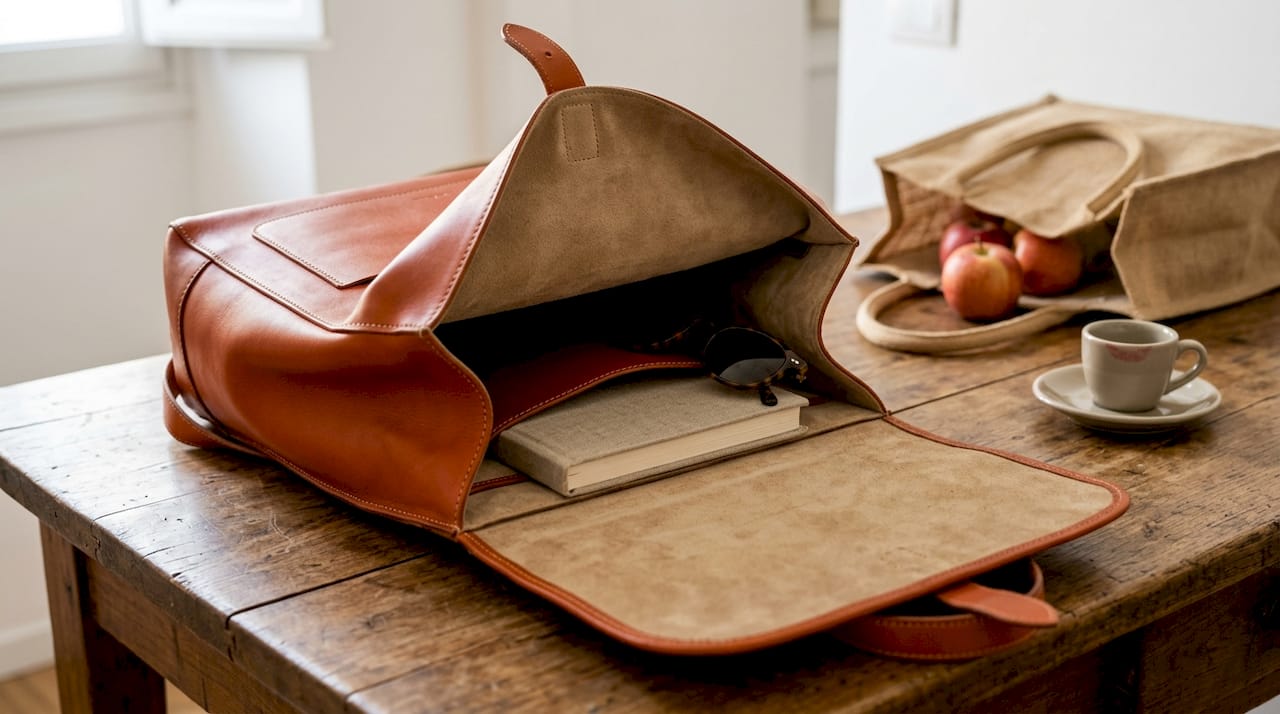
Full-grain veg-tanned leather lasts decades, developing genuine character over time, with straps softening over weeks of wear and some makers offering warranties of 25 years or more, though the weight of dense full-grain hides can reach six pounds empty on the most substantial examples.
Pros of investing in these styles:
- Eco-tanned using natural, non-toxic processes
- Heirloom longevity that outlasts trends by decades
- Leather softens and moulds to your body over time
- Patina becomes increasingly beautiful and personal
Considerations to bear in mind:
- Initial stiffness, particularly in straps and closures
- Sensitivity to moisture before conditioning treatment
- Higher price point reflecting true artisan labour
- Weight of dense full-grain leather on larger styles
Pro Tip: Before you buy, think about how the bag’s patina will develop in relation to your wardrobe. A cognac or tan leather will warm and deepen over time, becoming richer against neutrals and earth tones. A darker chocolate brown will develop subtle highlights that suit a more classic, structured wardrobe. Choosing with patina in mind is choosing for the long term.
Exploring the best Italian leather for handbags will help you understand the specific grades and finishes available, so you can match material to your personal aesthetic with confidence.
“The most beautiful bag I own is the one that carries the memory of every journey I have taken with it. That is something no new bag can offer.”
Comparing vegetable-tanned and chrome-tanned leather knapsacks
The unique feel and appearance of a knapsack depends not only on craftsmanship but also on which tanning method is chosen. The tanning process transforms raw hide into durable leather, and the method used has profound implications for the bag’s character, longevity, and environmental footprint.
Vegetable-tanned leather excels in patina and artisanal prestige, while chrome-tanned leather offers greater softness and water resistance at a more accessible price point, with luxury buyers consistently favouring vegetable tanning for its heritage status and depth of character.
| Feature | Vegetable-tanned leather | Chrome-tanned leather |
|---|---|---|
| Tanning process | Natural tannins, weeks-long process | Chemical salts, hours-long process |
| Patina development | Rich, deepening, highly personal | Minimal, surface remains consistent |
| Initial texture | Firm, moulds over time | Soft and supple from the outset |
| Water resistance | Lower without treatment | Higher naturally |
| Environmental impact | Biodegradable, eco-friendly | Chemical waste, less sustainable |
| Artisanal prestige | High, associated with Italian tradition | Lower, more industrial association |
| Longevity | Decades with proper care | Good, but less character over time |
| Price point | Higher, reflecting process and skill | More accessible |
| Luxury status | Preferred by discerning buyers | Common in mid-market bags |
For women investing in a knapsack intended to last a lifetime and carry genuine artisan heritage, vegetable-tanned leather is the clear choice. The slower process, the natural materials, and the resulting depth of character place it in an entirely different category from its chrome-tanned counterpart.
When considering Italian vs French leather, it is worth noting that the Italian tradition, particularly in Tuscany, has the deepest roots in vegetable tanning specifically, with the Santa Croce sull’Arno district producing some of the world’s most respected full-grain hides.
Statistic callout: Luxury buyers select vegetable-tanned leather for its unrivalled patina and heritage status, with the Tuscan tanning industry representing one of the most concentrated centres of traditional leather craft in the world.
Care and longevity: how to ensure your leather knapsack ages beautifully
Now that you know the differences in tanning, caring properly for your luxury knapsack will preserve both its beauty and its value. Vegetable-tanned leather, for all its extraordinary qualities, does require attentive care, particularly in the early months of ownership when the leather is still firm and most vulnerable to moisture and abrasion.
Vegetable-tanned leather is moisture-sensitive, initially stiff but moulding naturally to the user over time, and while a well-worn patina is a genuine luxury signal, the bag requires protective treatment before exposure to rain or damp conditions.
Essential care practices:
- Condition regularly with a high-quality, natural leather conditioner, ideally one formulated for vegetable-tanned hides. Every two to three months is a reasonable schedule for a bag in daily use.
- Protect against moisture using a dedicated leather protector spray before first use and reapplied seasonally. This does not make the bag waterproof, but it significantly reduces the risk of water staining.
- Store correctly when not in use. Stuff the bag lightly with tissue paper to maintain its shape, and keep it in a breathable dust bag away from direct sunlight and heat sources.
- Clean gently using a slightly damp cloth for surface dust and a specialist leather cleaner for more stubborn marks. Never use household cleaning products, which strip the leather’s natural oils.
- Allow the leather to breathe. Avoid storing in plastic or airtight containers, which can cause the leather to dry out and crack over time.
| Care factor | Vegetable-tanned leather | Expected outcome with good care |
|---|---|---|
| Conditioning frequency | Every 2 to 3 months | Supple, nourished surface |
| Strap softening | Weeks of regular wear | Comfortable, body-moulded fit |
| Patina development | Months to years | Rich, deepening colour and character |
| Typical longevity | 20 to 40 years | Heirloom quality bag |
| Common warranty | 25 years with reputable makers | Confidence in construction |
| Water sensitivity | High without treatment | Preventable with protector |
The patina that develops on a well-maintained vegetable-tanned knapsack is one of the most distinctive signals of considered luxury. Unlike a bag that looks identical after five years of use, a patinated Italian leather knapsack tells a story. The areas of most frequent contact, the handles, the base corners, the strap attachment points, deepen in colour first, creating a natural gradient that no factory finish can replicate.
For detailed guidance, the expert leather luggage care tips available from San Rocco Italia offer practical, specific advice tailored to premium Italian hides. Understanding which best leather bag companies stand behind their products with genuine after-care support is also worth considering before you invest.
Choosing the perfect Italian leather knapsack for your lifestyle
With deep knowledge of care and materials, here is a simple framework to ensure you find the knapsack that reflects your style and needs. Choosing well at the outset means you will not be replacing this bag in three years. You will be carrying it for thirty.
-
Define your primary use. Are you looking for a travel companion, a daily work bag, or a weekend piece for cultural outings and city exploration? A structured Florentine style suits professional environments, while a softer Tuscan daypack transitions more naturally between contexts. Travel-focused buyers should prioritise a secure zip closure and a padded laptop sleeve.
-
Consider your patina preference. Lighter leathers in tan, cognac, or natural develop the most visible and dramatic patina over time. Darker shades in chocolate or midnight navy develop subtler, more refined changes. Neither is superior, but the choice should reflect how you want the bag to evolve alongside you.
-
Be honest about your maintenance willingness. Vegetable-tanned leather rewards attentive care with extraordinary beauty, but it does require that care. If you prefer a lower-maintenance option, a chrome-tanned full-grain leather from a reputable Italian maker still represents a significant step above mass-market alternatives.
-
Get the sizing right. A knapsack that is too large will feel cumbersome and undermine the elegance of the leather. A bag that is too small will frustrate you daily. Measure the items you carry most often and choose a bag with at least two centimetres of clearance on each side.
-
Choose your visual style with intention. Italian leather knapsacks range from the severely architectural to the softly romantic. Consider the rest of your wardrobe and the occasions you dress for most frequently. A bag that feels slightly formal in isolation will often feel perfectly calibrated when worn.
Pro Tip: If you are considering a bag with a lighter-coloured interior lining, choose one in a warm cream or natural cotton rather than stark white. Warmer tones hide minor marks more gracefully and complement the natural tones of Italian leather far more elegantly.
Full-grain veg-tanned bags are built to last decades, with straps softening over weeks and warranties of 25 years reflecting the maker’s genuine confidence in their construction. This longevity should factor into your budget calculation. A bag that costs significantly more upfront but lasts 30 years costs far less per year of use than a mid-market alternative replaced every few seasons.
For women whose professional lives call for a more structured carry, the Italian ladies’ leather briefcases tradition offers related insights into how Italian artisans approach functional elegance across different bag categories.
Why true Italian knapsacks are more than a luxury accessory
Stepping beyond checklists and comparisons, it is worth reflecting on what a true Italian leather knapsack can represent in your life. We talk a great deal about investment pieces in the context of fashion, but the conversation tends to stay focused on resale value and trend longevity. That framing misses something important.
A well-chosen artisan knapsack does not simply hold its value. It accumulates value of a kind that no market can price. The first scratch on a new Italian leather bag is a moment that many owners dread, and yet it marks the beginning of the bag’s real life. From that point forward, every mark, every deepening of colour at the corners, every softening of the strap, is a record of where you have been and what you have carried. This is entirely unlike the experience of owning a bag that simply ages and deteriorates.
The fast fashion mindset treats wear as damage. The artisan mindset treats wear as biography. These are not compatible philosophies, and choosing an Italian leather knapsack is, in some sense, a declaration of which side you are on.
There is also something worth considering about the makers themselves. The workshops producing these bags are often family operations, passing skills from parent to child across generations. When you purchase from them, you are participating in the legacy of Italian leather, a tradition that stretches back to the Renaissance and that faces genuine pressure from industrial production. Your choice has consequences beyond your own wardrobe.
We have seen customers carry their San Rocco Italia pieces for a decade and return to tell us that the bag looks better now than it did when new. That is not marketing language. That is the honest result of full-grain vegetable-tanned leather, made by skilled hands, cared for with attention. These bags become conversation pieces, heirlooms passed to daughters, objects that carry emotional weight alongside practical contents. The luxury, ultimately, is not in the price. It is in what the bag becomes.
Experience Italian craftsmanship: discover your luxury leather knapsack
If you have found yourself nodding along to the criteria above, recognising that what you want is not simply a beautiful bag but a genuinely crafted one, San Rocco Italia was built precisely for you.
Our collection of handmade Italian leather knapsacks is sourced directly from skilled Tuscan and Italian artisans who work in the tradition described throughout this article. Every piece uses premium full-grain leather, hand-finished edges, and solid hardware. We stand behind each bag with the kind of product knowledge that only comes from working closely with the makers themselves. Whether you are beginning your collection or adding a considered piece to an existing wardrobe, our team is here to help you find exactly the right match. Browse our full range at San Rocco Italia and discover the difference that genuine Italian craftsmanship makes in your daily life.
Frequently asked questions
What is the difference between full-grain and top-grain leather in Italian knapsacks?
Full-grain leather lasts decades and develops a rich, personal patina, while top-grain leather is sanded to remove natural marks, resulting in a more uniform surface that lacks the depth and character of its untouched counterpart.
How do I protect my vegetable-tanned leather knapsack from water?
Apply a quality leather protector spray before first use and reapply seasonally, as veg-tanned leather is moisture-sensitive and not suited to heavy rain without appropriate protective treatment.
Why do luxury buyers prefer vegetable-tanned leather?
Luxury buyers favour veg-tanned leather for its eco-friendly heritage, the unrivalled depth of patina it develops over time, and the artisanal prestige associated with the traditional Tuscan tanning process.
How heavy are high-end Italian leather knapsacks?
Some substantial styles can weigh up to 6 pounds empty due to the density of full-grain leather and the weight of solid brass hardware, a reflection of the heirloom-quality construction rather than a design flaw.
How long does it take for a leather knapsack strap to soften?
Straps typically soften over weeks of regular wear as the vegetable-tanned leather gradually moulds to your shoulder and body, becoming noticeably more comfortable with each use.
Recommended
- Italian business messenger bags: timeless style for 2026 – San Rocco Italia
- Italian ladies leather briefcases: timeless craft for 2026 – San Rocco Italia
- Travel leather guide 2026: luxury, craft & sustainability – San Rocco Italia
- Discover the Best Leather Luggage for 2024 – San Rocco Italia
- Stylish Ladies Cork Rucksacks/Backpacks - Effortless Elegance Meets Ev – The Cork Store



