


Caring for leather goods: the essential guide
TL;DR:
- Proper leather care requires minimal intervention with the right products tailored to each leather type to prevent damage. Regular dusting and cautious cleaning maintain leather, while conditioning should respond to signs of dryness and not a fixed schedule. Proper storage in breathable materials and professional restoration for serious issues help preserve leather’s beauty and longevity.
Leather is unforgiving. Ignore it, and it cracks. Overdo it, and the finish weakens, the fibres saturate, and the surface starts attracting grime like a magnet. Most damage to leather goods comes not from neglect alone, but from well-intentioned care done badly. Caring for leather goods properly sits in a narrow, satisfying middle ground: minimal intervention, the right products, and a keen eye for what your leather is actually telling you. This guide cuts through the noise and gives you a practical, balanced routine you can trust.
Table of Contents
- Key takeaways
- Caring for leather goods: tools and materials
- How to clean leather goods safely
- When and how to condition leather goods
- Storage, protection and everyday handling
- Troubleshooting common problems
- My honest take on leather care myths
- Discover Sanroccoitalia’s leather care resources
- FAQ
Key takeaways
| Point | Details |
|---|---|
| Less is more | Over-cleaning and over-conditioning are as harmful as neglect; react to what you observe. |
| Match products to leather type | Not all conditioners, cleaners, and cloths suit every leather; using the wrong one causes damage. |
| Storage matters enormously | Temperature, humidity, and airflow directly affect leather’s longevity and shape retention. |
| Condition by feel, not calendar | Condition leather only when it shows genuine signs of dryness or stiffness, not on a fixed schedule. |
| Know your limits | Minor surface issues are DIY-manageable, but serious damage warrants professional restoration. |
Caring for leather goods: tools and materials
Before you touch your leather with anything, you need the right kit. Walking into a chemist and grabbing the nearest cleaning spray is how beautiful bags get ruined. The products and tools you choose determine everything.
For everyday maintenance, you need three things at minimum: a soft, dry microfibre cloth for dusting, a leather-specific cleaner appropriate to your leather type, and a quality conditioner. Avoid anything that is not explicitly formulated for leather. Household oils such as coconut and olive oil cause permanent damage over time, going rancid inside the fibres and attracting insects. Hand cream is equally problematic. Neither belong anywhere near your leather goods.
The cloth you use for cleaning should be lint-free and soft enough to use on your face. Stiffer cloths, sponges, or anything abrasive will scratch the surface or remove the protective finish. A soft-bristled brush, like a clean shoe brush, is useful for getting into seams and textured surfaces without pressure.
The table below outlines which care products suit which leather types, because one of the most common mistakes is applying the same routine to every piece you own.
| Leather type | Suitable cleaner | Suitable conditioner | What to avoid |
|---|---|---|---|
| Full-grain smooth | pH-neutral leather cleaner | Beeswax or cream conditioner | Harsh soaps, saddle soap |
| Nubuck or suede | Dry brush or suede eraser | Specialist suede protector spray | Water-based cleaners, oily conditioners |
| Patent leather | Damp cloth only | Patent-specific lotion | Wax conditioners, abrasive cloths |
| Saffiano | Mild leather cleaner | Light cream conditioner | Heavy wax products |
| Vegetable-tanned | pH-neutral cleaner | Natural wax or neatsfoot oil | Silicone-based products |
Pro Tip: Store all your leather care products away from direct sunlight and in a cool, dry area. Heat degrades the efficacy of conditioners and can cause some products to separate.
The environment in which you store and use your leather also counts as part of your care routine. Optimal conditions sit between 15 and 24°C, with relative humidity between 40 and 55 per cent. Too dry and the leather loses moisture and cracks. Too humid and mould finds its footing. Good airflow is equally significant; stale, enclosed spaces accelerate deterioration even at the right temperature.
How to clean leather goods safely
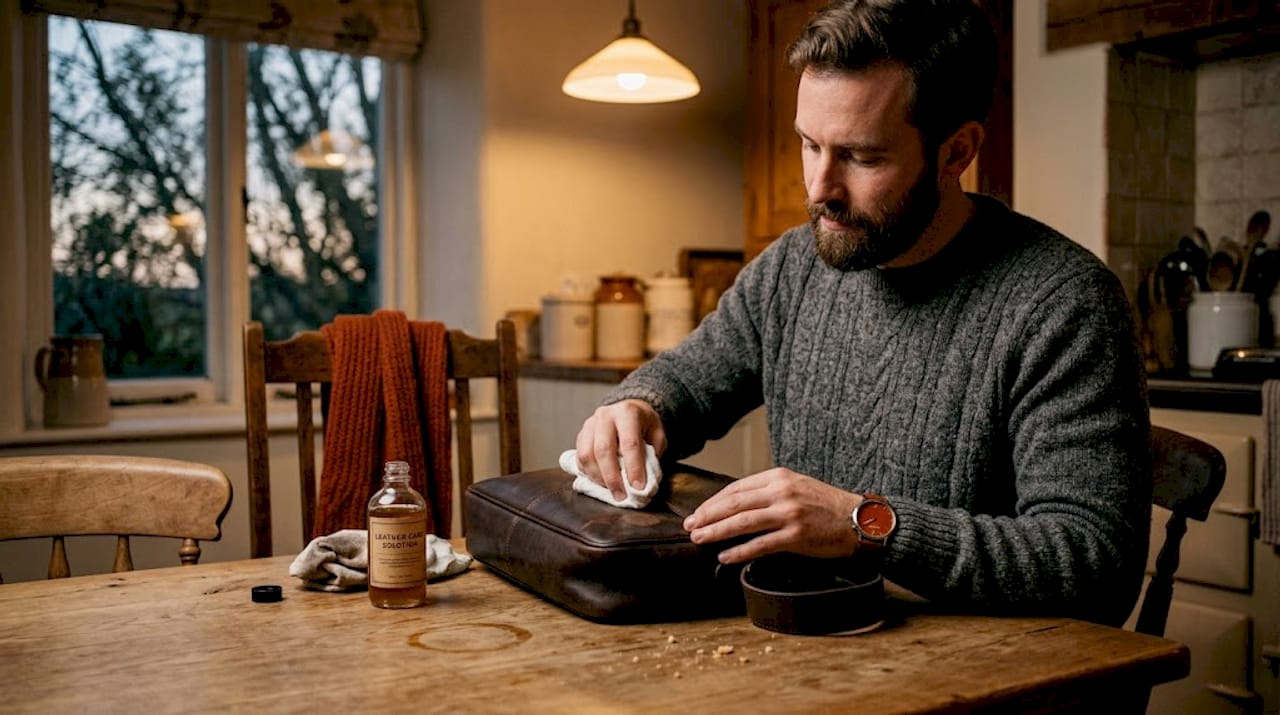
Most leather goods need far less cleaning than their owners give them. Regular cleaning should be minimal and adapted to visible grime, with simple dust removal often being all that is required. That said, when cleaning is necessary, doing it correctly protects the leather rather than stripping it.
Follow this sequence every time you clean:
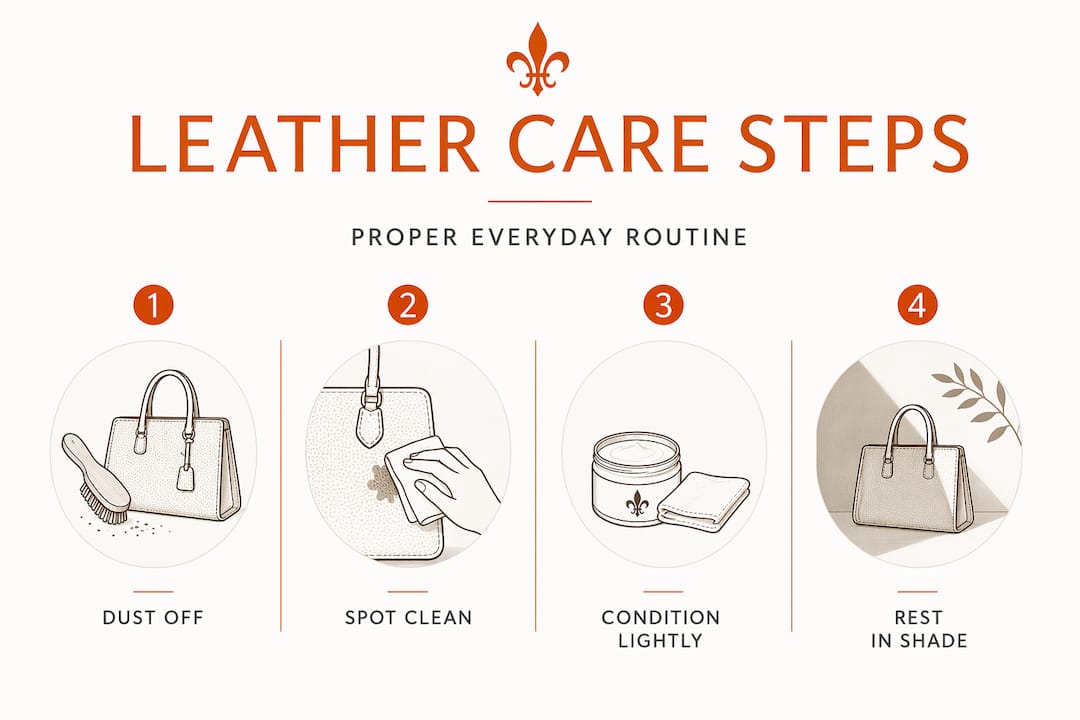
- Remove loose dust and debris first. Use a dry microfibre cloth or soft brush. Work in gentle, circular motions. Never press hard. This step alone handles most routine maintenance and is often all you need.
- Assess whether deeper cleaning is genuinely needed. Look for visible grime, stickiness, or odour. If the surface looks and smells clean after dry dusting, stop there.
- Apply a small amount of leather cleaner to your cloth. Never apply cleaner directly to the leather. Work in small sections with light pressure.
- Use a slightly damp cloth for particularly stubborn areas. The cloth should be barely damp, not wet. Soaking leather is one of the fastest ways to damage it.
- Allow the leather to dry naturally. Move it away from heat sources, radiators, and direct sunlight. Pat gently with a dry cloth if there is any excess moisture.
- Buff gently once dry. Use a clean, dry cloth to restore the surface to a gentle sheen before conditioning.
Saddle soap was once the standard for cleaning leather, but modern experts advise against it for luxury or delicate items. It can leave residue that is genuinely difficult to remove and may alter the finish of fine leather goods permanently.
Spot cleaning requires particular care. When addressing a specific stain, work from the outside of the stain inward to prevent spreading. Use the lightest possible treatment first. If a stain resists a damp cloth, try a leather-specific spot cleaner before escalating.
Pro Tip: Always test any new product on a small, hidden area of the leather first, such as the underside of a strap or inside a base corner. Wait 24 hours before proceeding. This one step prevents irreversible mistakes.
A word on overwetting: leather and water are not natural friends. When leather gets too wet during cleaning, the fibres swell, dry unevenly, and often stiffen or crack. For guidance on safe cleaning methods for leather bags, including the difference between surface cleaning and deeper cleaning, the Sanroccoitalia blog covers this in practical detail.
When and how to condition leather goods
Conditioning is not a cosmetic treatment. It restores the natural oils that leather loses over time through use, air exposure, and cleaning. The mistake most people make is treating conditioning as a scheduled ritual rather than a response to what the leather actually needs.
Watch for these signs that conditioning is genuinely required:
- The surface feels dry or slightly rough to the touch
- The leather appears dull and lacks its usual depth of colour
- Small creases or flex lines look lighter or greyish, suggesting moisture loss
- The leather feels stiff when you open or close a bag flap or fold
If none of these signs are present, your leather does not need conditioning. Conditioning should be based on feel and environment, not a fixed calendar. For most well-maintained leather goods, conditioning every three to six months is reasonable, but in drier climates or heated indoor environments, you may need to act sooner. In humid climates, you may rarely need it at all.
When you do condition, use this approach:
Apply a pea-sized amount of conditioner to a soft cloth, not directly to the leather. Work in gentle, circular motions across a small section at a time. The goal is a thin, even layer, not saturation. Allow it to absorb for five to ten minutes, then buff off any excess with a clean, dry cloth.
The table below compares common conditioner types to help you choose the right one for your piece.
| Conditioner type | Best for | Key benefit | Caution |
|---|---|---|---|
| Beeswax cream | Full-grain, smooth leather | Feeds and adds subtle protection | Can darken leather slightly |
| Lanolin-based | Structured bags, jackets | Very gentle, good for dry climates | Not suitable for patent leather |
| Neatsfoot oil | Vegetable-tanned leather | Deep penetration, restores suppleness | Overapplication softens structure |
| Mink oil | Heavy-use leather goods | Excellent moisture retention | Can affect stitching colour |
| Water-based conditioner | Saffiano, coated leathers | Light treatment, won’t oversaturate | Less lasting than wax types |
Over-conditioning leather oversaturates the fibres, weakens finishes, and makes the surface a magnet for dirt. More conditioner does not mean more protection. It means more problems.
Pro Tip: If you are unsure which conditioner to use, the Sanroccoitalia guide on choosing the right conditioner breaks down the differences between product types and what works best for luxury Italian leather goods.
Storage, protection and everyday handling
How you store and handle your leather between uses matters as much as any cleaning or conditioning routine. Most premature ageing in leather goods is caused not by heavy use, but by poor storage.
Here are the core principles:
- Never store leather in plastic bags or airtight containers. Leather needs to breathe. Plastic traps humidity, which breeds mould and breaks down the leather’s surface coating over time.
- Use breathable cotton dust bags or unbleached cotton pillowcases. Proper storage in breathable bags in a cool, dry place with airflow prevents mould and shape distortion.
- Stuff structured bags with acid-free tissue paper. This maintains the bag’s shape and prevents creasing at fold lines. Hanging a bag by its straps for extended periods stretches them and distorts the overall structure.
- Keep leather away from direct sunlight and heat sources. Both cause drying, fading, and cracking far faster than normal use. A shelf in a wardrobe, away from radiators and windows, is ideal.
- Rotate your leather goods. Resting pieces between uses allows the leather to recover its shape and prevents concentrated wear in high-stress areas like handles and corners.
When leather gets wet from rain or spillage, blot the excess moisture gently and leave it to air-dry at room temperature. Never use a hair dryer, place it near a radiator, or leave it in direct sunlight to speed up drying. Forced drying causes brittleness and deep cracking that cannot be undone.
Pro Tip: Place a small cedar block inside stored bags. Cedar absorbs excess moisture, repels insects, and keeps the interior smelling fresh without introducing any chemicals that might affect the leather.
For more specific guidance on storing leather handbags through different seasons and environments, the Sanroccoitalia resource on natural storage methods is worth bookmarking.
Troubleshooting common problems
Even well-maintained leather will develop issues over time. Knowing how to read those issues, and when not to touch them, is a skill worth developing.
Here is how to approach the most common problems:
- Surface scratches on smooth leather. Light scratches often respond to gentle buffing with a fingertip or a soft cloth. The natural warmth of your skin can help blend minor marks into the surrounding leather. Deeper scratches need a leather repair cream matched to your leather’s colour.
- Dryness and cracking. This is addressable if caught early. Clean the area gently, allow it to dry fully, and apply a conditioning treatment. Deep cracks, however, are structural damage. They can be minimised but not reversed.
- Peeling or flaking. This generally signals a failure of the leather’s surface coating rather than the leather itself. DIY fixes rarely hold well. A professional restoration service is the better choice.
- Ink or dye transfer. Act quickly. Blot, do not rub, with a clean cloth. Specialist leather ink removers exist, but results depend on the leather type and how long the stain has set.
Before attempting any repair treatment, always test on an inconspicuous area and give it time to show any adverse reaction. The most common cause of worsening leather damage is impatient, repeated treatment with products that were not tested first.
Professional deep cleaning for leather bags typically costs between £40 and £80 in the UK and is recommended every three to six months for pieces in regular use. For bags that see daily use or have suffered staining, oil build-up, or surface damage, professional restoration is money well spent. A qualified leather technician can also re-dye, re-finish, and re-condition leather in ways that no home treatment can replicate.
Know when to step back. Over-treatment is a genuinely common cause of accelerated damage. If you are not confident about what you are dealing with, consult a professional before applying anything new.
My honest take on leather care myths
I’ve spent years watching people panic over their leather goods, and the most consistent pattern I’ve seen is this: the damage usually comes from doing too much, not too little.
The idea that leather needs weekly conditioning, or that it should be cleaned every time it leaves the house, is a myth that product manufacturers have very little reason to correct. I’ve seen beautiful full-grain bags stripped of their natural patina by over-zealous owners who conditioned monthly and cleaned with saddle soap every few weeks. The leather was technically clean. It was also flat, dull, and prematurely aged.
What I’ve learned to trust is observation over routine. Pick up your leather bag. Run your hand across it. Does it feel supple and smooth? Leave it alone. Does it feel dry and slightly rough along the fold lines? That is your cue to condition, lightly and once. I’ve found that the leather goods that age most beautifully are the ones whose owners resist the urge to constantly intervene.
There is also a myth that expensive products equal better results. In practice, a high-quality pH-neutral cleaner and a simple beeswax conditioner outperform elaborate multi-step systems for most leather types. The skill is in the restraint of application, not the complexity of the product.
My advice: learn to read your leather rather than following a calendar. The leather will tell you what it needs. Your job is simply to listen, and then to act with as light a touch as possible.
— Mara
Discover Sanroccoitalia’s leather care resources

If you invest in quality leather goods, caring for them properly is part of protecting that investment. At Sanroccoitalia, we create and curate leather pieces built to last, made by skilled Italian artisans using premium full-grain leather and time-honoured techniques. We also believe that informed owners make better custodians of beautiful pieces.
Our blog covers everything from expert handbag cleaning advice to detailed guidance on conditioners and storage methods specific to luxury Italian leather. Whether you have just made your first leather purchase or you are looking to refine a care routine you have had for years, you will find practical, honest guidance at Sanroccoitalia. No fluff, no product pushing. Just the knowledge you need to keep your leather looking its best for decades.
FAQ
How often should I clean leather goods?
For most leather goods, a light dry dusting every few uses is sufficient. A more thorough clean with a leather-specific product is only needed when visible grime, stickiness, or odour is present, roughly every four to six weeks for regularly used items.
Can I use household oils to condition leather?
No. Oils such as coconut or olive oil are not suitable for leather care. They can go rancid inside the leather fibres, cause permanent discolouration, and attract pests over time. Use only conditioners specifically formulated for leather.
How do I know when leather needs conditioning?
Look for visible dullness, a dry or slightly rough texture, or lighter-coloured creasing along flex lines. If the leather feels supple and looks healthy, it does not need conditioning regardless of how long it has been since the last treatment.
What is the best way to store a leather bag?
Store leather bags in breathable cotton dust bags, stuffed with acid-free tissue paper to maintain shape. Keep them in a cool, dry area with good airflow, away from direct sunlight and heat sources. Never store leather in plastic bags or airtight containers.
When should I take leather to a professional?
Seek professional help for peeling or flaking surfaces, deep cracking, stubborn stains, or any damage that does not respond to gentle home treatment. Professional restoration services typically cost between £40 and £80 and are recommended every three to six months for pieces in frequent use.
Recommended
- How to Clean Leather Handbag for Long-Lasting Luxury Care – San Rocco Italia
- How can I Clean My Leather Purse Effectively and Naturally – San Rocco Italia
- Leather Handbag Cleaner: Expert Guide to Pristine Luxury Bags – San Rocco Italia
- How to Care for Leather Bags: A Complete Guide for Longevity – San Rocco Italia


